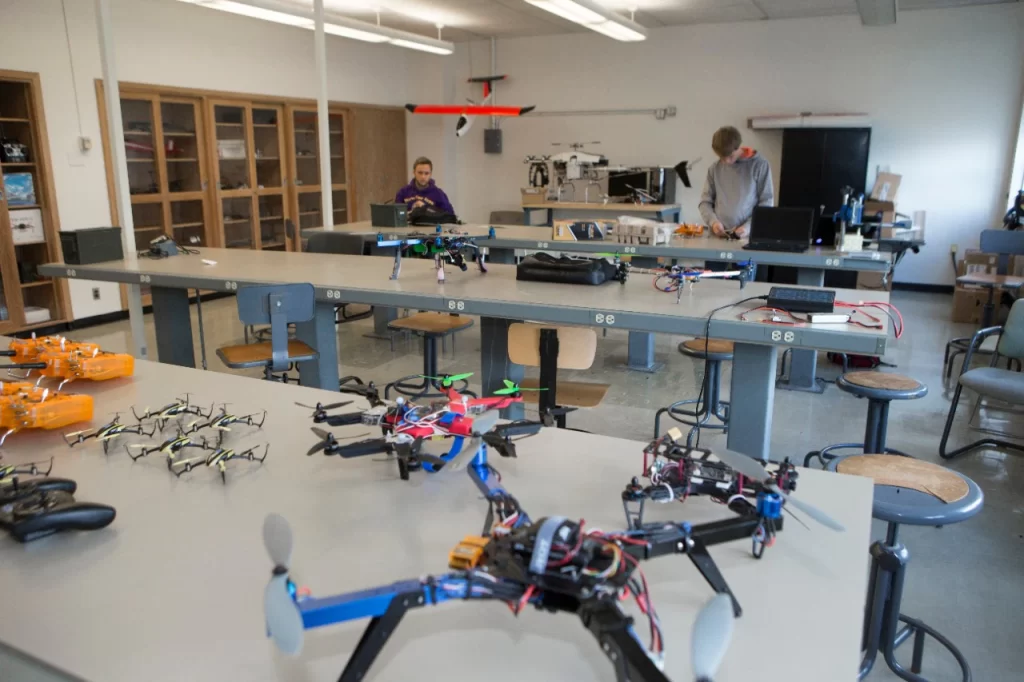
Learning how to work with UAVs is no longer just about flying skills or academic knowledge in isolation. As UAV systems become more complex and more embedded in real-world operations, a growing gap has emerged between theoretical education and practical competence.
Bridging this gap is one of the central challenges in modern UAV education — and it is the core mission of the UAV Drone Academy.
The Problem with Purely Academic UAV Education
Traditional academic programs excel at teaching:
- Aerodynamics
- Control theory
- Signal processing
- Systems engineering principles
However, they often struggle to connect this knowledge to:
- Real hardware limitations
- Integration issues
- Environmental noise and interference
- Maintenance and operational constraints
Graduates may understand equations and models but feel unprepared when facing real UAV systems in the field.
The Limits of Practice-Only Learning
On the opposite side, many UAV operators learn almost exclusively through:
- Trial and error
- Online tutorials
- Preset configurations
- Platform-specific workflows
While this approach builds intuition and hands-on confidence, it often lacks:
- Conceptual understanding
- Transferable skills
- System-level reasoning
As a result, problems are fixed by guesswork rather than diagnosis — and knowledge does not scale beyond a specific setup.
Why UAV Education Must Bridge Both Worlds
UAVs are systems, not isolated components.
As explored in our article What Is a UAV? A System-Level Introduction, meaningful competence emerges only when learners understand how theory and practice inform each other.
Theory provides:
- Predictability
- Design frameworks
- Understanding of limits
Practice provides:
- Reality checks
- Failure modes
- Operational intuition
When combined, they enable engineers and operators to reason instead of memorizing.
From Architecture to Learning Strategy
In Understanding UAV Architecture: Subsystems and Integration, we showed that most UAV failures occur at integration points, not at individual components.
The same is true for education.
Effective UAV learning requires:
- System-level thinking
- Hands-on experimentation
- Feedback from real failures
- Continuous iteration between concept and application
This is where many learning paths break — and where structured hybrid education becomes critical.
The UAV Drone Academy Approach
The UAV Drone Academy was created to explicitly bridge theory and practice, not treat them as separate tracks.
Our educational philosophy is built on:
- Clear system-level foundations
- Progressive technical depth
- Practical experimentation informed by theory
- Real-world constraints and trade-offs
We focus on how engineers think, not just what operators do.
Who Benefits from a Hybrid UAV Education?
This approach is designed for:
- FPV pilots transitioning into engineering roles
- Engineers entering UAV development from other fields
- Students seeking applied UAV competence
- Professionals working in inspection, research, or defense contexts
If your goal is to understand UAVs deeply and work with them reliably, theory and practice must evolve together.
What Comes Next?
With a solid understanding of why hybrid education matters, the next step is to move deeper into technical substance.
In the following articles, we will explore UAVs at the subsystem level, starting with the physical foundation of every aerial system:
- UAV Airframe Design: Structure, Materials, and Vibration Control
- UAV Propulsion Systems: Motors, Propellers, and Thrust Optimization
- UAV Power Systems: Batteries, Power Distribution, and Noise Management
- UAV Flight Control Systems: Sensors, Controllers, and Firmware Logic
- UAV Communication Systems: Radio Links, Telemetry, and Video Transmission
- UAV Payload Integration: Mission Design and System Trade-Offs
These articles will build a complete and coherent UAV engineering knowledge path, grounded in both theory and practice.

Pingback: Welcome to UAV Drone Academy: Bridging Theory and Practice
Pingback: What Is a UAV? A System-Level Introduction | UAV Drone Academy
Pingback: Understanding UAV Architecture: Subsystems and Integration | UAV Drone Academy