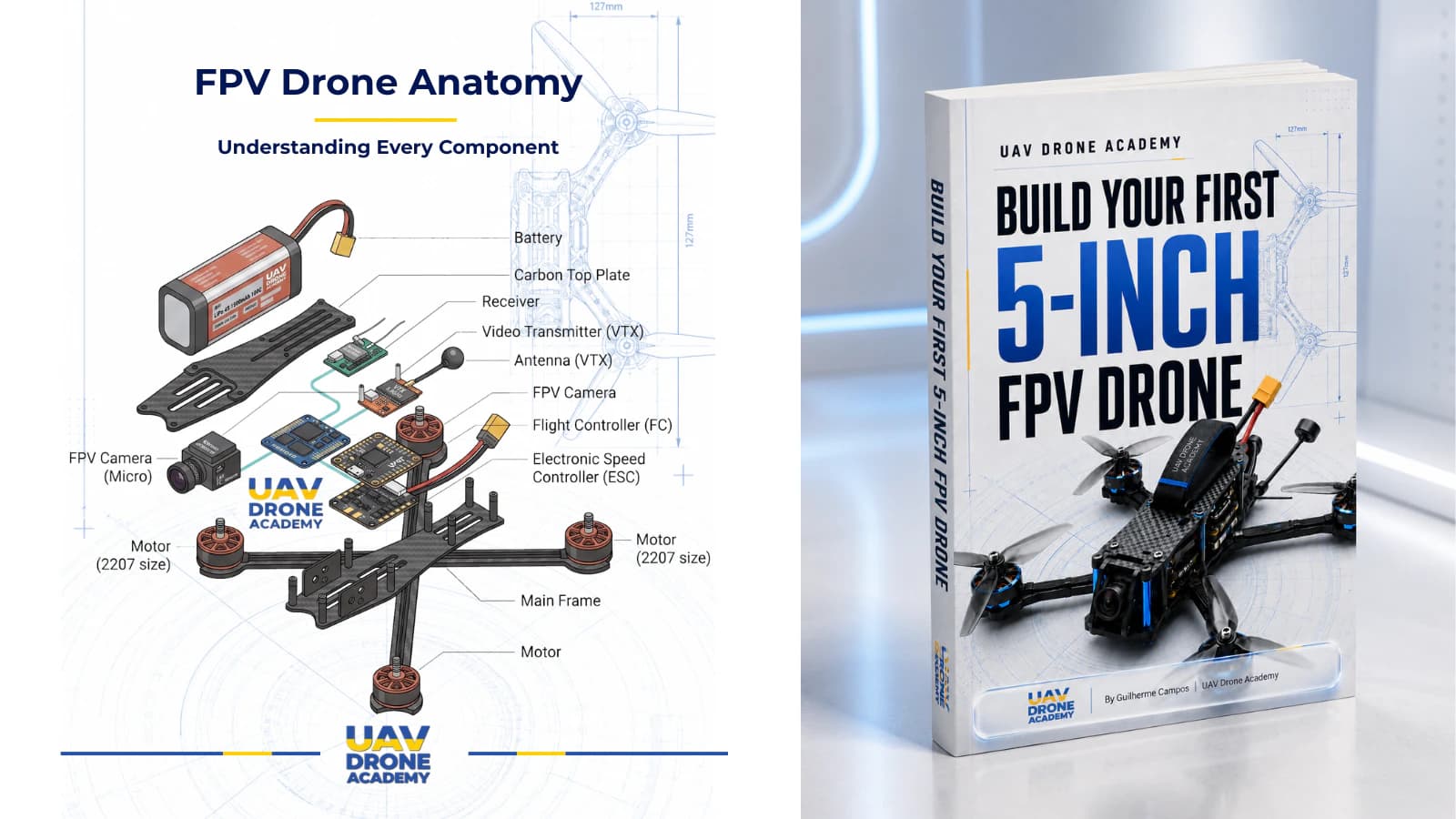
The first time you look at a component list for a 5-inch build, it reads like a foreign language. ESC, FC, VTX, RX, 6S, 2207, U.FL — a wall of acronyms that makes even experienced engineers from other fields feel like beginners again. Understanding FPV drone anatomy is what turns that wall of jargon into a machine you can actually reason about, and that is exactly what this guide delivers.
After twenty years working across mechanics, electronics, and drone systems, I can tell you where most beginners go wrong: they memorize part names instead of understanding functions. A part name tells you what to buy. A function tells you why your drone drifts, why one motor runs hot, or why your video feed dies at 80 meters. By the end of this article, you will be able to name every major component of a 5-inch FPV drone, explain what each one contributes to flight, control, and video, and read any parts spec without confusion.
The Frame: The Skeleton Everything Depends On
The frame is the carbon fiber skeleton that holds every other component in a fixed geometric relationship. That phrase matters more than it sounds. Motors must sit at precise distances from the center of mass, the camera must point where the drone is going, and the electronics must be protected in the middle where crash energy is lowest.
A frame does not just carry parts. It defines the drone's stiffness, and stiffness defines how vibration travels from the motors into the gyroscope on the flight controller. A flexible or cracked frame feeds noise into the gyro, and the flight controller responds by fighting phantom movements. This is why a drone with perfect electronics can still fly badly on a damaged frame — a lesson most pilots learn the hard way, as covered in Common FPV Crashes and Repairs: What Usually Breaks First.
The Propulsion System: Motors, Propellers, and ESC
Propulsion is where electrical energy becomes thrust, and it involves three components working as one chain.
Brushless Motors
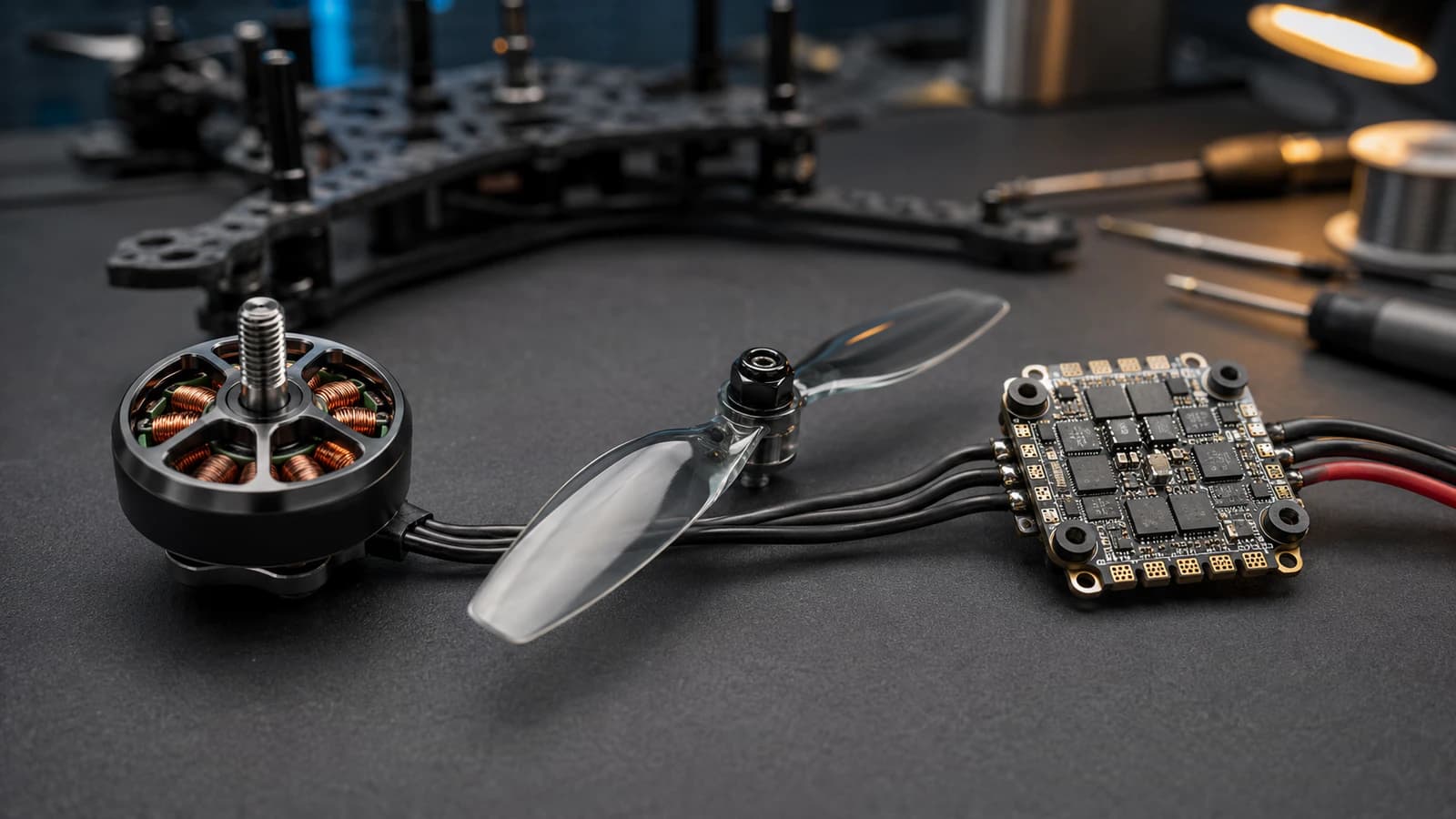
A 5-inch drone uses four brushless motors, typically in the 2207 size class. Each motor spins tens of thousands of RPM, and the drone steers by changing the speed of individual motors — there are no rudders, flaps, or moving control surfaces. Speed up the two rear motors and the drone pitches forward. Every maneuver you will ever fly is just a coordinated speed change across four motors.
Propellers
Propellers convert that rotation into thrust by accelerating air downward. On a 5-inch build, the propeller diameter is what gives the platform its name, and prop choice changes the drone's personality: more pitch means more speed and more current draw, more blade area means more grip in turns and more load on the motors. A bent propeller is not a cosmetic problem. It is an unbalanced rotating mass that injects vibration directly into the system.
ESC (Electronic Speed Controller)
The ESC is the muscle between brain and motors. It takes low-power digital commands from the flight controller and switches battery current into each motor thousands of times per second. Modern builds usually use a 4-in-1 ESC board mounted under the flight controller. When beginners see one motor twitching or desyncing under throttle, the ESC-motor pairing is usually the first place an experienced builder looks.
The Flight Controller: The Brain of the System
The flight controller (FC) is a small circuit board with a processor and a gyroscope, and it is the reason a quadcopter is flyable at all. A quad is inherently unstable — no human can manually balance four motors fast enough. The FC reads the gyro hundreds of times per second, compares actual rotation against what your sticks are asking for, and corrects each motor's output before you even perceive the error.
Everything connects to the FC: the receiver feeds it your commands, the ESC executes its decisions, and the camera's video often passes through it so the OSD (on-screen display) can overlay battery voltage and warnings onto your goggles. When you configure a drone in Betaflight, you are programming this board.
The Control Link: Radio and Receiver
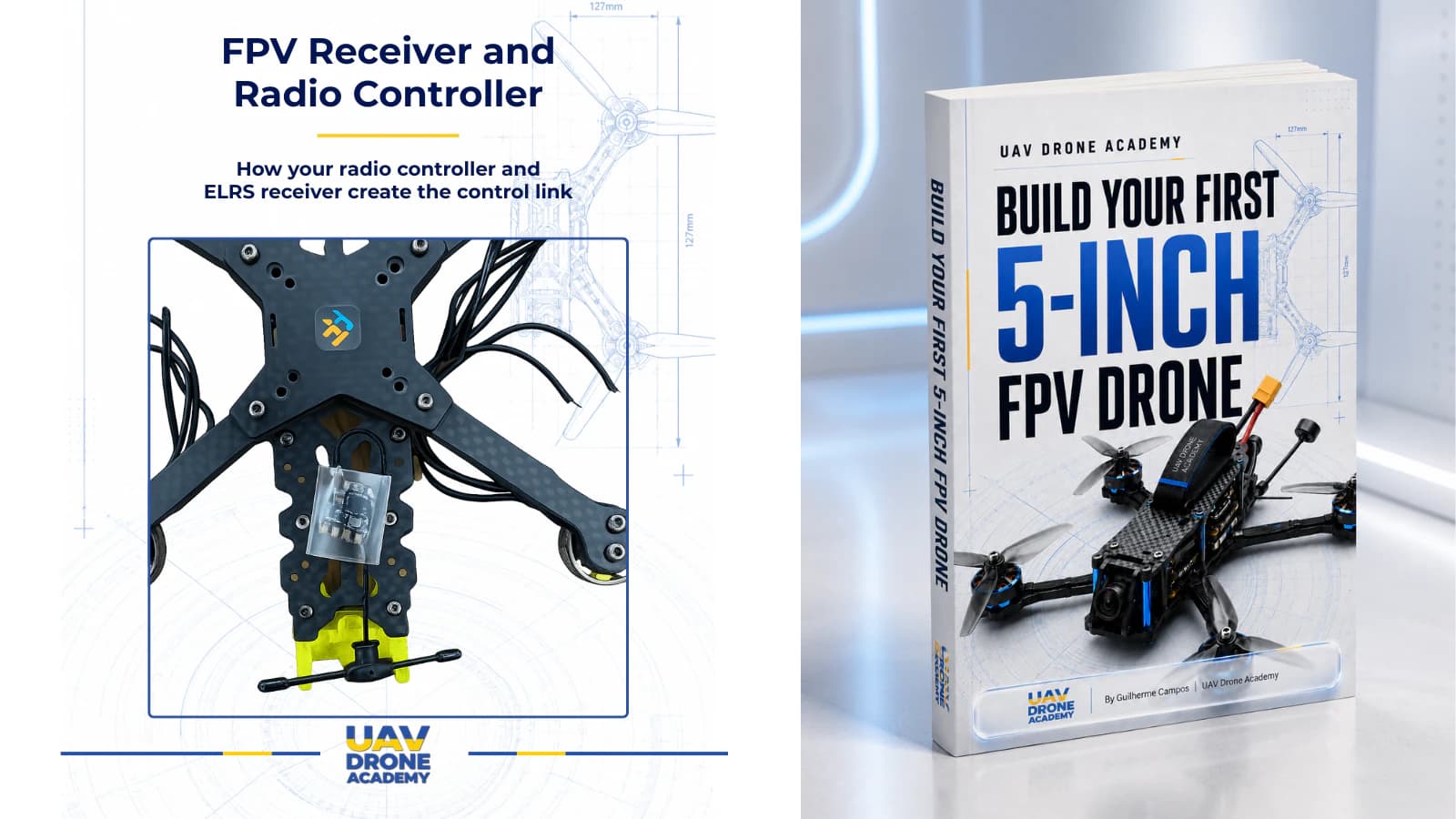
Your radio transmitter in your hands and the receiver (RX) on the drone form the control link. Modern systems like ExpressLRS send your stick positions as digital packets many times per second, and the receiver hands them to the flight controller. The receiver is physically tiny — often smaller than a fingernail — but it is one of the most safety-critical parts of the aircraft, because losing the control link means losing the drone.
The receiver's antenna placement matters as much as the receiver itself. An antenna pressed against carbon fiber is shielded by it, since carbon blocks RF. This is a classic integration failure: two healthy components, one bad placement decision, and the range drops to a fraction of what the spec sheet promised.
The Video System: Camera, VTX, and Antenna
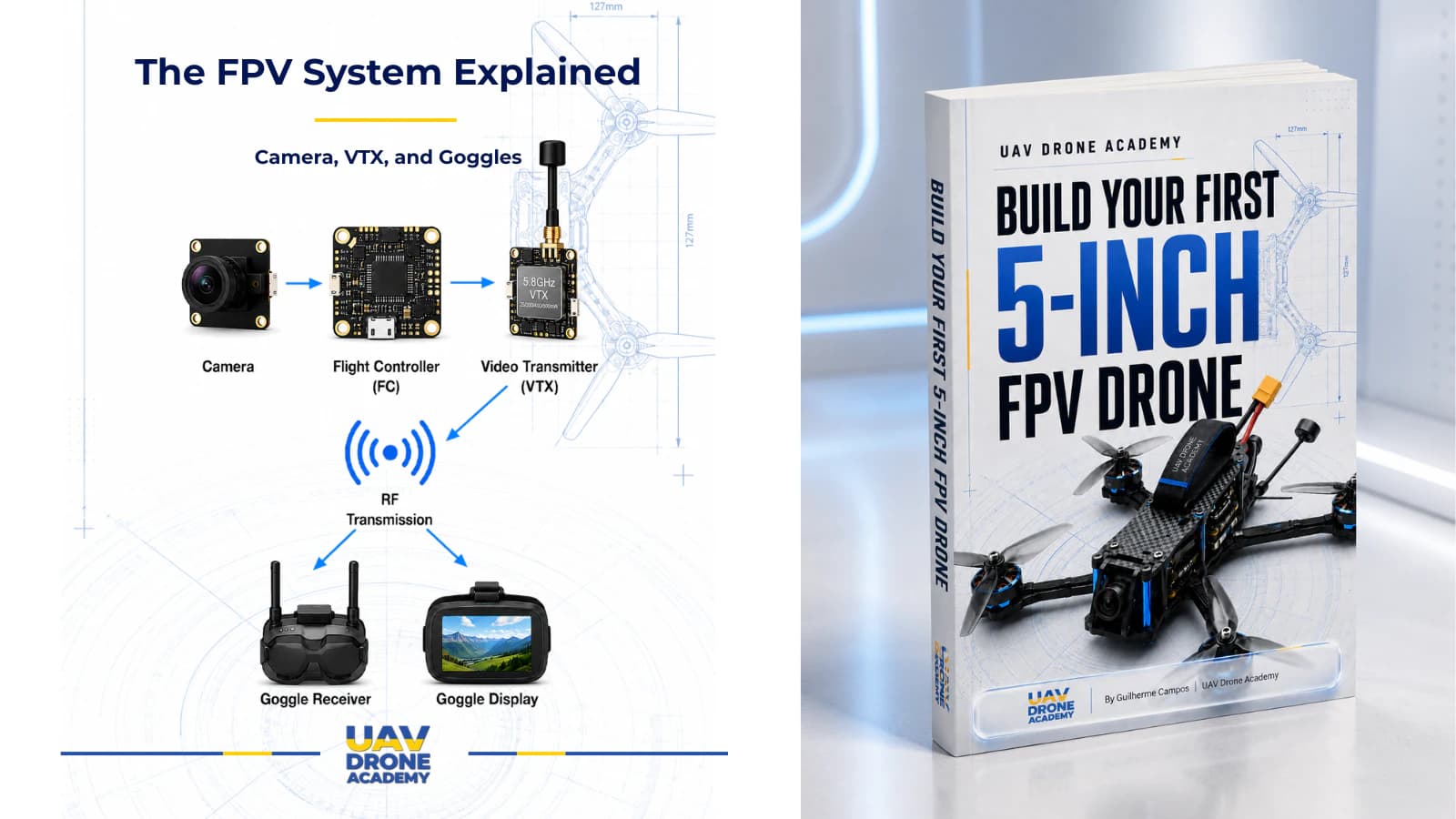
The video chain is what makes FPV first-person. Three components carry the image from the drone's nose to your eyes.
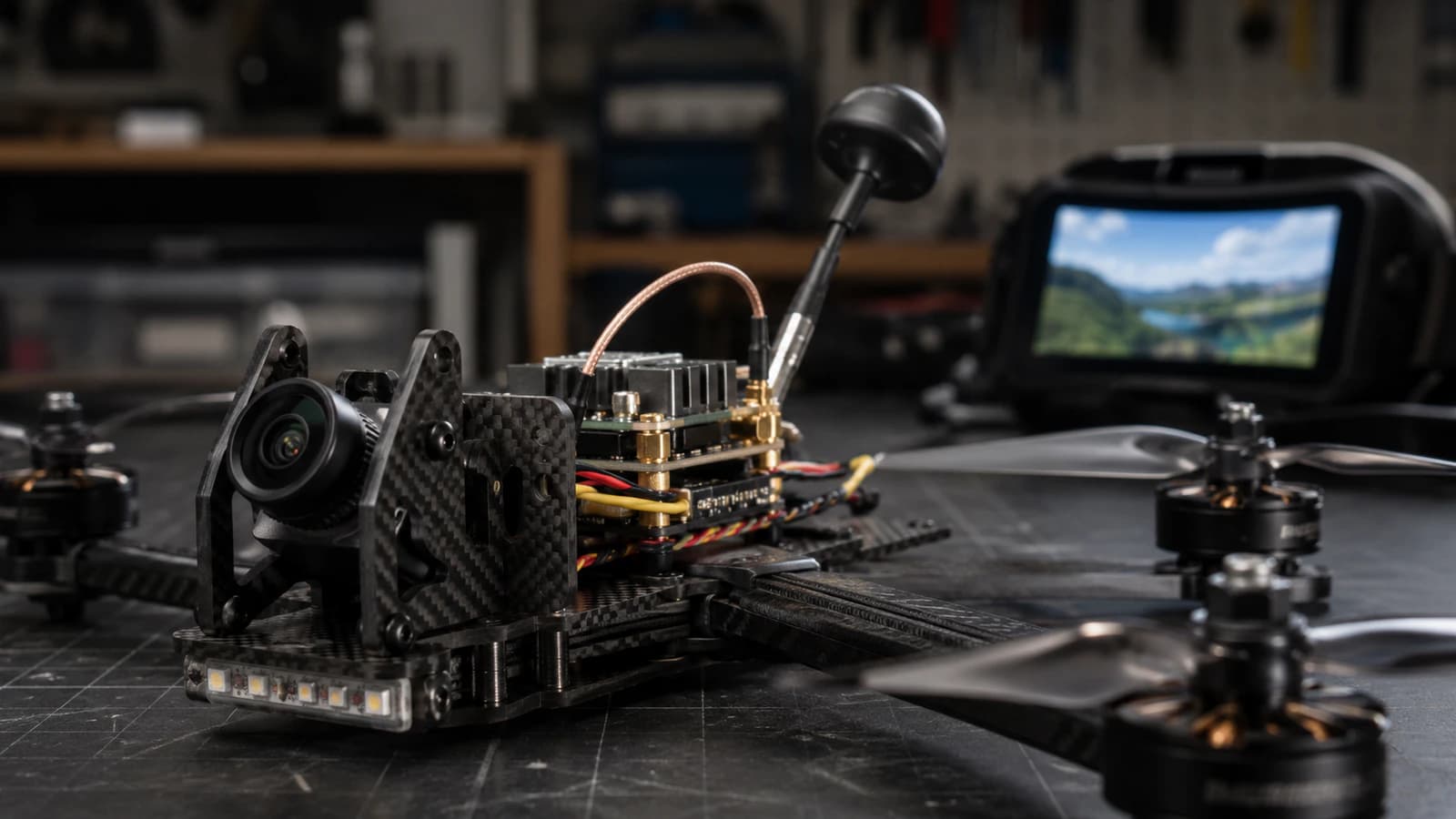
The FPV camera sits at the front, angled upward so that when the drone pitches forward at speed, the horizon stays level in your view. The video transmitter (VTX) takes the camera's signal and broadcasts it, and the VTX antenna shapes how that energy radiates. Video quality problems are rarely the camera's fault — a damaged antenna or a poor connector causes most breakup. If you want to trace exactly how the control and video paths flow through the aircraft, I break down the full chain in FPV Drone Signal Flow: Control Link and Video Feed Explained.
The Power System: Battery, Connector, and Wiring
The LiPo battery is the drone's only energy source, and on a modern 5-inch build that usually means a 6S pack delivering serious current under load. The battery connects through an XT60 connector into the ESC's power pads, and from there power branches to every component on the aircraft.
The power system is also where the most dangerous failures live. A damaged pack, a cold solder joint on the XT60, or a battery lead routed into the propeller path can end a flight — or a drone — instantly. Treat power wiring with the same respect you would give any high-current circuit on a bench.
FPV Drone Anatomy at a Glance
| Component | Primary function | Symptom when it fails |
|---|---|---|
| Frame | Structure, geometry, vibration path | Oscillation, poor tune, cracked arms |
| Motors | Generate thrust via rotation | Grinding, heat, desync, wobble |
| Propellers | Convert rotation into thrust | Vibration, drift, unstable hover |
| ESC | Deliver battery current to motors | Motor twitching, no spin, burnt smell |
| Flight controller | Stabilization and command processing | No response, erratic flight, no USB |
| Receiver | Deliver pilot commands to the FC | RXLOSS warnings, failsafe, lost link |
| Camera + VTX + antenna | Capture and transmit live video | Static, breakup, no image in goggles |
| LiPo battery | Store and supply energy | Voltage sag, swelling, short flights |
Why the Connections Matter More Than the Parts
Here is the part most component guides skip: a drone is not a collection of parts. It is an integrated system, and most real-world failures happen at the interfaces — the solder joints, connectors, antenna placements, and mounting points where components meet. A perfect motor with a pinched wire is a dead motor. A premium VTX with a cracked antenna connector is a blind drone.
This is why understanding anatomy by function pays off. When something goes wrong on the bench or in the air, you can trace the symptom backward through the chain instead of guessing. And when you are ready to turn this knowledge into a parts list, the companion guide Main Components Needed to Build a 5-Inch FPV Drone walks through exactly what to buy for a first build.
Frequently Asked Questions
What are the main components of an FPV drone?
A 5-inch FPV drone has eight core components: the frame, four brushless motors, propellers, an ESC, a flight controller, a radio receiver, a video system (camera, VTX, and antenna), and a LiPo battery. Each one handles a distinct function in flight, control, or video transmission.
What is the most important part of an FPV drone?
The flight controller is the functional heart of the aircraft, because a quadcopter is inherently unstable and cannot fly without hundreds of gyro-based corrections per second. That said, the system only works when every component and connection is sound.
What does the ESC do on a drone?
The ESC (electronic speed controller) converts low-power commands from the flight controller into high-current pulses that drive each brushless motor. It is the interface between the drone's brain and its muscles, switching battery current thousands of times per second.
Can an FPV drone fly without a flight controller?
No. A multirotor has no natural stability and no aerodynamic control surfaces, so it depends entirely on the flight controller making rapid motor-speed corrections. Without it, the drone would flip over within a fraction of a second of takeoff.
Conclusion
FPV drone anatomy stops being intimidating the moment you connect each name to a function: the frame holds geometry, the motors and props make thrust, the ESC delivers power, the flight controller stabilizes, the receiver carries your intent, the video chain carries your eyes, and the battery feeds it all. Read a parts spec now and you will see a system, not a shopping list.
That systems view is the foundation for everything that comes next — choosing parts, building, troubleshooting, and repairing. The parts are simple. The integration is the engineering.