
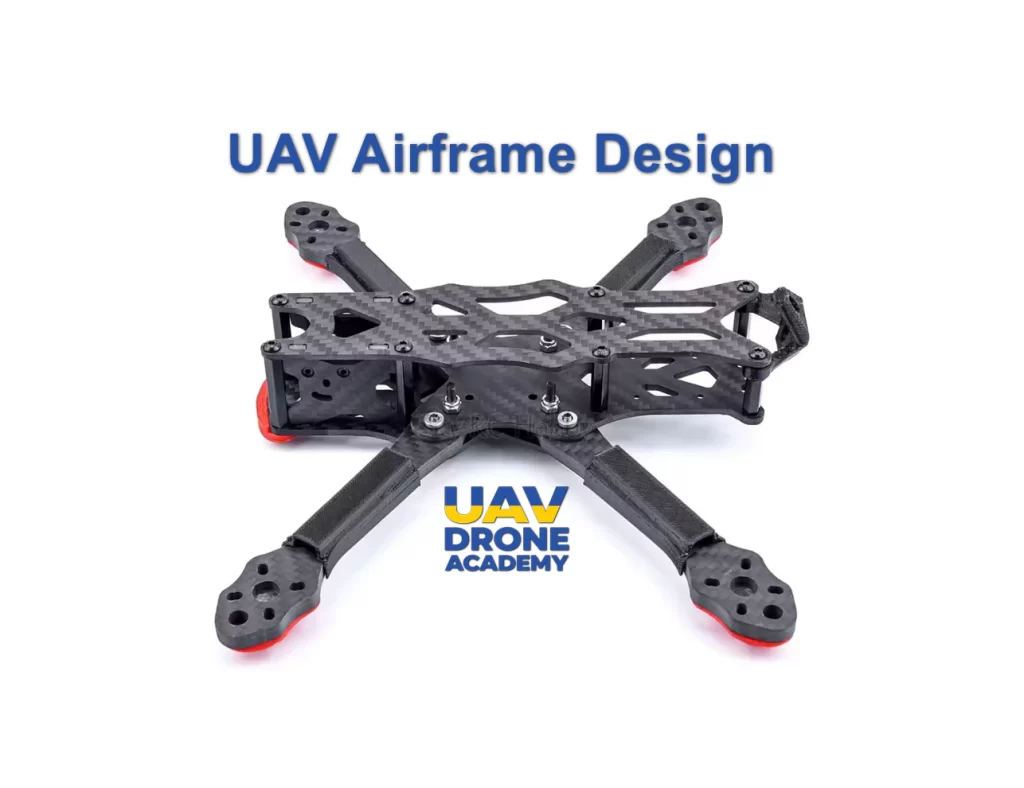
Every UAV system begins with a physical foundation: the airframe.
Before propulsion, power, flight control, or payload integration can be discussed, the structure that holds everything together must be understood.
In UAV engineering, airframe design is not about aesthetics — it is about structural integrity, vibration behavior, weight distribution, and system integration.
The Role of the Airframe in a UAV System
As discussed in Understanding UAV Architecture: Subsystems and Integration, a UAV is a system composed of tightly coupled subsystems.
The airframe is the mechanical backbone of this system.
Its primary roles include:
- Supporting all onboard components
- Maintaining structural rigidity under load
- Managing vibration and resonance
- Providing mounting geometry and alignment
Poor airframe design cannot be compensated by better electronics or software.
Structural Design Considerations
A UAV airframe must withstand:
- Static loads (weight of components and payload)
- Dynamic loads (thrust, acceleration, maneuvering)
- Vibrational loads (motors, propellers, airflow)
Key structural considerations include:
- Arm length and thickness
- Joint design and fasteners
- Load paths between components
- Crash tolerance versus weight
Design is always a trade-off between strength, stiffness, and mass.
Materials Used in UAV Airframes
Common materials used in UAV frames include:
- Carbon Fiber
High stiffness-to-weight ratio, excellent for vibration control, but brittle under impact. - Polymers and Plastics
Flexible, impact-tolerant, often used in 3D-printed or consumer frames, but less rigid. - Aluminum and Metal Alloys
Strong and durable, but heavier and more prone to vibration transmission.
Material selection directly affects vibration behavior, durability, and system longevity.
Vibration: The Silent Performance Killer
Vibration is one of the most underestimated problems in UAV systems.
Excessive vibration can:
- Degrade IMU sensor readings
- Confuse flight control algorithms
- Reduce image quality
- Accelerate mechanical fatigue
Common vibration sources include:
- Unbalanced propellers
- Motor resonance
- Flexible or poorly mounted frames
Effective vibration control requires a combination of:
- Structural stiffness
- Proper component mounting
- Mechanical isolation where necessary
This is a mechanical problem first — not a software one.
Airframe Design and System Integration
Airframe decisions affect every other subsystem:
- Motor placement influences propulsion efficiency
- Battery position affects center of gravity
- Component spacing impacts EMI and cooling
- Structural rigidity affects control stability
This is why airframe design must be approached with system-level awareness, not as an isolated mechanical task.
Common Beginner Mistakes in Airframe Selection
Some of the most common errors include:
- Choosing frames based only on appearance
- Ignoring vibration paths
- Overlooking mounting compatibility
- Prioritizing minimal weight over structural stability
Understanding the role of the airframe early prevents cascading problems later in the system.
What Comes Next?
With a solid understanding of airframe structure and vibration behavior, the next step is to analyze how UAVs generate thrust efficiently and reliably.
In the next article, we will explore:
This will build directly on the mechanical foundation established here.

Pingback: Understanding UAV Architecture: Subsystems and Integration | UAV Drone Academy