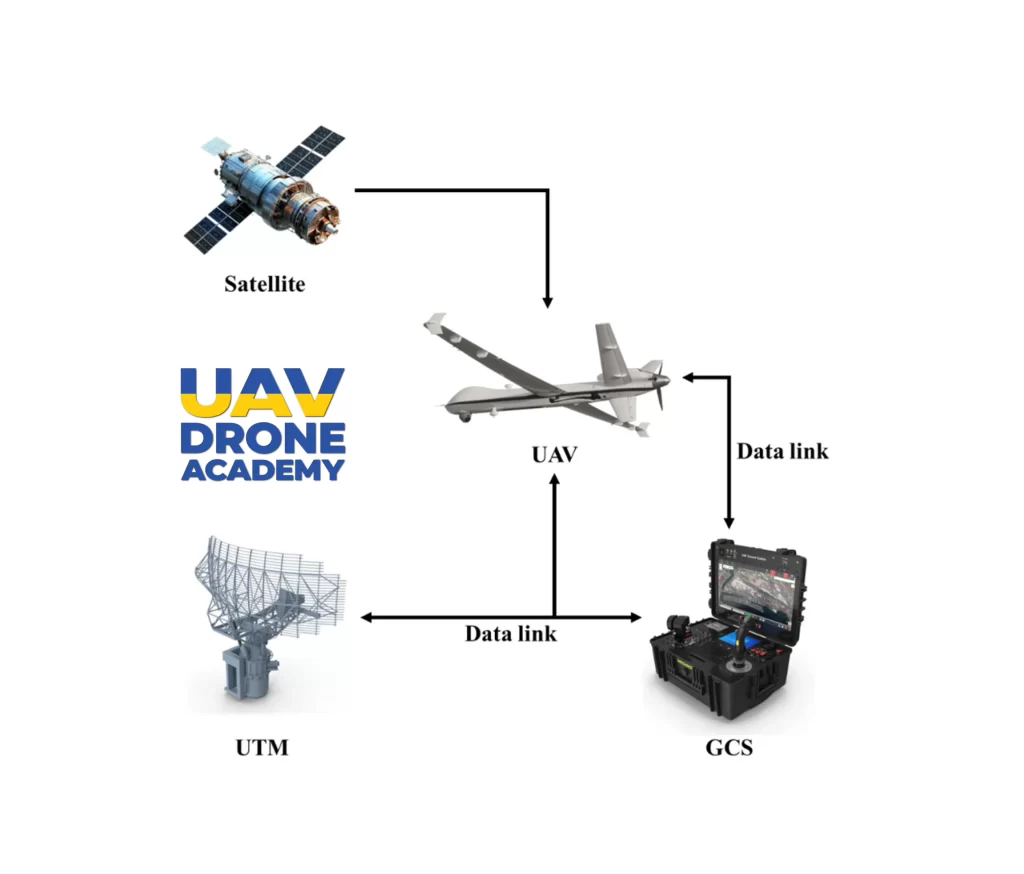
The term UAV (Unmanned Aerial Vehicle) is often used interchangeably with the word drone, but in professional, engineering, and defense contexts, a UAV represents much more than a flying gadget. It is a complex aerial system, composed of multiple subsystems that must work together reliably under demanding conditions.
Understanding what a UAV truly is — at a system level — is the first essential step for anyone who wants to move beyond basic piloting and toward UAV engineering, design, or operational expertise.
UAV vs Drone: Understanding the Terminology
In popular usage, the word drone typically refers to consumer or hobby aircraft, often operated with minimal technical understanding.
A UAV, on the other hand, is defined as:
An aircraft that operates without an onboard human pilot and is part of a broader system that includes control, communication, power, and mission-specific components.
In professional environments, the UAV is usually part of a larger concept called a UAS (Unmanned Aircraft System), which includes:
- The aerial vehicle (UAV)
- The ground control station
- Communication links
- Support equipment and software
This distinction is important because engineering decisions are made at the system level, not just at the airframe or flight controller level.
The UAV as a System, Not a Product
A common beginner mistake is to see a UAV as a single object. In reality, a UAV is a system-of-systems, where performance, reliability, and safety depend on how well subsystems are integrated.
At a high level, every UAV is composed of the following core subsystems:
- Airframe – The structural body that supports all components
- Propulsion System – Motors, propellers, ESCs, and thrust generation
- Power System – Batteries, power distribution, voltage regulation
- Flight Control System – Sensors, flight controller, firmware, control laws
- Communication System – Radio links, telemetry, video transmission
- Payload – Cameras, sensors, or mission-specific equipment
A failure or poor design choice in any one of these areas can compromise the entire system.
👉 A deeper breakdown of these components and their interactions is explored in our article on UAV system architecture.
Why a System-Level View Matters
Flying skills alone are not enough when operating or developing UAVs in real-world environments such as:
- Industrial inspection
- Emergency response
- Research and development
- Security and defense applications
A system-level understanding allows you to:
- Diagnose failures more effectively
- Optimize performance for specific missions
- Design UAVs that are reliable, maintainable, and scalable
- Understand trade-offs between weight, power, range, and control
This mindset is what separates operators from engineers.
UAVs in Practice: Theory Meets Reality
Many aspiring UAV professionals focus heavily on software or flight tuning while neglecting fundamentals such as:
- Electrical power limits
- Structural loads
- EMI and signal interference
- Thermal management
True UAV competence comes from bridging theory and practice — combining academic principles with hands-on experimentation and real operational constraints.
👉 This balance between theory and application is discussed in more detail in our article on academic and practical UAV education.
Who Should Learn UAV System Fundamentals?
This introduction is designed for:
- Beginners who want a solid technical foundation
- FPV pilots aiming to transition into engineering roles
- Engineers from other fields entering UAV development
- Students preparing for advanced UAV training
If you are new to this field, starting with clear terminology and system-level concepts will save you time and prevent costly mistakes later.
What Comes Next?
Now that you understand what a UAV is at a system level, the next logical step is to explore how these subsystems are structured and integrated.
Related Articles

Pingback: Welcome to UAV Drone Academy: Bridging Theory and Practice
Pingback: Understanding UAV Architecture: Subsystems and Integration | UAV Drone Academy
Pingback: Academic vs Practical UAV Education: Bridging Theory and Application | UAV Drone Academy