Beginner, Build, Course, Education, FPV, UAV
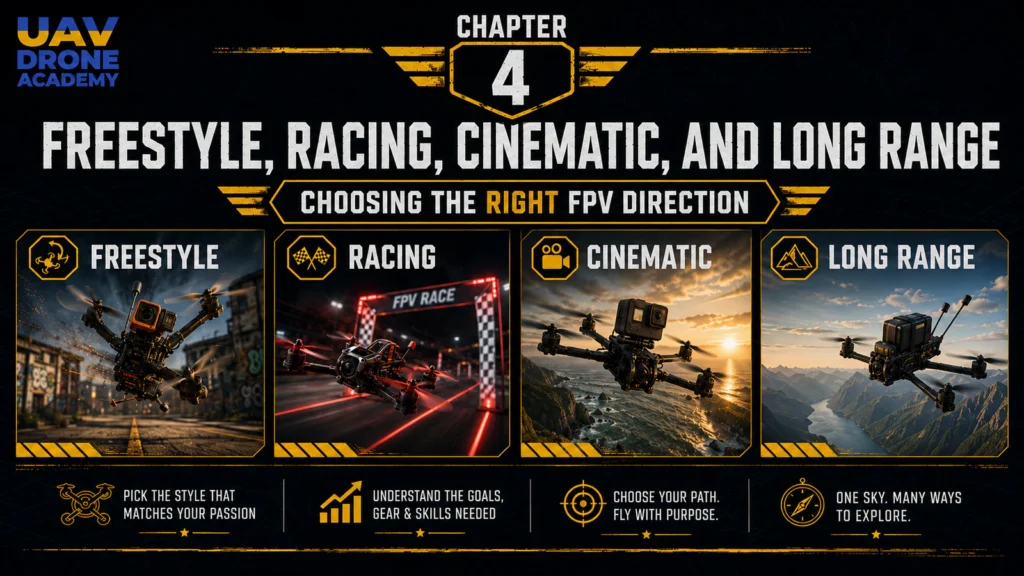
Chapter 4: Freestyle, Racing, Cinematic, and Long Range: Choosing the Right FPV Direction
Introduction
One of the most confusing things for FPV beginners is realizing that:
not all FPV drones are built for the same purpose.
At first, many people think FPV is just “one type of drone.”
But after watching a few videos online, you quickly notice huge differences between builds.
Some drones:
- fly aggressively through abandoned buildings;
- perform flips and acrobatic tricks;
- race at extremely high speeds;
- carry cinematic cameras smoothly through landscapes;
- or travel several kilometers away from the pilot.
This happens because FPV is not a single category.
It is an entire ecosystem with multiple flying styles, goals, and design philosophies.
Understanding these categories is extremely important before building your first drone.
Why?
Because:
- flight style affects component choice;
- component choice affects drone behavior;
- and drone behavior affects the entire learning experience.
That is exactly what we will explore in this chapter.
The Four Main FPV Categories
Although there are many subcategories in FPV, most builds fall into four major directions:
- Freestyle
- Racing
- Cinematic
- Long Range
Each one prioritizes different characteristics.
Some focus on:
- speed;
- agility;
- smoothness;
- endurance;
- camera carrying capacity;
- or flight distance.
Let’s break them down one by one.
Freestyle FPV
Freestyle is probably the most popular FPV category today.
This is the type of flying most beginners imagine when they first discover FPV.
Freestyle focuses on:
- acrobatic maneuvers;
- creativity;
- flow;
- precision control;
- dynamic movement.
Freestyle pilots perform:
- flips;
- rolls;
- dives;
- power loops;
- split-S maneuvers;
- proximity flying.
The goal is not simply speed.
The goal is:
expressive flight control
What Freestyle Drones Prioritize
Freestyle builds usually prioritize:
- durability;
- responsiveness;
- smooth control;
- balanced power;
- crash resistance.
Since crashes are common during freestyle practice, durability becomes extremely important.
That is one reason 5-inch freestyle drones became so popular.
They offer an excellent balance between:
- strength;
- agility;
- repairability;
- and flight feel.
Freestyle Is Great for Beginners
Freestyle is usually the best starting point for new FPV pilots because it teaches:
- aircraft control;
- throttle management;
- orientation awareness;
- recovery skills;
- overall FPV confidence.
That is exactly why our project focuses primarily on a:
beginner-friendly freestyle-oriented 5-inch drone
This platform creates the strongest foundation for future evolution.
Racing FPV
FPV racing focuses on pure speed and precision.
Racing pilots fly through:
- gates;
- tracks;
- tight obstacles;
- high-speed courses.
Everything is optimized for:
- acceleration;
- cornering;
- reaction speed;
- weight reduction.
Racing Drones Are Extremely Specialized
Racing drones often use:
- ultra-light frames;
- very aggressive motor setups;
- lightweight components;
- highly optimized tuning.
The goal is maximum performance.
But this also creates disadvantages for beginners.
Racing drones can be:
- less durable;
- more difficult to tune;
- more difficult to control;
- harder to repair.
Why Racing Is Usually Not Ideal for Beginners
Although racing is exciting, it introduces a much steeper learning curve.
Beginners often struggle because:
- speeds are very high;
- reaction times are short;
- crashes happen frequently;
- tuning becomes more critical.
That does not mean racing is bad.
It simply means:
freestyle usually creates a smoother entry point into FPV.
Cinematic FPV
Cinematic FPV focuses on smooth video capture.
These drones are often used for:
- filmmaking;
- commercials;
- travel videos;
- real estate footage;
- cinematic storytelling.
The goal is smooth and controlled movement instead of aggressive acrobatics.
Cinematic Builds Prioritize Stability
Cinematic drones often prioritize:
- smooth throttle response;
- stable flight;
- vibration reduction;
- camera stabilization;
- HD video systems.
Many cinematic drones carry:
- GoPro cameras;
- DJI O3 systems;
- larger batteries;
- propeller guards;
- vibration dampening systems.
Cinewhoops
One very popular cinematic category is:
Cinewhoops
These are smaller drones with protected propellers designed for:
- indoor flying;
- close proximity filming;
- safer operation near people.
They are excellent tools but behave differently from traditional 5-inch freestyle drones.
Why We Are Not Starting With a Cinematic Build
Cinematic setups are fantastic later.
But for beginners, they can introduce:
- additional weight;
- more expensive equipment;
- more complicated setups;
- higher crash costs.
Our goal right now is learning the core FPV fundamentals first.
Once those fundamentals are mastered, cinematic flying becomes much easier later.
Long Range FPV
Long-range FPV focuses on:
- endurance;
- efficiency;
- signal reliability;
- extended flight distance.
These drones are designed to travel far away from the pilot while maintaining:
- control signal;
- video transmission;
- stable power delivery.
Long-Range Builds Require Additional Complexity
Long-range drones often include:
- GPS systems;
- larger batteries;
- higher-efficiency motors;
- advanced antennas;
- rescue systems;
- specialized tuning.
The pilot must also understand:
- signal penetration;
- battery management;
- failsafe behavior;
- flight planning;
- recovery strategies.
Why Long Range Is Not Ideal for First Builds
Long-range FPV adds significant complexity.
Beginners usually benefit much more from:
- short-range practice;
- visual proximity;
- simple repair cycles;
- fast learning repetition.
That is why long-range features will come later in the series as upgrades.
Why the 5-Inch Freestyle Platform Became the Best Starting Point
Now that you understand the major FPV categories, the reason behind our build philosophy becomes much clearer.
The 5-inch freestyle platform offers the best balance between:
- learning potential;
- affordability;
- simplicity;
- performance;
- repairability;
- versatility.
It allows beginners to:
- learn aircraft control;
- practice freestyle;
- carry action cameras;
- experiment with tuning;
- upgrade later;
- transition into other FPV categories.
It is essentially:
the universal learning platform of FPV
Our Build Philosophy
Throughout this course, we will focus on a drone that is:
Beginner Friendly
Easy to understand and repair.
Minimalist
Only the essential systems required for FPV flight.
Freestyle Oriented
Responsive and fun without becoming overwhelming.
Upgrade Ready
Capable of evolving later into:
- cinematic;
- HD;
- long-range;
- or advanced freestyle setups.
This creates the best long-term learning path.
The Importance of Avoiding Complexity Early
One of the biggest beginner mistakes is trying to build:
- freestyle;
- cinematic;
- long-range;
- and racing features;
all into one drone immediately.
This usually creates:
- excessive cost;
- wiring complexity;
- tuning problems;
- troubleshooting confusion.
Simple builds teach faster.
That is why our drone will start with:
- analog FPV;
- no GPS;
- no advanced accessories;
- no unnecessary complexity.
First:
learn the fundamentals
Then:
evolve naturally
Common Beginner Misunderstandings
“I Need the Most Powerful Drone Possible”
More power does not automatically create better flying.
Control and consistency matter much more during the learning phase.
“Cinematic FPV Is Easier”
Cinematic flying may look smooth and calm, but carrying expensive cameras adds pressure and risk for beginners.
“Long Range Means Better”
Long-range FPV is a specialized category with additional safety and technical requirements.
It is better approached after mastering basic FPV control.
“Freestyle Is Only for Experts”
Actually, freestyle is often the best learning environment because it teaches:
- recovery;
- control;
- throttle precision;
- spatial awareness.
Conclusion
FPV is a huge ecosystem with multiple flight styles and design philosophies.
Each category prioritizes different characteristics:
- racing prioritizes speed;
- cinematic prioritizes smooth footage;
- long range prioritizes endurance;
- freestyle prioritizes control and agility.
For beginners, the 5-inch freestyle platform offers the best balance between:
- simplicity;
- learning potential;
- affordability;
- durability;
- and future upgrade possibilities.
That is exactly why we chose this direction for the project.
Now that you understand the major FPV categories, the next step is understanding the philosophy behind our specific beginner build strategy and why we are intentionally keeping this drone simple.
Next Chapter
Beginner FPV Build Strategy: Why We Are Building a Minimalist 5-Inch Drone
