One of the biggest mistakes FPV beginners make is trying to build their “dream drone” immediately.
At first, this sounds logical.
You start watching FPV videos online and quickly see drones with:
- GPS systems
- HD video transmission
- long-range antennas
- LEDs
- action cameras
- buzzers
- advanced tuning
- complex wiring
- expensive electronics
Naturally, many beginners think:
“I should build the most advanced setup possible from the beginning.”
But in reality, this usually creates the exact opposite result.
Instead of accelerating learning, it creates:
- confusion
- frustration
- compatibility problems
- repair difficulty
- unnecessary cost
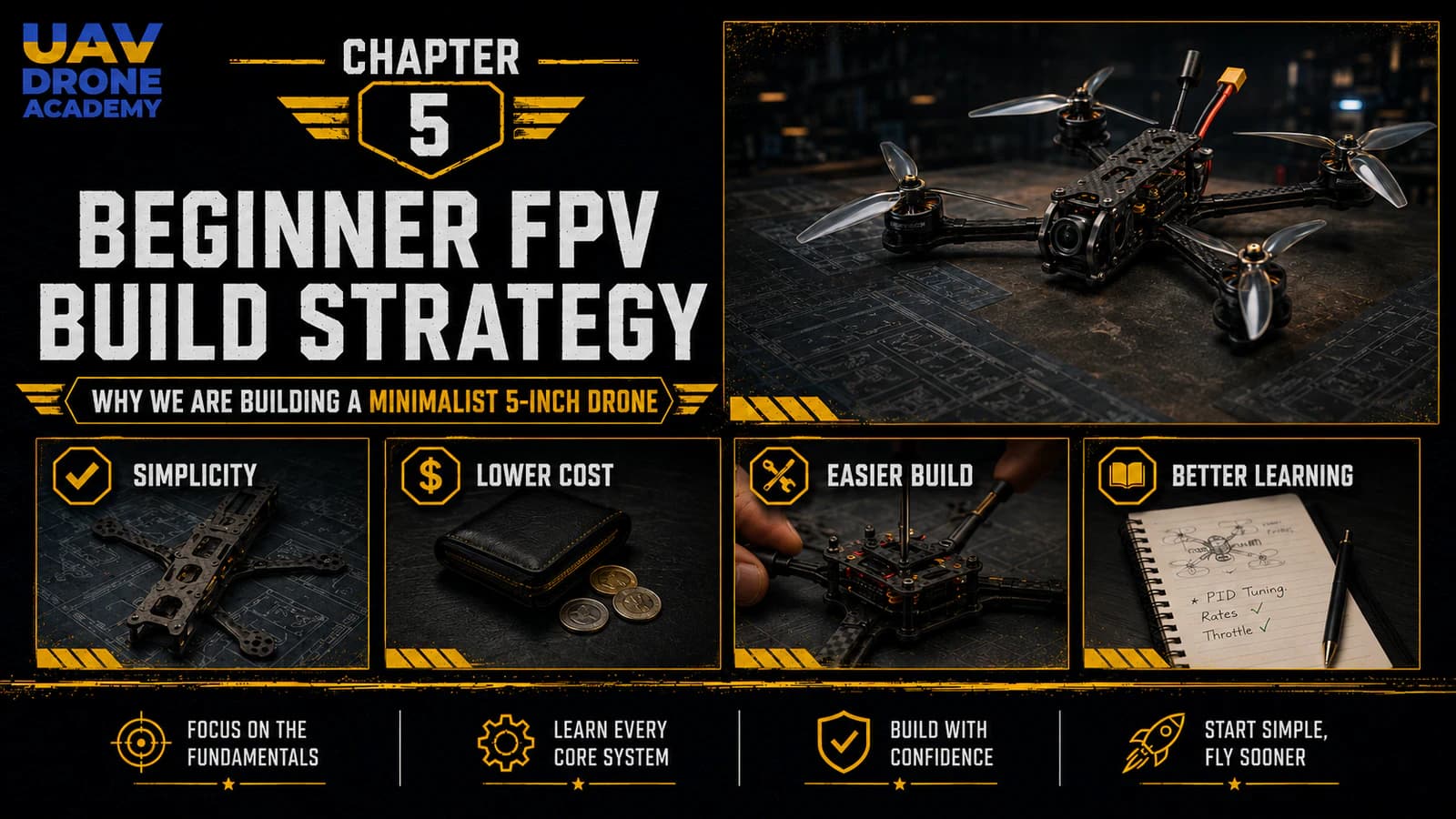
That is why this series follows a very different philosophy.
We are not building:
- the fastest drone
- the most expensive drone
- the most advanced drone possible
We are building:
The best possible learning platform for beginners.
And that means keeping things:
- simple
- practical
- reliable
- understandable
- easy to repair
This chapter explains exactly why.
The Real Goal of a First FPV Build
Before choosing components, we need to define the true purpose of this project.
The goal is not:
- impressing people online
- building a professional cinematic rig
- flying 20 kilometers away
- creating a competition racing drone
The real goal is much more important:
Understanding FPV correctly.
Your first build should teach:
- how the systems work
- how components connect together
- how to troubleshoot problems
- how to repair crashes
- how to configure the drone
- how to fly confidently
Everything else comes later.
Why Simplicity Matters So Much
FPV drones are already complex enough for beginners.
Even a basic setup requires understanding:
- electronics
- soldering
- firmware
- batteries
- radio systems
- video transmission
- aircraft control
Adding too many systems at the beginning creates unnecessary cognitive overload.
A minimalist build solves this problem.
A Simple Drone Is Easier to Understand
When fewer components exist:
- the wiring becomes clearer
- troubleshooting becomes easier
- system interactions become easier to understand
Instead of memorizing random tutorials, beginners start understanding the logic behind the build.
That is one of the most important goals of this course.
A Simple Drone Is Easier to Repair
Crashes are part of FPV.
Every pilot crashes.
Even experienced pilots crash regularly.
That means your first drone should be designed with repairs in mind.
A minimalist drone:
- has fewer wires
- has fewer failure points
- uses fewer fragile accessories
- creates less complexity during maintenance
This dramatically improves the learning experience.
A Simple Drone Is Less Expensive
FPV can become expensive very quickly.
Especially when beginners try to buy:
- premium HD systems
- GPS modules
- advanced radios
- expensive action cameras
- unnecessary accessories
The problem is simple:
Beginners crash more often.
Damaging a simple analog setup is much less painful than destroying expensive HD equipment during early training.
That is why starting simple is usually the smartest financial decision.
Why We Are Starting With Analog FPV
Many beginners immediately ask:
“Why not start with DJI or digital FPV?”
The answer is not because digital systems are bad.
Modern HD systems are excellent.
But for beginners, analog still offers major advantages.
Lower Cost
Analog systems are significantly cheaper.
This lowers:
- entry cost
- repair cost
- replacement cost
Simpler Architecture
Analog setups are generally:
- easier to wire
- easier to configure
- easier to troubleshoot
That makes them ideal for learning the fundamentals.
Better Learning Environment
When beginners are less afraid of damaging expensive equipment, they usually:
- practice more
- experiment more
- progress faster
Confidence matters in FPV learning.
Why We Are Not Starting With GPS
GPS systems are extremely useful later.
They allow:
- rescue mode
- return-to-home functions
- speed tracking
- position tracking
But they also add:
- extra wiring
- configuration complexity
- mounting challenges
- additional setup procedures
For a first build, GPS is not essential.
Right now, we want to focus on:
Core FPV fundamentals.
GPS can come later as an upgrade.
Why We Are Avoiding Excess Accessories
Many beginners overload their first drone with:
- LEDs
- buzzers
- extra mounts
- oversized antennas
- unnecessary hardware
This creates:
- more weight
- more complexity
- more repair points
Minimalism helps beginners focus on what actually matters:
- flight behavior
- control
- reliability
- system understanding
The Philosophy of a Learning Platform
Our drone is not just a flying machine.
It is a:
Training platform.
Every component was chosen to maximize:
- understanding
- repairability
- accessibility
- compatibility
- long-term learning potential
That is much more valuable than chasing extreme performance immediately.
The Core Characteristics of Our Build
Throughout this series, our drone will follow five major principles.
1. Beginner Friendly
The drone must be:
- understandable
- predictable
- easy to configure
- easy to maintain
2. Reliable
A beginner drone should prioritize:
- stability
- durability
- consistent performance
Not maximum speed.
3. Repairable
Parts should be:
- easy to replace
- widely available
- affordable
Because crashes are part of the learning process.
4. Popular
We will prioritize components that are:
- commonly used
- widely supported
- easy to find online
- backed by strong community support
This makes troubleshooting much easier later.
5. Upgrade Ready
Although the drone starts simple, it should still support future upgrades like:
- GPS
- HD systems
- long-range antennas
- buzzers
- improved cameras
This creates a smooth long-term learning path.
Why the 5-Inch Platform Is Perfect for This Strategy
The 5-inch platform fits this philosophy extremely well.
It offers:
- excellent spare part availability
- strong durability
- balanced flight characteristics
- simple repair cycles
- endless upgrade potential
Most importantly:
It teaches real FPV fundamentals correctly.
That is why it became the global standard for learning FPV.
What We Are Actually Trying to Build
At the end of this series, we want a drone that is:
Clean
Simple wiring and organized layout.
Reliable
Stable and predictable flight behavior.
Practical
Easy to transport, repair, and maintain.
Capable
Powerful enough for real freestyle flying.
Educational
Every system easy to understand.
That combination creates the ideal beginner platform.
Common Beginner Mistakes
Buying Everything at Once
Many beginners purchase:
- multiple batteries
- expensive accessories
- premium gear
- advanced modules
before understanding the basics.
This usually increases confusion.
Chasing Maximum Performance
Extreme performance often creates:
- unstable behavior
- difficult tuning
- intimidating flight characteristics
Beginners progress faster with balanced setups.
Building an Overcomplicated Drone
More components do not automatically create a better drone.
Sometimes:
Simpler builds fly better.
Especially for learning.
Why This Strategy Works Long Term
This approach creates a very important advantage:
Progressive evolution.
Instead of building a complicated drone immediately, we:
- learn the fundamentals
- master the basics
- gain confidence
- add complexity later
This creates much stronger long-term understanding.
And that understanding becomes extremely valuable later when:
- troubleshooting problems
- upgrading systems
- building custom drones
- designing advanced setups
Conclusion
A beginner FPV drone should not try to do everything at once.
The smartest first build is:
- simple
- reliable
- repairable
- understandable
- upgradeable
That is exactly why we are building a minimalist 5-inch FPV platform.
This approach creates:
- faster learning
- lower frustration
- lower repair cost
- stronger technical understanding
- a much smoother entry into FPV
Now that we fully understand the philosophy behind our project, it is finally time to begin selecting the actual hardware for the build.
In the next chapter, we will choose the foundation of the entire drone:
The frame.
Next Chapter
Best 5-Inch FPV Frame for Beginners: Choosing the Foundation of the Build