No component affects the “personality” of an FPV drone more than the battery.
The battery influences:
- power delivery
- throttle response
- flight time
- weight
- agility
- voltage stability
- overall flight feel
Even with the exact same:
- frame
- motors
- propellers
- electronics
different batteries can make the drone feel completely different in the air.
For beginners, batteries are often one of the most intimidating topics in FPV because they introduce many unfamiliar concepts:
- LiPo
- 4S
- 6S
- voltage sag
- mAh
- C-rating
- charging safety
- storage voltage
- cell balance
At first, this may seem overwhelming.
But once the basic concepts are understood, FPV batteries become much easier to work with.
In this chapter, we will understand:
- how FPV batteries work
- why LiPo batteries dominate FPV
- why modern freestyle drones increasingly use 6S systems
- how to choose a safe and balanced beginner battery setup
Why Batteries Matter So Much in FPV
FPV drones require:
- high power
- rapid acceleration
- aggressive throttle changes
- fast motor response
Normal consumer batteries cannot handle this type of demand efficiently.
That is why FPV drones use:
LiPo batteries
What Is a LiPo Battery?
LiPo means:
Lithium Polymer
LiPo batteries became the FPV standard because they provide:
- high discharge capability
- lightweight construction
- compact size
- excellent power density
This allows FPV drones to:
- accelerate aggressively
- react instantly
- maintain stable power delivery
Without LiPo batteries, modern freestyle FPV would not exist.
Why LiPo Batteries Require Respect
LiPo batteries are extremely powerful.
But they also require:
- proper charging
- proper storage
- proper handling
Improper use can damage the battery or create safety risks.
That sounds intimidating at first.
But with correct habits, LiPo batteries are generally safe and reliable.
Understanding Battery Cell Count
One of the first things beginners notice is:
- 4S
- 6S
- 3S
- other battery labels
The:
S
stands for:
cells in series
Each LiPo cell has:
- nominal voltage around 3.7V
- fully charged voltage around 4.2V
Understanding 6S Voltage
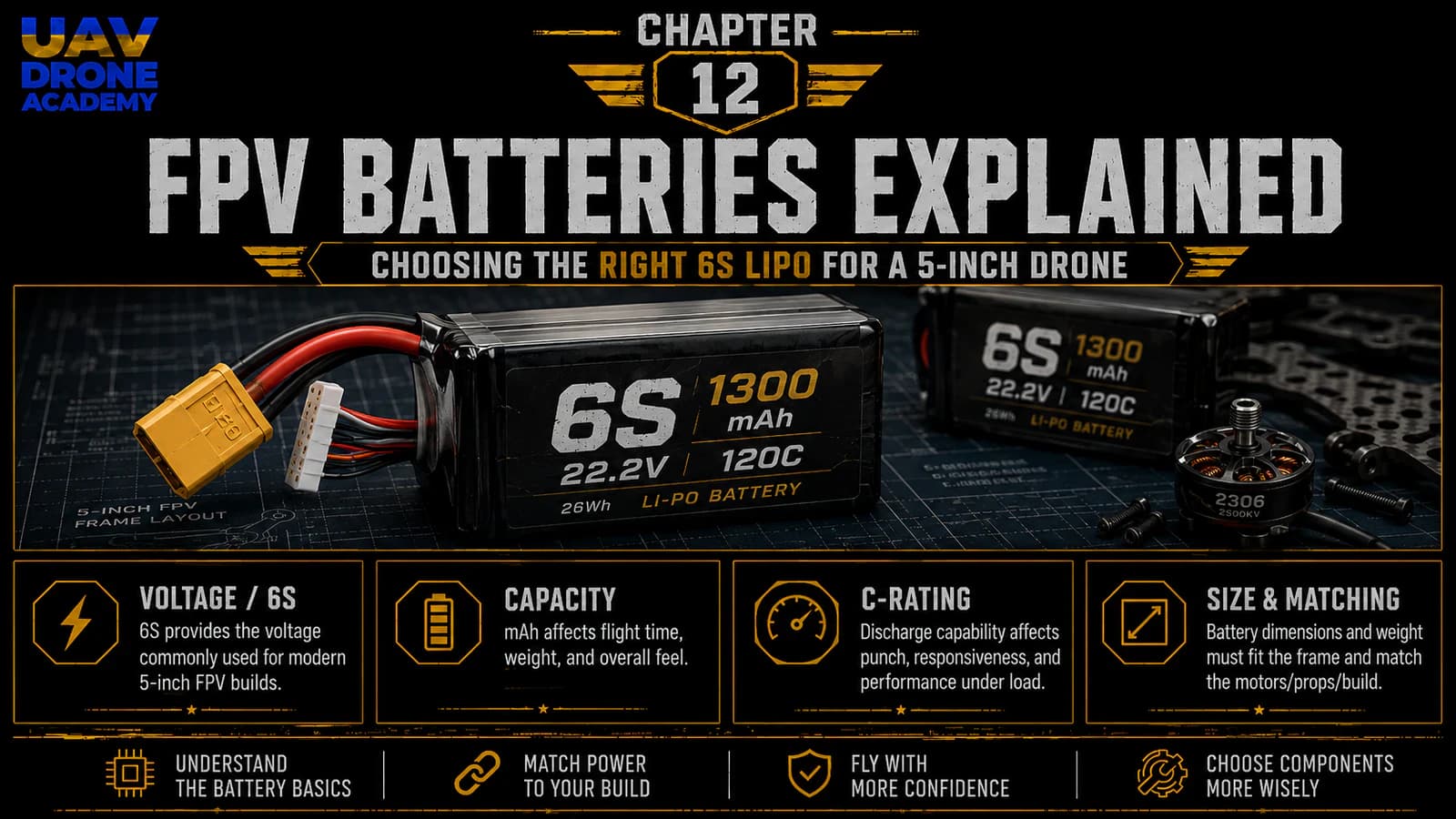
A:
6S battery
contains:
six cells connected in series
Approximate voltages:
Fully Charged
6 × 4.2V = 25.2V
Nominal Voltage
6 × 3.7V = 22.2V
This higher voltage is one reason modern FPV moved heavily toward 6S systems.
Why 6S Became So Popular
Older freestyle drones commonly used:
4S systems
Today, most modern 5-inch freestyle builds use:
6S
because it provides several important advantages.
Smoother Throttle Response
6S systems often feel:
- smoother
- more linear
- easier to control
This is excellent for beginners learning throttle management.
Lower Current Draw
Higher voltage allows the drone to produce the same power using:
less current
Lower current reduces:
- ESC stress
- heat generation
- electrical inefficiency
- voltage sag
Better Efficiency
6S systems usually provide:
- improved power consistency
- cleaner throttle behavior
- more stable voltage under load
This creates a very balanced freestyle experience.
What Is mAh?
Another important battery specification is:
mAh
which means:
milliamp-hours
This represents:
battery capacity
Higher mAh generally means:
- longer flight time
- heavier battery weight
Lower mAh generally means:
- lighter battery
- more agility
- shorter flight time
Why Battery Weight Matters
Battery weight heavily affects:
- flight feel
- agility
- momentum
- throttle response
Heavier batteries:
- increase flight time
- reduce agility
Lighter batteries:
- feel more responsive
- improve freestyle movement
- reduce inertia
Best Battery Size for Beginner 5-Inch Builds
For a beginner-friendly 6S freestyle build:
1100mAh–1300mAh
became one of the most balanced ranges.
This provides:
- good flight time
- balanced weight
- manageable throttle behavior
- smooth freestyle characteristics
What Is C-Rating?
Another confusing specification is:
C-rating
C-rating describes:
maximum discharge capability
Higher C-ratings theoretically allow:
- stronger current delivery
- reduced voltage sag
- more aggressive power handling
Why C-Rating Numbers Can Be Misleading
Many battery manufacturers exaggerate C-ratings.
That means:
advertised numbers are not always realistic.
In practice:
reputable brands matter more than chasing huge C-rating numbers.
For beginners, battery quality is usually more important than extreme specifications.
What Is Voltage Sag?
Voltage sag happens when battery voltage drops temporarily under heavy throttle load.
Some sag is normal.
Excessive sag can create:
- weaker throttle response
- unstable power delivery
- reduced performance
Good batteries generally:
- recover voltage faster
- maintain more stable performance
Why Battery Care Matters
LiPo batteries degrade over time.
Good battery habits significantly improve:
- lifespan
- reliability
- safety
Important LiPo Safety Rules
Never Over-Discharge
LiPo cells should not drop too low in voltage.
Excessive discharge damages battery health.
Never Leave Batteries Fully Charged for Long Periods
LiPos should be stored at:
storage voltage
when not flying for extended periods.
Always Use a Proper LiPo Charger
FPV batteries require:
- balance charging
- cell monitoring
- safe charging procedures
Never use random chargers.
Inspect Batteries After Crashes
Damaged LiPos can become dangerous.
Always check for:
- swelling
- punctures
- damaged wires
- unusual heat
What Is Battery Internal Resistance?
Over time, LiPo cells develop:
internal resistance
Higher resistance reduces:
- efficiency
- voltage stability
- overall performance
Healthy batteries maintain:
- lower internal resistance
- more stable voltage behavior
Why Beginners Should Avoid Battery Obsession
Many FPV beginners become overly focused on:
- maximum flight time
- extreme discharge ratings
- ultra-high-performance batteries
But during the learning phase:
consistency matters more than extreme performance.
Balanced batteries create a much smoother experience.
XT60 Connectors
Most 5-inch FPV drones use:
XT60 connectors
These connectors became the standard because they provide:
- strong current handling
- reliable connections
- good durability
That is exactly what we will use in this build.
Why Battery Placement Matters
Battery position affects:
- center of gravity
- balance
- flight behavior
Most freestyle builds mount the battery:
on top of the frame
This improves:
- freestyle handling
- stability during maneuvers
- landing protection
Popular Beginner-Friendly LiPo Brands
Several battery brands became very popular in FPV because of:
- reliability
- consistency
- community trust
Popular choices include:
- CNHL
- Tattu
- GNB
- Dogcom
- Ovonic
These brands offer good balance between:
- cost
- performance
- durability
Common Beginner Mistakes
Buying Batteries That Are Too Large
Huge batteries:
- increase weight
- reduce agility
- make crashes harder
Balanced setups fly better for beginners.
Ignoring Battery Safety
LiPos are powerful energy sources.
Safe charging and storage habits are extremely important.
Over-Discharging Batteries
Flying batteries too low damages:
- lifespan
- performance
- reliability
Chasing Extreme Specifications
The highest C-rating or largest battery is not automatically the best choice.
Balanced performance matters more.
What We Want in Our Beginner Build
Our ideal beginner battery should be:
Reliable
Stable power delivery.
Balanced
Good compromise between weight and flight time.
Beginner Friendly
Predictable throttle behavior.
Affordable
Reasonable replacement cost.
Widely Available
Easy to replace and purchase later.
This fits our project philosophy perfectly.
Our Build Philosophy Moving Forward
At this point, a very clear pattern should exist throughout the entire project.
We prioritize:
- smooth learning
- practical understanding
- reliability
- repairability
- balanced performance
Not extreme specifications.
That creates a much stronger FPV foundation for beginners.
Conclusion
The battery is the heart of the FPV power system.
It directly affects:
- flight feel
- responsiveness
- efficiency
- throttle behavior
- overall drone performance
Understanding:
- LiPo basics
- 6S systems
- mAh
- voltage behavior
- battery safety
is one of the most important parts of becoming comfortable with FPV.
For beginners, a balanced 6S setup provides one of the best combinations of:
- smooth power
- manageable control
- modern compatibility
- future upgrade flexibility
Now that we understand every major subsystem of the drone individually, the next step is bringing everything together into one complete beginner build.
Next Chapter
Complete 5-Inch FPV Drone Parts List for Beginners