Here is a truth that surprises most beginners: you never fly the drone you see in the sky. You fly the drone the camera shows you. The FPV system is the set of components that makes this possible, and it deserves the same attention you give motors and batteries, because when the video fails, the flight ends. Usually against something hard.
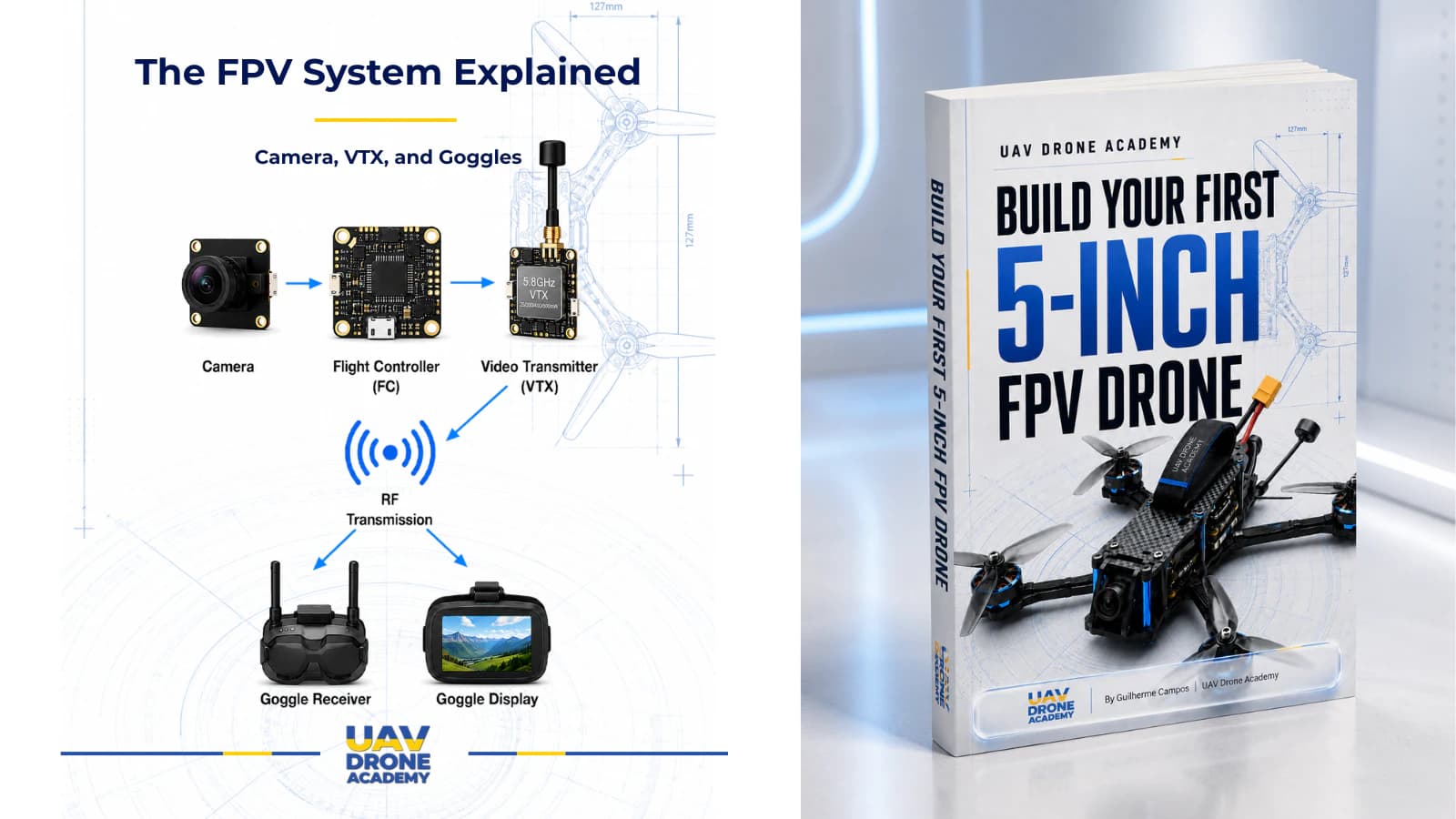
FPV stands for First Person View. The FPV system lets you see what the drone sees, in real time, through goggles on your face. It consists of three main parts: the camera on the drone, the video transmitter (VTX) on the drone, and the goggles worn by the pilot. Two parts fly. One stays on the ground with you. Together they form a live television broadcast running between your quad and your eyes.
This article covers the classic analog FPV system, which is still the most affordable and beginner-friendly way to start on a beginner 5-inch platform. Digital systems exist, and we will touch on them, but analog is where most first builds begin.
What Is the FPV System, Exactly?
Before looking at each part, it helps to see the whole chain in one glance. Video is captured on the drone, converted into a radio signal, thrown through the air, caught by a receiver, and displayed on a screen a few centimeters from your eyes. All of this happens fast enough that you can react to a tree branch at full speed. That speed requirement shapes every component in the system.
| Component | Where it lives | What it does |
|---|---|---|
| FPV camera | Front of the drone | Captures the live video feed with minimal delay |
| Video transmitter (VTX) | On the drone, usually rear | Converts video into a 5.8 GHz radio signal and broadcasts it |
| Goggles | On your head | Receive the signal and display it on small screens |
One detail worth knowing: on most builds, the camera signal does not go straight to the VTX. It first passes through the flight controller, where an OSD (On-Screen Display) chip overlays flight data like battery voltage onto the image. Then the combined signal goes to the VTX. That is why your goggles show numbers floating over the video.
The FPV Camera
The FPV camera captures the live video feed. It is mounted at the front of the frame, usually on a tilt bracket, so you can angle it upward as your flying gets faster. Why upward? Because a quad moving forward pitches its nose down. If the camera pointed straight ahead, all you would see at speed is grass. Tilting the camera up keeps the horizon in view while the drone leans into the flight.
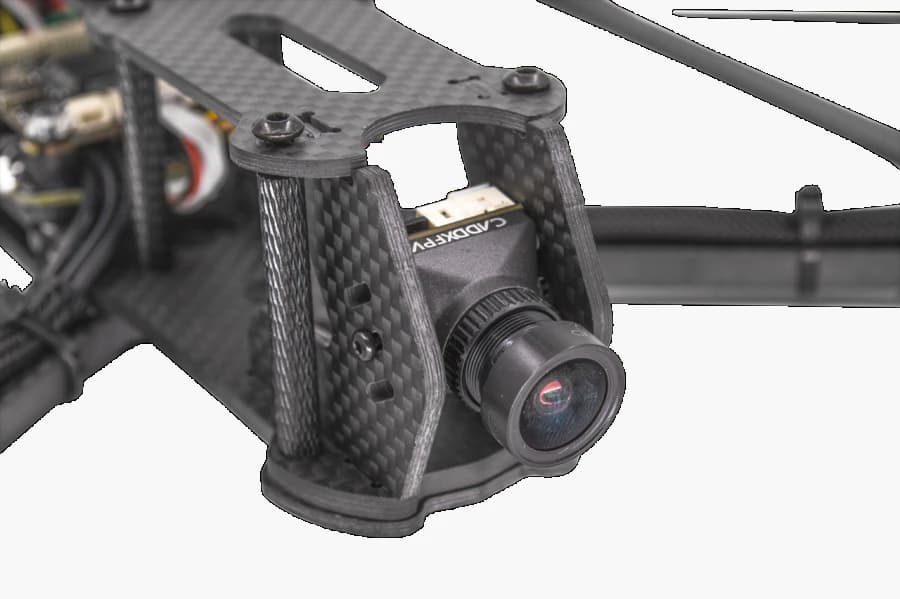
An FPV camera is not an action camera. It is not trying to look pretty. Its one job is to deliver an image to your eyes with as little delay as possible, because delay in the video means delay in your reactions. This is why pilots happily fly with image quality that would embarrass a ten-year-old phone.
For beginner analog builds, a standard CMOS camera with 1200TVL resolution and a wide-angle lens is a solid starting point. CMOS is the sensor type used in virtually all modern FPV cameras, and TVL (TV lines) is how analog cameras describe resolution. The wide-angle lens matters more than the numbers: it gives you peripheral vision, and peripheral vision is what keeps you from clipping obstacles you did not know were there.
Two practical camera tips. First, keep the tilt angle low while learning. A steep camera angle encourages speed, and speed is exactly what a beginner does not need yet. Second, protect the lens. The camera sits at the front of the drone, which is also the part that arrives first in every crash.
The Video Transmitter (VTX)
The video transmitter is the broadcast station of your drone. It receives the video signal, modulates it onto a 5.8 GHz radio carrier, and pushes it out through an antenna toward your goggles. Everything you see in flight travels through this small board, so its health and configuration matter more than its size suggests.
VTX output power is measured in milliwatts (mW). More power generally means longer range and better penetration through obstacles like trees and walls. It also means more heat, more current draw from the ESC and the stack that powers everything, and more interference for anyone flying near you. Power is a tool, not a score to maximize.
For beginner flying in open spaces, a VTX capable of 200 mW to 400 mW is sufficient. You will run out of confidence long before you run out of video range. And here is the part you must not skip: high-power VTX output is regulated in many countries, and in some regions the legal limit without a radio license is far lower than what the hardware can do. Always check your local regulations before flying. A fine is a very expensive way to learn about radio law.
Most modern VTX units also support remote control from the flight controller, so you can change channel and power from your goggles instead of poking a tiny button on the drone. When you shop, this feature is usually listed as SmartAudio or Tramp. It is worth having.
The Antenna: The Part Everyone Underestimates
The VTX does not talk to your goggles directly. The antenna does. A great VTX with a damaged or badly placed antenna performs worse than a cheap VTX with a healthy one, which is why experienced pilots inspect antennas the way beginners inspect propellers.
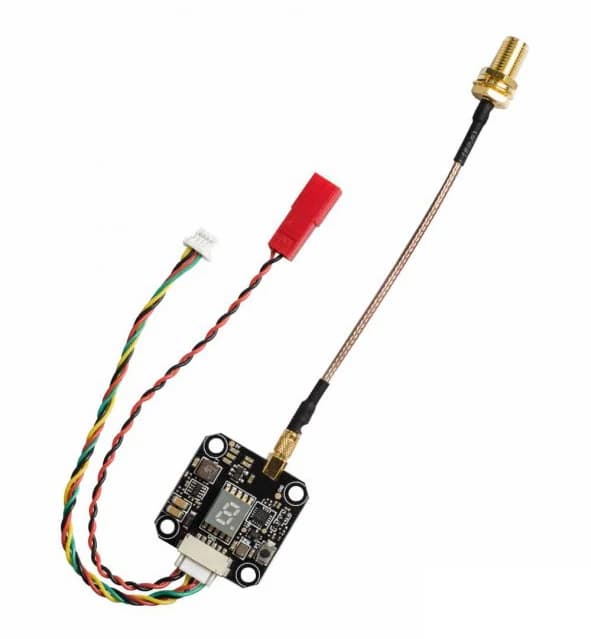
One rule matters above all others, so read it twice. Never power a VTX without an antenna attached. The transmitter needs somewhere to send its energy. Without an antenna, that energy reflects back into the circuit and can overheat or destroy the VTX in seconds. Plugging in a battery on the bench with the antenna removed is one of the most common ways beginners kill a perfectly good transmitter.
FPV Goggles
FPV goggles are the ground side of the system. They contain a receiver that picks up the VTX signal and one or two small screens that display it right in front of your eyes. Put them on and the outside world disappears, which is exactly the point. Immersion is what makes FPV feel like flying instead of watching.
Goggles come in two families. Box-style goggles use a single larger screen inside a bigger housing, giving a wide, TV-like image at a friendly price. Compact goggles, sometimes called binocular-style, use two small high-resolution screens in a slim housing, cost more, and feel more premium on the face. Neither is wrong. They optimize for different things.
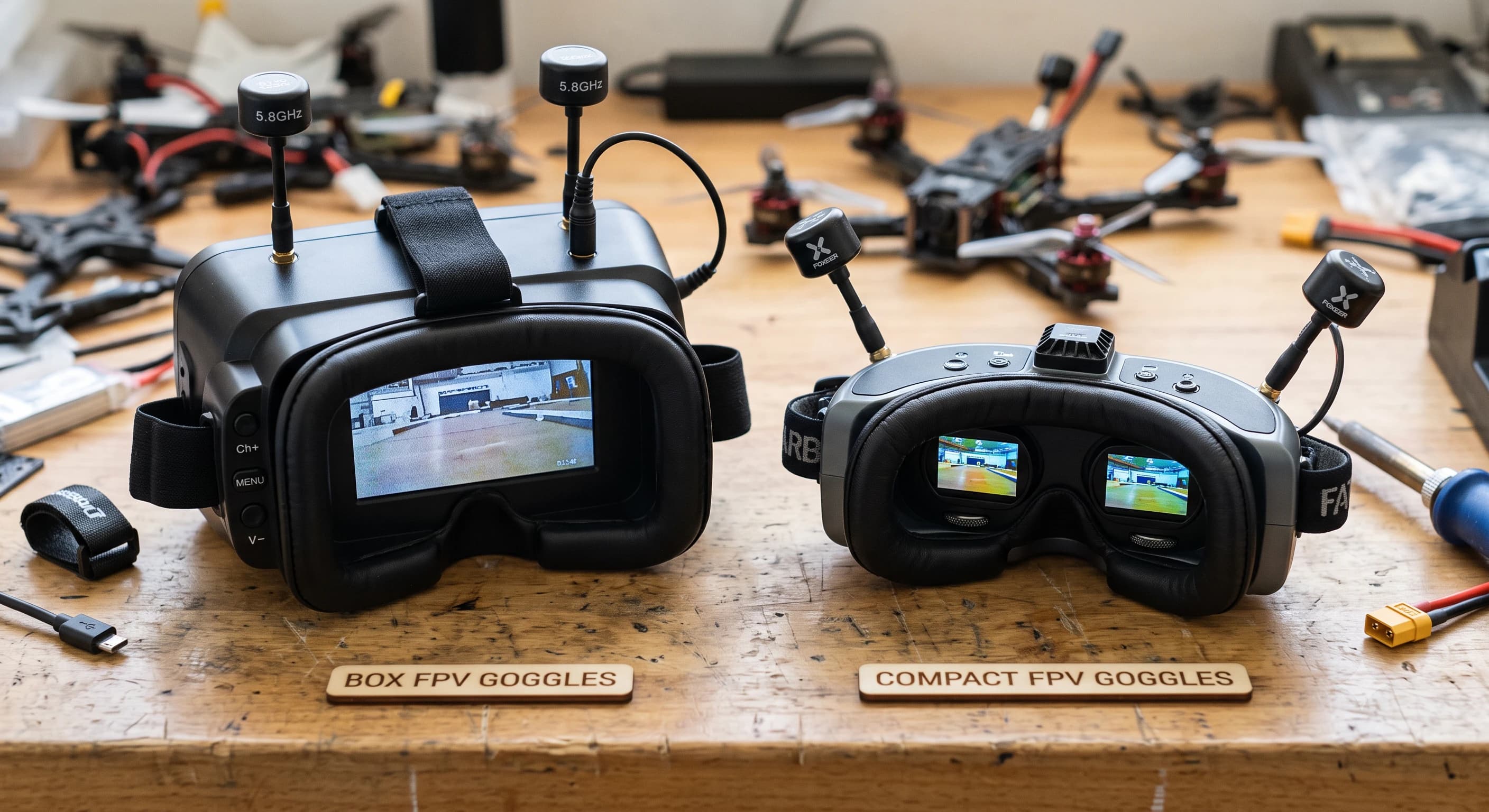
| Feature | Box style | Compact style |
|---|---|---|
| Size and weight | Larger, bulkier | Slim, lighter |
| Image feel | Wide field of view, like sitting close to a TV | Sharper, more focused image |
| Price tier | Lower | Higher |
| Glasses friendly | Often yes | Usually needs diopter inserts |
| Best for | First goggles, budget builds | Pilots committed to the hobby |
Most beginners start with an affordable box-style goggle, and that is a sensible call. Your first goggles teach you whether you love FPV. Your second goggles can be the expensive ones. Whatever you choose, make sure the goggles match your video system: analog goggles receive analog VTX signals, and digital systems like DJI, Walksnail, and HDZero each need their own compatible hardware. An analog camera cannot talk to digital goggles, no matter how much you paid for either.
Analog or Digital: A Quick Reality Check
Digital FPV systems deliver dramatically sharper images, and if you have watched cinematic FPV videos online, you were almost certainly watching digital. So why does this article focus on analog? Because analog is cheaper across all three components, easier to repair after crashes, and everything you learn about cameras, transmitters, antennas, and goggles transfers directly when you upgrade later. Starting analog is not settling. It is learning on hardware you will not cry about breaking.
Common Beginner Mistakes With the FPV System
A few mistakes show up in almost every beginner's first weeks, so let's get ahead of them. Powering the VTX without an antenna is the classic, and we covered why it kills transmitters. Running maximum power at the field is another: it heats the VTX, drains the battery faster, and stomps on the video of anyone flying nearby. Use the power you need, not the power you have.
Camera angle creep is subtler. Beginners see experienced pilots flying with steep camera tilt and copy it, then wonder why the drone feels impossible to fly slowly. Keep the angle low until slow flight feels boring. Finally, remember that the FPV system lives at the most exposed parts of the drone: the camera up front and the antenna sticking out the back. After any hard landing, inspect both. Our guide to common FPV crashes and repairs shows exactly what to look for.
FAQ: FPV System Questions
What is an FPV system on a drone?
The FPV system is the set of components that delivers live video from the drone to the pilot. It has three parts: an FPV camera that captures the image, a video transmitter (VTX) that broadcasts it as a 5.8 GHz radio signal, and goggles that receive and display it in real time.
How much VTX power do I need as a beginner?
For open-field flying close to yourself, a VTX running 200 mW to 400 mW is more than enough. Higher power helps range and obstacle penetration, but it also generates heat and may exceed the legal limit in your country, so always verify local regulations first.
Why should you never power a VTX without an antenna?
Without an antenna, the radio energy the VTX produces has nowhere to go and reflects back into the transmitter circuit. This can overheat and permanently damage the VTX in seconds. Always attach the antenna before connecting a battery.
Do FPV goggles work with any drone?
No. Goggles must match the video system on the drone. Analog goggles work with analog VTX hardware, while digital systems like DJI, Walksnail, and HDZero each require their own compatible goggles and transmitters.
Is analog FPV still good for beginners?
Yes. Analog gear is affordable, widely available, easy to repair, and everything you learn about cameras, transmitters, antennas, and goggles applies directly if you upgrade to a digital system later.
Recap
The FPV system is a live broadcast chain with three links: the camera captures the image, the VTX transmits it over 5.8 GHz radio, and the goggles receive and display it. For a first analog build, a 1200TVL CMOS camera with a wide lens, a 200 mW to 400 mW capable VTX, and affordable box-style goggles cover everything a beginner needs. Respect the antenna, respect your local power regulations, and keep the camera angle low while you learn. Get those right and your video will outlast your batteries.
What's Next
With the video system understood, the next piece of the component puzzle is the part that actually pulls the drone through the air. Learn how to read FPV prop specs like 5.1x4.1x3 and choose the right propellers for a beginner 5-inch build.