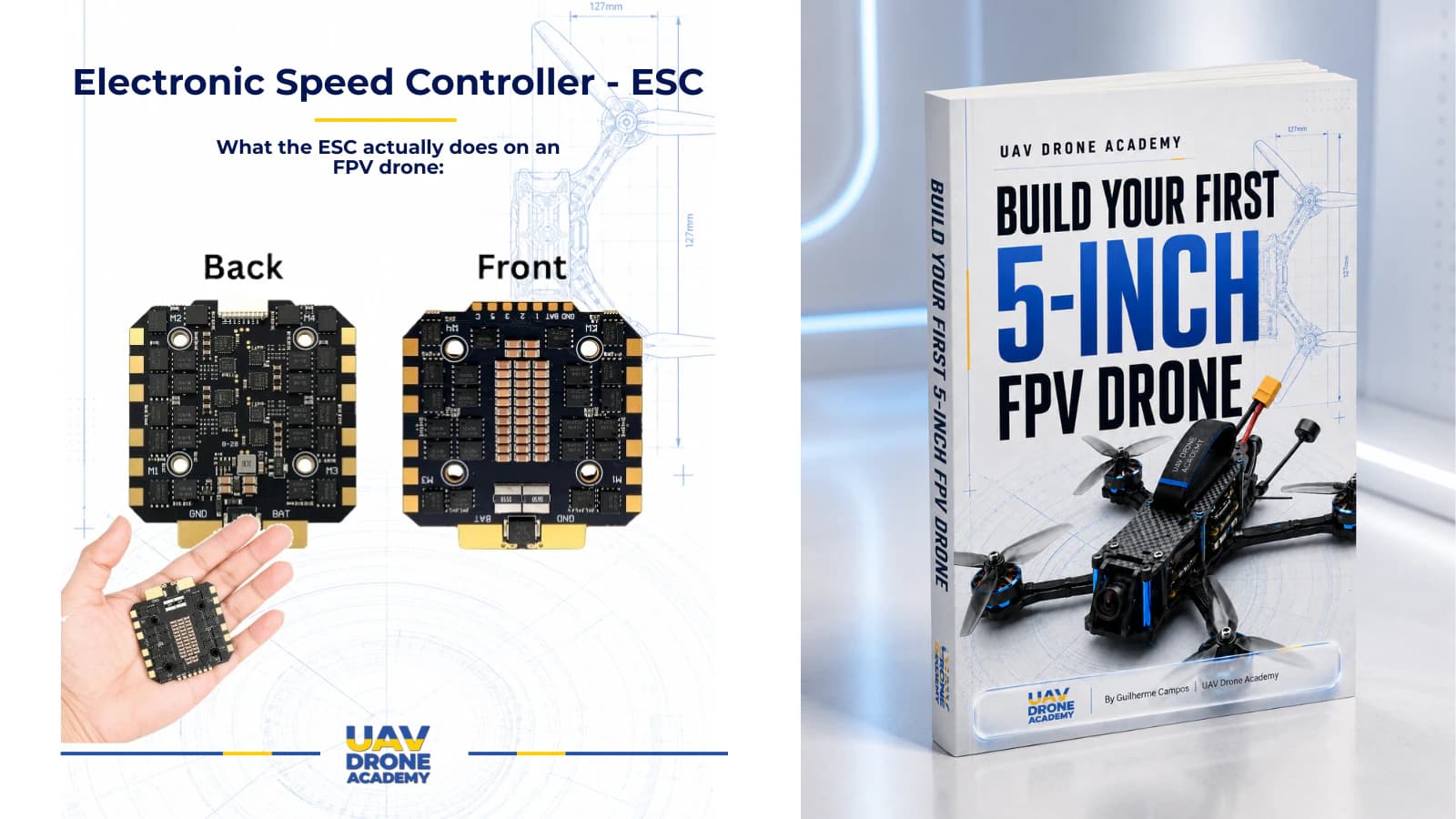
Your flight controller can calculate the perfect correction a thousand times per second. Impressive. It also cannot move a single motor on its own. The flight controller is a brain with no muscles, and the electronic speed controller (ESC) is what turns its decisions into actual rotation. The ESC sits between the battery and the motors, takes the command "spin motor 3 faster, now", and makes it physically happen.
If the flight controller gets all the glory, the ESC does most of the heavy lifting. Literally. Every amp that reaches your motors passes through it. In this lesson, we will look at what the ESC actually does, why almost every modern 5-inch build uses a single 4-in-1 board, and how to read the one number that decides whether your ESC survives: the current rating.
What an Electronic Speed Controller Actually Does
An electronic speed controller is a circuit board that regulates how fast each motor spins. It receives a throttle command from the flight controller and controls how much of the battery's power reaches the motor. When the flight controller says "more thrust on the front-left motor", the ESC is the component that delivers it. If you want to see where the ESC fits among all the other parts before zooming in, our guide to FPV drone anatomy maps every component of the aircraft.
Here is the part most beginner explanations skip. The brushless motors on an FPV drone have three wires, not two, because they run on three phases that must be energized in a precise sequence. The ESC creates that sequence. It switches battery voltage across the three motor phases thousands of times per second, and the timing and duration of that switching determine the motor's speed. The current flowing into the motor is a consequence of the voltage applied and the load on the propeller, and that current is exactly what the ESC's ratings are built around.
So the ESC is doing two jobs at once: translating a digital command into three-phase power, and doing it fast enough that the drone feels connected to your sticks. When people say a quad feels "locked in", a healthy ESC doing clean, fast switching is a quiet part of that feeling.
Where the ESC Sits in the Power Chain
The ESC is the meeting point of the two systems inside your drone: the power system and the control system. Power comes in from one side, instructions come in from the other, and spinning motors come out.
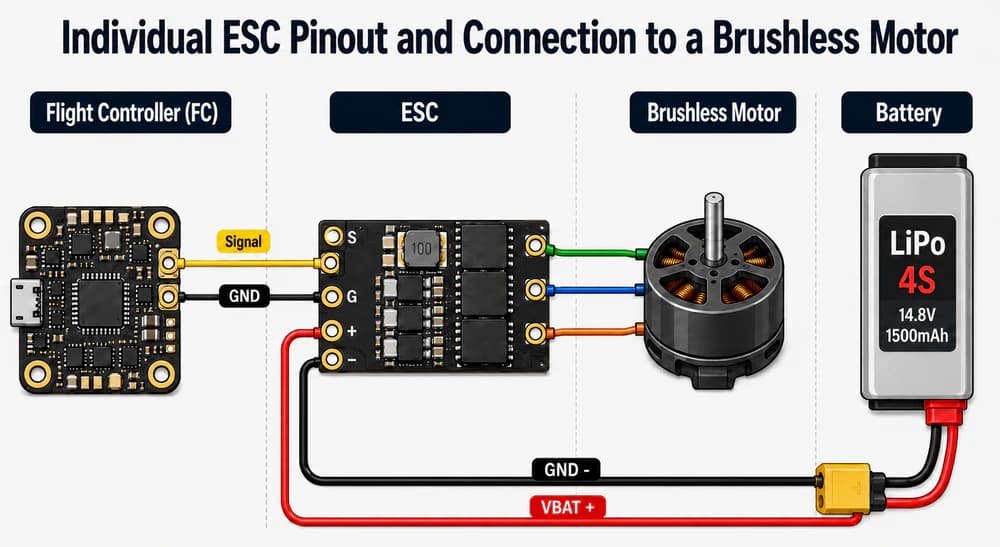
The connections are simple to map:
- Battery to ESC: one thick power lead (positive and negative). All the current for all four motors flows through here.
- Flight controller to ESC: a thin signal connection, usually a small ribbon cable or a few signal wires. No meaningful power flows here, only commands.
- ESC to motors: three wires per motor. This is where the three-phase switching happens.
On modern builds, the command traveling from the flight controller to the ESC is a digital protocol, most commonly DShot. A protocol is simply the agreed language the two boards use to talk. You do not need to master protocols to build your first drone, but it helps to know that the signal is digital, precise, and completely separate from the power path. The thick wires carry energy. The thin ones carry intent. To follow that intent all the way from your radio sticks to spinning motors, see our breakdown of the FPV drone signal flow.
Why Modern 5-Inch Builds Use a 4-in-1 ESC
Years ago, builders soldered four individual ESCs, one on each arm, plus a separate power distribution board to feed them. It worked, but it meant more solder joints, more wiring, more weight, and more things to break in a crash. On a typical 5-inch build today, that approach is mostly gone. If you are not sure what "5-inch" actually means as a platform, that article is worth reading first.
The modern answer is the 4-in-1 ESC: a single board that contains four independent speed controllers, one per motor. The battery connects once. Each motor connects with its three wires. The flight controller mounts directly on top of the ESC, forming what pilots call a stack. Choosing that combination is a build decision of its own, and we cover it in our guide to the flight controller and ESC stack.
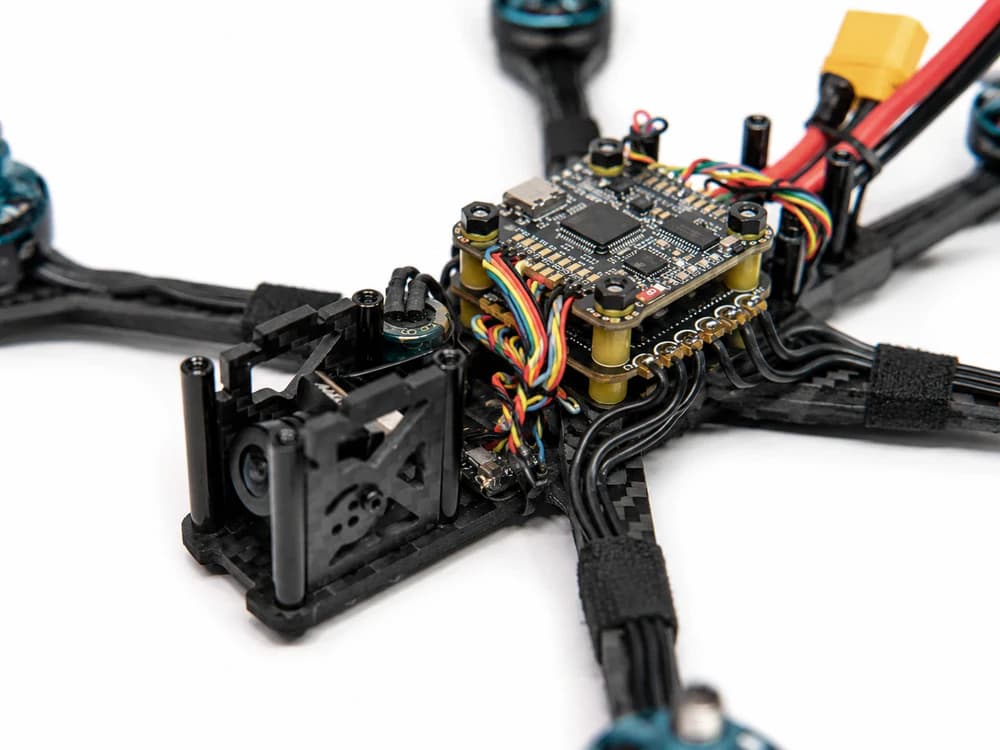
The benefits are practical, not theoretical:
- Less wiring and fewer solder joints, which means fewer opportunities for a bad connection.
- Lower weight, because you remove the power distribution board and a lot of wire.
- Centralized mass, which slightly helps agility since heavy parts sit near the center of the frame.
- A cleaner build that is easier to inspect and repair.
The honest trade-off: if one of the four ESC channels dies, you usually replace the whole board. Individual ESCs let you swap only the damaged one. For a beginner on a 5-inch build, the simpler wiring of a 4-in-1 wins that argument comfortably. Fewer solder joints means fewer beginner mistakes, and beginner mistakes are the real enemy of a first build.
ESC Current Rating: How Much Is Enough?
Every ESC has a current rating, measured in amps (A) per motor channel. A 45A ESC can continuously deliver up to 45 amps to each motor. This is the single most important number on the spec sheet, because it defines the limit of what the board can survive.
Motors do not draw a fixed current. At hover, a 5-inch quad sips power. At full throttle with aggressive propellers, each motor demands dramatically more. The ESC must be rated for those peaks, not for the calm moments. If the motors pull more current than the ESC can handle for too long, the board overheats, and an overheated ESC does not politely shut down. It burns. Sometimes with smoke, occasionally mid-air, and always at the least convenient moment.
For a 5-inch build running 6S batteries, an ESC rated between 45A and 60A per motor provides adequate headroom. Headroom means the rating sits comfortably above what your motors normally demand, so the ESC never operates at its limit. Here is how the common rating classes compare in practice:
| ESC rating | Fit for a 5-inch 6S build | What it means in practice |
|---|---|---|
| 45A | Workable baseline | Adequate headroom for typical freestyle setups; less margin with aggressive props |
| 55A | Comfortable middle ground | Extra thermal margin for harder flying without a big cost jump |
| 60A+ | Maximum headroom | For aggressive props and demanding flying; the ESC rarely gets close to its limit |
One more spec-sheet detail: many ESCs also advertise a burst rating, which is higher than the continuous rating. Burst means the board can tolerate that current only for short moments, not sustained. When comparing ESCs, judge them by the continuous rating and treat the burst number as marketing seasoning.
Voltage Rating: Match the ESC to Your Battery
Current is not the only limit. Every ESC also lists a supported voltage range, expressed in LiPo cell counts, such as 3-6S. The rating must include the battery you plan to fly. Connect a 6S battery to an ESC rated only for 4S and you can destroy it instantly, before the motors even spin.
For a 6S 5-inch build, this is simple: buy an ESC explicitly rated for 6S. Most modern 4-in-1 boards in the 45A to 60A class are, but checking takes ten seconds and skipping the check can cost the whole board.
Common ESC Mistakes Beginners Make
Most ESC failures are not the ESC's fault. They come from decisions made before the first flight. These are the ones that show up over and over:
- Choosing a rating with no headroom. An ESC that barely covers your motors' demands runs hot every flight. Heat is cumulative abuse; the board fails weeks later and looks like a mystery.
- Ignoring the voltage rating. A 6S pack on a 4S-only ESC is an instant kill. Always confirm the cell count range.
- Skipping the capacitor. Most 4-in-1 ESCs ship with a low-ESR capacitor that solders onto the battery pads. It absorbs voltage spikes that would otherwise hammer your electronics. It is not optional decoration. Install it.
- Mismatched mounting size. 4-in-1 ESCs come in standard mounting patterns, commonly 30.5×30.5 mm for 5-inch builds and 20×20 mm for smaller drones. The ESC, flight controller, and frame must agree on this before you buy.
- Testing with propellers installed. Motors under propeller load draw far more current than bare motors, and a wiring mistake becomes dangerous instead of merely annoying. Bench testing happens without props. Always.
FAQ
Is a 45A ESC enough for a 5-inch 6S drone?
For a typical freestyle setup, yes. A 45A per-motor rating covers common 5-inch 6S configurations with adequate headroom. If you plan to fly aggressively with demanding propellers, stepping up to 55A or 60A buys extra thermal margin for a small price difference.
What happens if you exceed the ESC current rating?
The ESC overheats. Sustained current above the rating degrades and eventually burns the board's components, and the failure can be permanent and immediate. This is why headroom matters: an ESC that never approaches its limit lives a long, boring, reliable life.
Does the ESC voltage rating need to match the battery?
Yes, strictly. The battery's cell count must fall inside the ESC's supported range. Higher voltage than rated can destroy the ESC the moment you plug in, with no warning and no second chance.
Recap
The electronic speed controller is the muscle between your flight controller's decisions and your motors' rotation. It receives digital commands, switches battery power across each motor's three phases, and does it fast enough to keep the drone stable and responsive. Modern 5-inch builds use a 4-in-1 ESC because one board means less wiring, less weight, and fewer beginner mistakes. When choosing one, two numbers decide everything: a current rating with real headroom (45A to 60A for a 5-inch 6S build) and a voltage rating that includes your battery.
What's Next
Understanding the ESC on paper is step one. Physically connecting it to the rest of the drone is where the build gets real, and that starts with the motors it will control. Read how to install motors on a 5-inch FPV drone to prepare the four motors your ESC will drive, including screw length checks and wire routing that will make the soldering stage much easier.