Now that we have chosen the frame — the physical foundation of the drone — it is time to select the electronic core of the entire system.
This is where many FPV beginners start feeling intimidated.
Suddenly you encounter terms like:
- F4
- F7
- UART
- BEC
- gyro
- BLHeli
- amperage
- stack size
- ESC protocols
- firmware compatibility
At first, all of this can feel extremely technical.
But the truth is much simpler than it appears.
In practical terms:
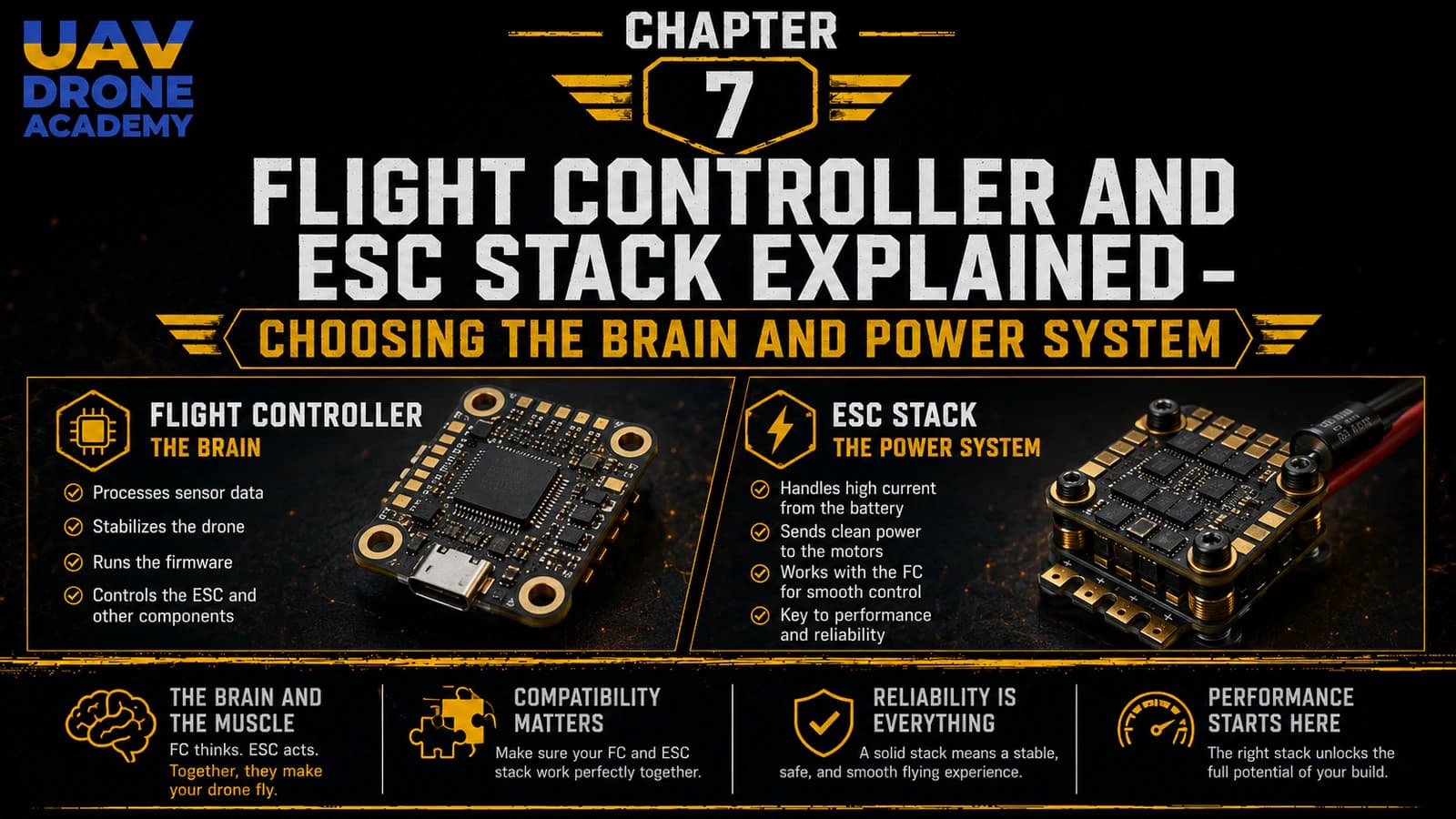
The flight controller is the brain.
The ESC is the power management system.
Together, they form what FPV pilots commonly call:
The stack.
This subsystem is responsible for:
- stabilization
- motor control
- communication between components
- overall drone behavior
Without a properly functioning stack, the drone cannot fly.
That is why this chapter is extremely important.
But do not worry: we will approach everything from a beginner-friendly perspective focused on understanding instead of memorization.
What Is a Flight Controller?
The flight controller, also called the FC, is the main computer inside the drone.
Its job is to:
- receive information
- process calculations
- control stabilization
- coordinate all onboard systems
You can think of the flight controller as:
The drone’s brain.
What the Flight Controller Actually Does
The flight controller constantly receives data from:
- the radio receiver
- onboard sensors
- Betaflight settings
- the gyroscope
- pilot commands
Then it calculates:
- how fast each motor should spin
- how to stabilize the drone
- how to react to movement
This happens thousands of times every second.
The Gyroscope: One of the Most Important Components
Every modern flight controller contains a:
Gyroscope
The gyroscope measures:
- rotational movement
- orientation changes
- angular velocity
This allows the drone to understand:
- how it is moving
- how fast it is rotating
- how to stabilize itself
Without the gyroscope, stable FPV flight would not exist.
What Is an ESC?
ESC stands for:
Electronic Speed Controller
The ESC controls motor speed.
It acts as the power bridge between:
- battery
- flight controller
- motors
The flight controller tells the ESC:
- how much power each motor should receive
- how quickly motor speed should change
The ESC then rapidly adjusts electrical power delivery.
Modern FPV Drones Use 4-in-1 ESCs
Older drones sometimes used one ESC per motor.
Modern FPV drones usually use:
4-in-1 ESCs
This means all four ESCs are combined into one board.
Advantages include:
- cleaner wiring
- lower weight
- simpler assembly
- better organization
That is exactly what we want for a beginner build.
What Is a Stack?
In FPV, the term stack usually refers to:
- the flight controller
- the ESC mounted together
These boards are normally connected using:
- wiring harnesses
- soft mounting
- stack screws
The stack becomes the electronic center of the drone.
Why the Stack Is So Important
The stack affects:
- flight quality
- reliability
- repairability
- tuning stability
- future expandability
A bad stack can create:
- unstable flight
- overheating
- random failures
- difficult troubleshooting
A good stack makes the entire drone easier to work with.
Understanding F4 vs F7 Flight Controllers
One of the first things beginners notice is:
F4 and F7
These refer to processor families used inside the flight controller.
F4 Flight Controllers
F4 boards are:
- affordable
- widely used
- beginner friendly
- highly capable
For most beginner freestyle drones:
F4 is more than enough.
F7 Flight Controllers
F7 boards are:
- faster
- more powerful
- better at handling multiple peripherals
- more future-oriented
But they are also:
- more expensive
- sometimes unnecessary for simple beginner builds
Which One Should Beginners Choose?
For this project:
- F4 is perfectly acceptable
- F7 is also excellent if pricing is reasonable
The most important thing is not chasing maximum processing power.
Instead, beginners should prioritize:
- reliability
- compatibility
- community support
- ease of setup
Understanding UARTs
Another common FPV term is:
UART
UARTs are communication ports.
They allow the flight controller to communicate with:
- receivers
- GPS modules
- VTX systems
- radios
- other devices
Think of UARTs like communication channels.
More advanced builds require more UARTs.
But our minimalist beginner build only needs a few.
Why We Are Keeping the Build Simple
Some flight controllers support:
- GPS
- Bluetooth
- HD systems
- LEDs
- blackbox logging
- advanced peripherals
But remember our philosophy:
Simplicity first.
We are intentionally avoiding unnecessary complexity in the beginning.
That means:
- fewer wiring points
- fewer setup steps
- fewer troubleshooting variables
ESC Amperage Explained
ESCs are rated in:
Amps, or A
This defines how much electrical current they can safely handle.
Common 5-inch ESC ratings include:
- 35A
- 45A
- 50A
- 55A
Why Higher Numbers Are Not Always Necessary
Many beginners assume:
“Higher amperage automatically means better.”
Not necessarily.
For our beginner-friendly 5-inch build:
45A ESCs are usually an excellent balance.
They provide:
- good reliability
- strong compatibility
- future upgrade potential
- sufficient power handling
without becoming unnecessarily expensive.
ESC Firmware
ESCs also run firmware.
Modern ESCs often use:
- BLHeli_S
- BLHeli_32
- Bluejay
These systems control:
- motor timing
- startup behavior
- motor smoothness
- communication protocols
Do not worry about advanced ESC tuning yet.
We will keep things simple during the first build.
Why Reliable Power Delivery Matters
The ESC and power system directly affect:
- flight stability
- responsiveness
- motor smoothness
- system reliability
Power instability can cause:
- desyncs
- overheating
- unstable flight behavior
- crashes
That is why choosing proven components matters so much.
Stack Mounting Size
Most beginner 5-inch drones use:
30×30 mm stacks
Advantages include:
- easier soldering
- better spacing
- easier repairs
- better cooling
Smaller stacks exist, including:
- 20×20
- AIO boards
- compact builds
But for beginners:
Larger layouts are usually easier to work with.
AIO Boards vs Traditional Stacks
Another common beginner question is:
“Should I use an AIO board?”
AIO means:
All-In-One
This combines:
- flight controller
- ESC
- sometimes additional electronics
into one board.
Why We Are Avoiding AIO Boards
AIO boards are excellent for:
- micro drones
- ultralight builds
- compact systems
But for beginners on 5-inch drones, they introduce disadvantages:
- more difficult repairs
- higher heat concentration
- total board replacement if damaged
Traditional stacks are:
- easier to repair
- easier to understand
- more modular
That fits our philosophy much better.
Popular Beginner-Friendly Stack Brands
Some brands became highly respected in the FPV community because of:
- reliability
- documentation
- compatibility
- strong community support
Popular beginner-friendly options include:
- SpeedyBee
- Holybro
- Diatone
- Mamba
- iFlight electronics
Why SpeedyBee Became Extremely Popular
For beginner builds, SpeedyBee stacks became very popular because they offer:
- excellent value
- strong reliability
- beginner-friendly setup
- mobile app integration
- wide community support
This aligns extremely well with our project philosophy.
What We Are Looking for in Our Build
Our ideal beginner stack should be:
Reliable
Stable operation matters more than extreme specifications.
Beginner Friendly
Easy wiring and good documentation.
Widely Supported
Large community knowledge base.
Repairable
Easy replacement if damaged.
Future Ready
Enough capability for later upgrades.
Common Beginner Mistakes
Buying Ultra-Cheap Unknown Electronics
Very cheap stacks often suffer from:
- poor quality control
- unstable voltage regulators
- overheating
- unreliable ESCs
This can create endless troubleshooting frustration.
Chasing Maximum Specifications
Beginners often obsess over:
- processor speed
- ESC amperage
- advanced features
But reliability matters far more.
Choosing Electronics Without Community Support
Popular hardware matters.
When using common components:
- troubleshooting becomes easier
- tutorials become easier to follow
- replacement parts become easier to find
Our Build Philosophy Moving Forward
At this stage, our build philosophy should be becoming very clear.
We prioritize:
- simplicity
- reliability
- repairability
- accessibility
- real-world usability
That is far more important than building the most extreme FPV drone possible.
Especially for beginners.
Conclusion
The flight controller and ESC stack form the electronic heart of the FPV drone.
Together, they:
- process pilot commands
- stabilize the aircraft
- control motor speed
- manage power delivery
- coordinate the entire system
Choosing the right stack is one of the most important decisions in the build process.
For beginners, the best stack is not the most expensive or most powerful.
It is the one that provides:
- reliability
- simplicity
- strong community support
- a smooth learning experience
Now that we understand the brain and power management system of the drone, the next step is choosing the components that actually generate thrust: the motors.
Next Chapter
FPV Motors Explained: KV, Size, Thrust, and 6S Compatibility