No matter how powerful or advanced an FPV drone may be, none of it matters if the pilot cannot control the aircraft reliably.
That is where the:
radio link
becomes critical.
The radio link is the communication system between:
- the pilot
- and the drone
Every movement on the radio controller must travel wirelessly to the aircraft in real time.
This includes:
- throttle
- roll
- pitch
- yaw
- arm switch commands
- flight modes
- safety functions
If this communication fails:
- control is lost
- the drone may crash
- emergency failsafe systems must activate
That is why modern FPV systems prioritize:
- reliability
- low latency
- signal stability
- efficient communication
And today, one system dominates modern FPV:
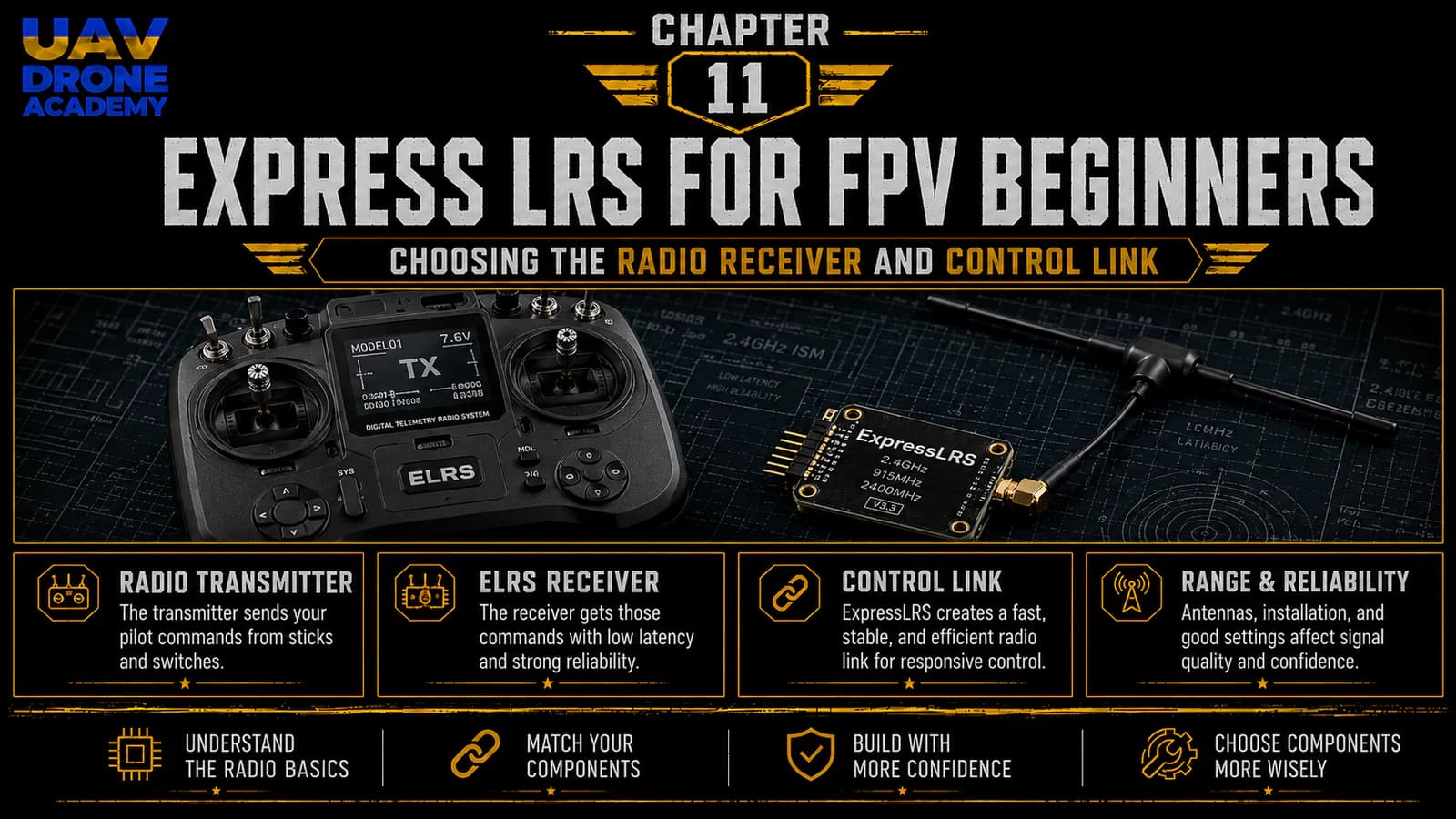
ExpressLRS (ELRS)
In this chapter, we will understand:
- what ExpressLRS actually is
- why it became so popular
- how radio systems work
- why ELRS is currently one of the best options for beginners
What Is a Radio Link?
The radio link is the wireless control system connecting:
- the radio controller in the pilot’s hands
- to the receiver installed inside the drone
The process works like this:
Pilot Moves the Sticks
↓
Radio Controller Sends Commands
↓
Receiver Inside the Drone Receives the Signal
↓
Flight Controller Processes the Commands
↓
Drone Reacts
This entire process happens continuously during flight.
Why Low Latency Matters
FPV flying depends heavily on:
low latency
Latency means:
delay between pilot input and drone response
High latency makes the drone feel:
- delayed
- disconnected
- unpredictable
Low latency makes the drone feel:
- responsive
- precise
- connected to the pilot
That is one reason modern radio systems became so advanced.
What Is ExpressLRS?
ExpressLRS, usually called:
ELRS
is an open-source radio communication protocol designed specifically for:
- low latency
- high reliability
- excellent range
- modern FPV performance
Over the past few years, ELRS rapidly became:
the modern FPV standard
especially for freestyle and long-range FPV.
Why ELRS Became So Popular
Before ELRS, FPV pilots commonly used:
- FrSky
- Crossfire
- FlySky
- Spektrum
- other older radio systems
Many of those systems still work.
But ELRS introduced major advantages:
- lower latency
- excellent range
- strong signal penetration
- lower cost
- active development
- open-source flexibility
That combination changed the FPV industry very quickly.
Open-Source Development
One reason ELRS evolved so fast is because it is:
open-source
This means:
- developers worldwide contribute improvements
- bugs are fixed rapidly
- firmware evolves continuously
The FPV community heavily supports ELRS today.
Understanding Radio Frequency Bands
ELRS commonly operates on:
- 2.4GHz
- 900MHz
Both have advantages.
2.4GHz ELRS
This became the most common ELRS setup for freestyle FPV.
Advantages:
- smaller antennas
- excellent responsiveness
- very low latency
- lightweight hardware
This is exactly what we will use for our beginner build.
900MHz ELRS
900MHz systems prioritize:
- extreme range
- signal penetration
- long-range applications
But they also:
- use larger antennas
- reduce update speed slightly
- are less common for beginner freestyle drones
Why We Are Choosing 2.4GHz ELRS
Our beginner build prioritizes:
- freestyle learning
- simplicity
- low latency
- lightweight hardware
2.4GHz ELRS fits this perfectly.
It became one of the best all-around solutions for:
- freestyle FPV
- beginner builds
- modern FPV ecosystems
What Is a Receiver?
The:
receiver
is the small component installed inside the drone.
Its job is to:
- receive radio commands from the pilot
- forward those commands to the flight controller
Without the receiver:
the drone cannot receive pilot input.
Why Modern ELRS Receivers Are So Popular
Modern ELRS receivers are:
- very small
- lightweight
- affordable
- highly capable
Many beginner builds use compact receivers like:
- EP1
- EP2
- RP1
- RP2
These receivers became extremely popular because they offer:
- reliability
- simplicity
- excellent performance
Receiver Antennas Matter
Even though ELRS is highly reliable, antenna quality and placement still matter.
Bad antenna placement can reduce:
- signal quality
- range
- penetration
That is why antenna mounting becomes important later during assembly.
What Is Packet Rate?
Another common ELRS term is:
packet rate
This describes how frequently control data is transmitted between:
- the radio controller
- the drone
Higher packet rates usually provide:
- faster response
- lower latency
But they may slightly reduce:
- maximum range
- signal robustness
Why Beginners Should Keep Things Simple
ELRS allows many advanced adjustments.
But beginners do not need to obsess over:
- maximum packet rates
- advanced telemetry tuning
- complex RF settings
Modern ELRS defaults are already extremely good.
For beginners:
reliability matters more than chasing tiny performance differences.
What Is Telemetry?
Telemetry is data sent:
from the drone back to the radio controller
This may include:
- battery voltage
- signal quality
- GPS information
- link statistics
Telemetry helps the pilot monitor system health during flight.
Understanding Failsafe
One of the most important safety concepts in FPV is:
failsafe
Failsafe activates if:
- the radio signal is lost
- communication fails
- the receiver stops receiving commands
Modern FPV systems are designed to react safely during signal loss.
This helps reduce:
- flyaways
- uncontrolled crashes
- dangerous behavior
Why ELRS Is Excellent for Beginners
ELRS aligns extremely well with our project philosophy.
It offers:
- low cost
- strong reliability
- huge community support
- future scalability
- modern compatibility
This makes it one of the best beginner-friendly radio systems available today.
The Importance of Community Adoption
One reason we continue choosing highly popular systems is:
support availability
Because ELRS became so widely adopted, beginners gain access to:
- tutorials
- troubleshooting guides
- firmware updates
- community support
- hardware compatibility
That dramatically reduces frustration during learning.
Choosing a Radio Controller
The receiver alone is not enough.
The pilot also needs a compatible:
radio controller
Modern ELRS-compatible radios became extremely popular because they offer:
- affordability
- modularity
- strong firmware ecosystems
Popular beginner-friendly options include:
- Radiomaster Boxer
- Radiomaster Pocket
- Radiomaster TX16S
- Jumper radios
Why Radiomaster Became Extremely Popular
Radiomaster radios became highly respected because they provide:
- excellent value
- OpenTX/EdgeTX support
- ELRS compatibility
- strong community adoption
For beginners, this creates a much smoother learning path.
Internal ELRS vs External Modules
Some radios include:
internal ELRS modules
Others require:
external ELRS modules
For beginners:
internal ELRS radios are usually simpler
They reduce:
- complexity
- setup steps
- additional hardware
Why Signal Reliability Matters More Than Extreme Range
Many beginners become obsessed with:
- maximum range
- ultra-long-distance flying
But for learning FPV:
- stable control
- predictable behavior
- reliable connection
matter far more.
Our beginner build prioritizes:
reliable freestyle-range performance
not extreme long-range operation.
Common Beginner Mistakes
Mixing Incompatible Protocols
Not all radios and receivers communicate automatically.
Always verify:
- ELRS compatibility
- frequency matching
- firmware compatibility
Obsessing Over Maximum Range
Most beginners do not need extreme long-range systems immediately.
Reliable nearby flying is far more important.
Ignoring Antenna Placement
Bad antenna mounting can significantly reduce:
- signal quality
- penetration
- overall reliability
Overcomplicating ELRS Settings
Modern ELRS works extremely well with default configurations.
Beginners should focus on:
- stable operation
- proper setup
- understanding the fundamentals
What We Want in Our Beginner Build
Our ideal radio link should be:
Reliable
Consistent connection during learning flights.
Beginner Friendly
Easy setup and strong community support.
Modern
Compatible with current FPV ecosystems.
Affordable
Reasonable entry cost.
Upgrade Ready
Capable of supporting future projects later.
ELRS fits all these goals extremely well.
Our Build Philosophy Moving Forward
At this point, the logic behind our project should feel very clear.
We prioritize:
- simplicity
- reliability
- accessibility
- repairability
- long-term learning
That creates a much stronger beginner FPV foundation than chasing extreme specifications too early.
Conclusion
The radio link is what connects the pilot directly to the aircraft.
Without it, FPV flight would not exist.
Modern ELRS systems became extremely popular because they offer:
- low latency
- strong reliability
- excellent range
- affordability
- huge community support
For beginners, ELRS provides one of the best combinations of:
- simplicity
- performance
- future scalability
- learning potential
That is exactly why we are using it in our beginner-friendly 5-inch FPV project.
Now that we understand how the pilot communicates with the drone, the next step is understanding the system that powers the entire aircraft:
the battery system.
Next Chapter
FPV Batteries Explained: Choosing the Right 6S LiPo for a 5-Inch Drone