If there is one FPV topic that confuses almost every beginner, it is motors.
The moment you start searching for FPV motors online, you immediately encounter terms like:
- 1750KV
- 1950KV
- 2306
- 2207
- stator size
- torque
- efficiency
- thrust curves
- 4S
- 6S compatibility
At first, this can feel extremely technical.
But the good news is:
Understanding FPV motors is much easier than it looks.
In fact, most beginner confusion comes from trying to memorize specifications without first understanding the basic concepts.
That is exactly what we will fix in this chapter.
Our goal here is not turning you into a motor engineer.
Instead, we want to understand:
- what FPV motors actually do
- what KV really means
- how motor size affects flight behavior
- why 6S systems became so popular
- what makes a good beginner motor setup
By the end of this chapter, you will be able to look at FPV motors and understand what you are actually seeing instead of reading random numbers without context.
What FPV Motors Actually Do
The motors are responsible for generating rotational force.
That rotational force spins the propellers.
The propellers then push air downward and generate:
Thrust.
Thrust is what allows the drone to:
- lift off
- accelerate
- maneuver
- stabilize itself
Without motors, the drone cannot produce movement.
Why FPV Motors Are Special
FPV drones use:
Brushless motors
Brushless motors became the industry standard because they are:
- powerful
- efficient
- durable
- responsive
- lightweight
Compared to traditional brushed motors, brushless systems provide:
- smoother operation
- better efficiency
- much higher performance
That is exactly what FPV requires.
Understanding Motor Naming
One of the first confusing things beginners notice is motor naming.
You see names like:
- 2207
- 2306
- 2205
These numbers describe:
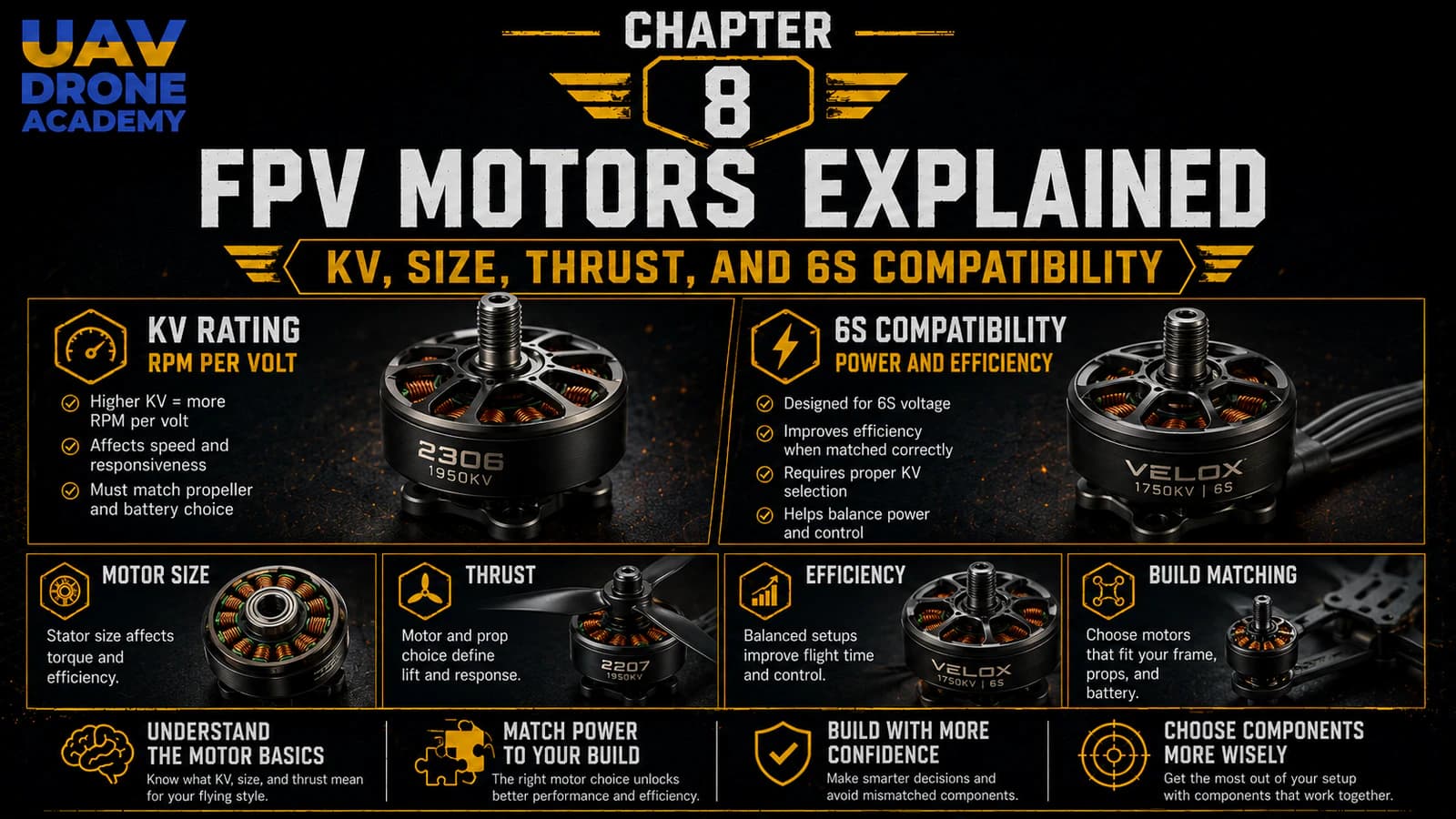
Stator size.
The stator is the stationary internal part of the motor responsible for generating magnetic force.
How Motor Numbers Work
Example:
2306 motor
This means:
- 23 mm stator diameter
- 6 mm stator height
The first two digits represent:
Diameter.
The last two digits represent:
Height.
Why Stator Size Matters
Motor size affects:
- torque
- responsiveness
- efficiency
- heat generation
- propeller control
Different motor sizes create different flight characteristics.
Larger Diameter Means More Torque
Wider motors generally produce:
- stronger torque
- better propeller control
- smoother throttle response
This helps especially with:
- aggressive freestyle
- larger propellers
- heavier builds
Taller Motors Mean More Power Delivery
Taller stators can improve:
- sustained power
- acceleration
- aggressive throttle response
But they may also:
- consume more power
- generate more heat
Common 5-Inch Motor Sizes
The most common 5-inch freestyle motor sizes include:
- 2207
- 2306
- 2306.5
These became extremely popular because they provide:
- excellent balance
- smooth freestyle behavior
- strong control authority
- efficient 5-inch performance
What Is KV?
KV is one of the most misunderstood concepts in FPV.
Many beginners incorrectly assume:
“Higher KV means more power.”
Not exactly.
KV describes:
Motor RPM per volt.
Example:
A 1800KV motor will theoretically spin:
1800 RPM per volt applied, without propeller load.
Understanding KV More Simply
Higher KV motors:
- spin faster
- react more aggressively
- generate more RPM
Lower KV motors:
- spin slower
- produce smoother behavior
- usually improve efficiency
Why KV Must Match Battery Voltage
This is extremely important.
Motor KV must match the battery system.
Common FPV battery systems include:
- 4S
- 6S
Higher voltage batteries already increase motor RPM significantly.
That means:
6S systems require lower KV motors.
Typical KV Ranges
4S 5-Inch Builds
Usually:
2300KV–2700KV
6S 5-Inch Builds
Usually:
1700KV–2000KV
Why We Are Using 6S
Modern FPV increasingly moved toward:
6S systems
because they provide:
- smoother throttle behavior
- better efficiency
- lower current draw
- improved power consistency
Why Lower Current Matters
Higher voltage systems produce the same power using:
Less electrical current.
Lower current reduces:
- ESC stress
- heat generation
- voltage sag
- electrical inefficiency
That is one reason 6S became so popular.
Why 6S Feels Smoother
Many pilots describe 6S as:
- smoother
- more controlled
- more linear
The throttle response tends to feel less aggressive and more predictable compared to high-KV 4S systems.
This is excellent for beginners learning throttle control.
What Is Torque?
Torque is the motor’s rotational force.
In practical FPV terms:
- more torque improves propeller control
- more torque improves responsiveness
- more torque helps maintain stability during aggressive maneuvers
Torque matters heavily during:
- freestyle recovery
- fast throttle changes
- prop wash handling
What Is Prop Wash?
Prop wash happens when turbulent air disrupts clean airflow over the propellers.
This often occurs during:
- sharp turns
- dives
- rapid direction changes
Better motors with stronger torque usually handle prop wash more effectively.
Why Motor Quality Matters
Not all motors are equally good.
Better motors often provide:
- smoother bearings
- better balancing
- tighter tolerances
- improved efficiency
- lower vibration
This directly affects:
- flight feel
- reliability
- tuning quality
- motor lifespan
Why We Are Avoiding Extreme Motor Setups
Some FPV builds prioritize:
- extreme speed
- maximum thrust
- racing acceleration
But our beginner philosophy is different.
We want:
- smooth control
- predictable handling
- balanced efficiency
- durability
- manageable power
Too much power can actually make learning harder.
What We Want in Our Beginner Build
For this project, our ideal motors should be:
Reliable
Consistent performance matters more than extreme specifications.
Widely Available
Easy replacement is important.
Efficient
Good flight time and manageable temperatures.
Smooth
Predictable throttle behavior for beginners.
Compatible with 6S
Balanced performance without excessive aggressiveness.
Popular Beginner-Friendly Motor Brands
Several motor brands became highly respected in FPV because of:
- reliability
- value
- strong community support
Popular beginner-friendly choices include:
- EMAX ECO II
- Xing E-Pro
- T-Motor Velox
- iFlight Xing
- RCinPower
These motors provide excellent value for learning builds.
Why Extremely Cheap Motors Can Be Problematic
Very cheap motors may suffer from:
- poor bearings
- bad balancing
- excessive vibration
- weak shafts
- inconsistent quality control
This can create:
- unstable flight
- tuning frustration
- premature failures
Reliable motors save significant frustration later.
Common Beginner Mistakes
Choosing Motors Only Based on KV
KV alone does not define:
- quality
- torque
- smoothness
- efficiency
The entire motor design matters.
Buying Overpowered Motors
Too much power can make:
- throttle control harder
- crashes more violent
- learning more intimidating
Balanced setups teach faster.
Ignoring Weight and Efficiency
Very aggressive setups often:
- consume more battery
- overheat faster
- reduce flight time
For beginners, consistency matters more than extreme performance.
Our Build Philosophy Moving Forward
At this point, our drone philosophy should be becoming very clear.
We prioritize:
- balance
- control
- simplicity
- repairability
- learning efficiency
Not extreme specifications.
That creates a much better long-term learning platform.
Conclusion
FPV motors are much more than spinning components.
They directly influence:
- flight feel
- throttle response
- efficiency
- stability
- overall drone behavior
Understanding:
- stator size
- KV
- torque
- 6S compatibility
is one of the most important steps in understanding how FPV drones actually fly.
For beginners, the best motors are not the most powerful.
They are the ones that create:
- smooth control
- predictable handling
- reliability
- a strong learning experience
Now that we understand the components responsible for generating thrust, the next step is understanding the parts that actually transform that thrust into flight behavior: the propellers.
Next Chapter
FPV Propellers Explained: How Props Affect Control, Efficiency, and Flight Feel