At first glance, FPV propellers may seem like one of the simplest parts of the drone.
After all, they are just small plastic blades attached to the motors.
But in reality:
Propellers are one of the most important tuning components in the entire FPV system.
Small propeller changes can completely alter:
- flight feel
- throttle response
- efficiency
- smoothness
- battery consumption
- noise
- overall control behavior
In fact, two identical drones with different propellers can feel like completely different aircraft.
That is why experienced FPV pilots often experiment with multiple propeller types until they find the exact flight characteristics they want.
For beginners, however, the goal is much simpler.
We want to understand:
- how propellers work
- what the numbers mean
- how propellers affect flight
- which types make the most sense for a beginner-friendly 5-inch build
Fortunately, propellers are much easier to understand once the basic concepts become clear.
What Propellers Actually Do
The propellers are responsible for converting motor rotation into:
Thrust.
When the motors spin the propellers:
- the blades push air downward
- downward airflow generates lift
- lift allows the drone to fly
Without propellers:
- the motors could spin freely
- but the drone would never leave the ground
Why Propellers Matter So Much
The propellers directly influence:
- acceleration
- responsiveness
- efficiency
- motor load
- battery consumption
- flight smoothness
Even tiny changes in propeller design can create noticeable differences in flight behavior.
That is why propellers are often called:
The “feel” component of FPV.
Understanding Propeller Naming
One of the first confusing things beginners notice is propeller naming.
You may see names like:
- 51433
- 51466
- 5040
- 5130
At first, these numbers look random.
But they actually describe:
- diameter
- pitch
- blade configuration
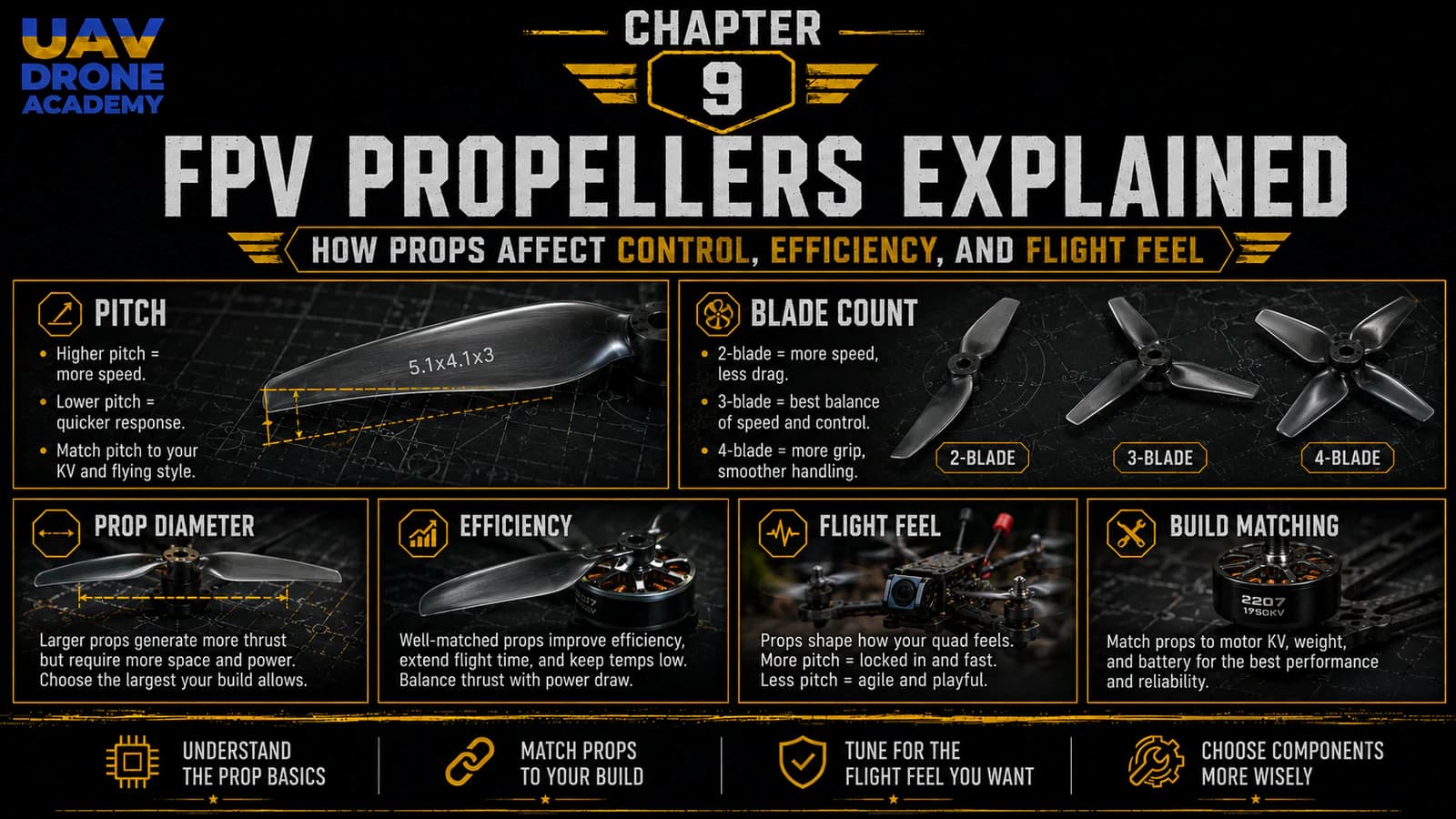
Understanding Propeller Size
Example:
51433
Usually means:
- 5-inch diameter
- 4.33 pitch
The first two digits generally represent:
Diameter.
The remaining numbers represent:
Pitch.
Diameter Explained
The diameter defines the overall propeller size.
For 5-inch FPV drones:
5-inch propellers are standard.
Larger propellers usually:
- generate more thrust
- improve efficiency
- require more motor torque
Smaller propellers generally:
- react faster
- feel lighter
- consume less power
What Is Pitch?
Pitch is one of the most important propeller characteristics.
Pitch describes:
How aggressively the propeller moves air.
Higher pitch propellers:
- push more air per rotation
- feel more aggressive
- generate stronger acceleration
Lower pitch propellers:
- feel smoother
- improve control precision
- reduce motor stress
- improve efficiency
Higher Pitch Is Not Automatically Better
Many beginners assume:
“More aggressive props means better performance.”
Not necessarily.
Very aggressive propellers can:
- overload motors
- reduce flight time
- generate excessive heat
- create difficult throttle control
For beginners, smoother control is usually more important than maximum aggression.
Understanding Blade Count
FPV propellers also vary in:
Blade count.
The most common configurations are:
- bi-blade
- tri-blade
- quad-blade
Bi-Blade Propellers
Bi-blades use:
Two blades.
Advantages:
- very efficient
- lower motor load
- longer flight times
Disadvantages:
- less grip
- less responsive handling
- reduced control authority
Today, bi-blades are less common in freestyle FPV.
Tri-Blade Propellers
Tri-blades use:
Three blades.
This became the modern standard for freestyle FPV.
Advantages:
- excellent grip
- balanced control
- strong responsiveness
- smooth handling
This is exactly what we want for our beginner freestyle build.
Quad-Blade Propellers
Quad-blades use:
Four blades.
Advantages:
- extremely strong grip
- aggressive response
Disadvantages:
- higher battery consumption
- increased motor load
- reduced efficiency
These are less common today for beginner freestyle drones.
Why Tri-Blades Became So Popular
Tri-blade propellers offer one of the best balances between:
- responsiveness
- efficiency
- control
- smoothness
That is why most modern 5-inch freestyle drones use:
Tri-blade propellers
especially for beginner and freestyle builds.
How Propellers Affect Flight Feel
Different propellers create very different flight behavior.
This is one reason experienced pilots often experiment heavily with props.
Aggressive Propellers
Higher pitch aggressive props usually feel:
- faster
- more reactive
- more powerful
But they also:
- consume more battery
- stress motors more
- create rougher throttle behavior
Smooth Propellers
Lower pitch smoother props usually feel:
- softer
- more predictable
- easier to control
- more efficient
This is often ideal for beginners.
Propeller Weight Matters Too
Heavier propellers require:
- more motor torque
- more power
- more braking force
Lighter propellers usually:
- react faster
- reduce motor stress
- improve efficiency
But they may also feel less locked in during aggressive maneuvers.
Why Propellers Break Frequently
Propellers are designed to be:
Sacrificial components.
This means they intentionally absorb crash energy.
It is much better to break:
A cheap propeller
than:
- a motor
- a frame arm
- expensive electronics
That is why FPV pilots always carry:
Lots of spare propellers.
Bent Props vs Broken Props
Sometimes propellers:
- chip
- bend
- crack slightly
Even small damage can create:
- vibrations
- unstable flight
- poor video quality
- motor stress
When in doubt:
Replace the propeller.
Props are cheap. Motors and electronics are not.
Propeller Direction
FPV drones use:
- clockwise props
- counterclockwise props
This is necessary to balance rotational forces.
Incorrect propeller installation prevents proper flight.
Fortunately, Betaflight makes motor direction verification relatively simple later in the build process.
Common Propeller Materials
Most FPV propellers are made from:
Polycarbonate.
This material offers:
- flexibility
- durability
- low cost
- good impact resistance
Different blends create slightly different characteristics:
- softer props
- stiffer props
- more durable props
Popular FPV Propeller Brands
Several propeller brands became extremely respected in the FPV community.
Popular options include:
- Gemfan
- HQProp
- DALProp
These companies produce:
- reliable
- affordable
- high-performance FPV props
Why We Are Avoiding Extreme Prop Setups
Some racing setups use:
- ultra-high pitch props
- highly aggressive blade profiles
But for our beginner build, we prioritize:
- control
- smoothness
- predictability
- efficiency
This creates a much better learning experience.
What We Want in Our Beginner Build
For this project, our ideal propellers should be:
Smooth
Predictable throttle response.
Efficient
Reasonable flight time and manageable heat.
Durable
Able to survive beginner crashes.
Widely Available
Easy replacement is important.
Balanced
Good freestyle behavior without excessive aggressiveness.
Why Propellers Are Great for Experimentation
One of the best things about FPV propellers is:
They are inexpensive.
This makes them perfect for experimentation later.
As your skills improve, you can test:
- different pitches
- blade counts
- stiffness levels
- aggressive vs smooth setups
This helps develop personal flight preferences over time.
Common Beginner Mistakes
Using Damaged Propellers
Bent or chipped props create:
- vibrations
- instability
- tuning problems
Always inspect props carefully after crashes.
Buying Extremely Aggressive Props Too Early
Aggressive props can make:
- throttle control harder
- battery consumption worse
- beginner flying more intimidating
Balanced setups teach faster.
Ignoring Propeller Orientation
Incorrect prop direction prevents proper stabilization.
Always verify:
- prop direction
- motor direction
- installation orientation
Our Build Philosophy Moving Forward
At this stage, the philosophy behind our project should feel very consistent.
We prioritize:
- smooth control
- balanced behavior
- repairability
- predictable handling
- beginner-friendly learning
Not extreme performance.
This creates a much stronger long-term FPV foundation.
Conclusion
Propellers may look simple, but they heavily influence:
- flight feel
- responsiveness
- efficiency
- motor load
- overall drone behavior
Understanding:
- diameter
- pitch
- blade count
- propeller characteristics
helps transform FPV from confusing hardware into a logical and understandable system.
For beginners, balanced tri-blade propellers provide one of the best combinations of:
- control
- smoothness
- efficiency
- durability
Now that we understand how the drone generates thrust and how propellers shape flight behavior, the next step is understanding the system that allows the pilot to actually see from the drone’s perspective: the FPV video system.
Next Chapter
Analog FPV System Explained: Choosing the Camera, VTX, and Antenna