You finally sit down to order your first set of propellers, and the store listing says 5.1×4.1×3. No explanation. No diagram. Just three numbers, as if everyone was born knowing what they mean. Understanding propeller size and pitch is one of those small skills that separates people who copy shopping lists from people who actually understand their drone. The good news: the code is simple, and once you can read it, you can read every prop on the market.
In this lesson we decode the spec, look at what each number does to your drone's behavior, and pick a sensible starting point for a beginner 5-inch build.
What Does 5.1×4.1×3 Mean on a Propeller?
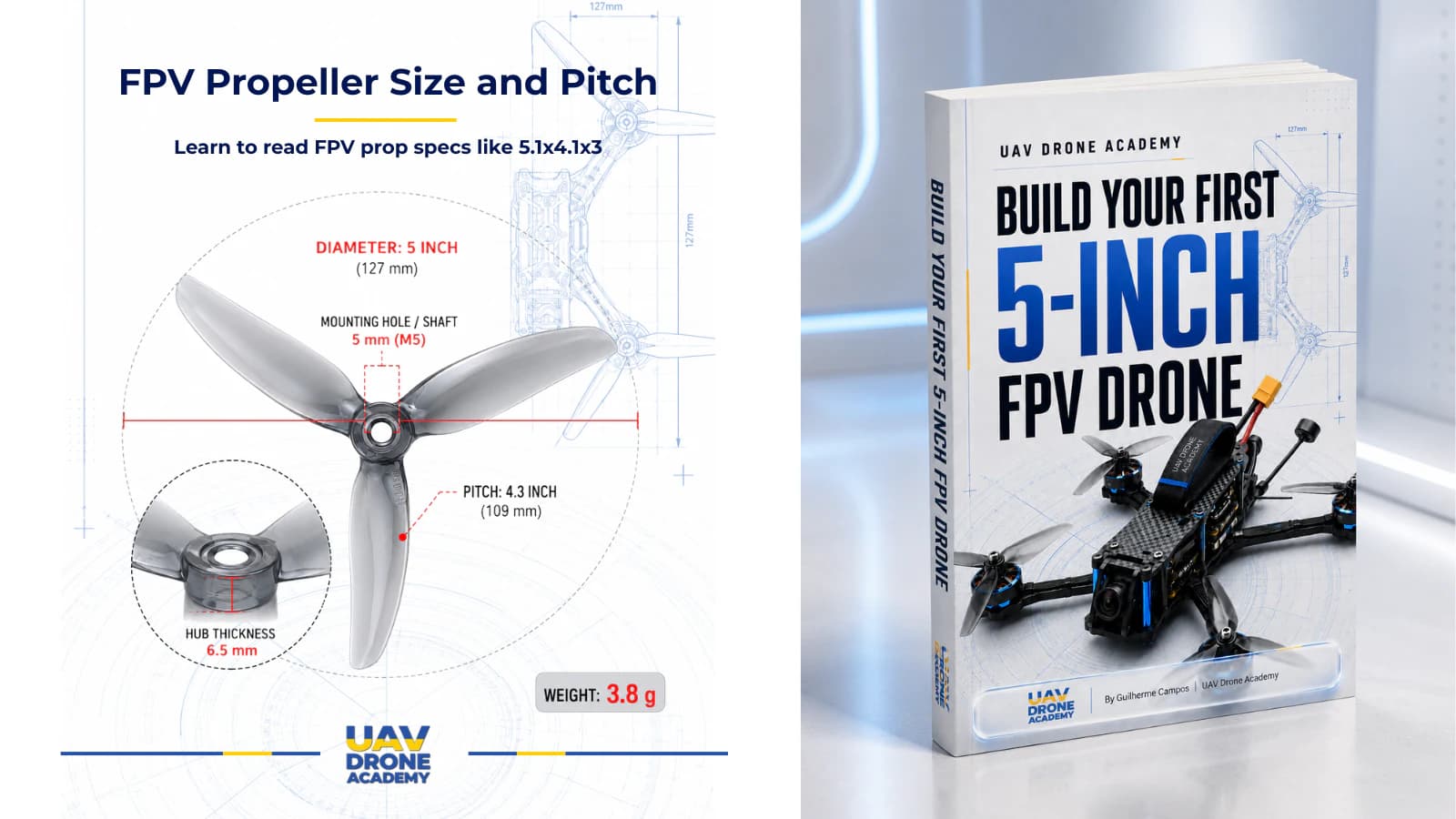
Every FPV propeller spec follows the same pattern: diameter × pitch × blade count. So 5.1×4.1×3 means a propeller that is 5.1 inches in diameter (about 130 mm), with 4.1 inches of pitch (about 104 mm), and 3 blades. That is the entire code. Diameter tells you how big the circle is, pitch tells you how aggressively the blades bite the air, and the last number tells you how many blades do the biting.
You will also see the compressed version of the same idea. A prop marked 51433 is a 5.1-inch diameter, 4.3-inch pitch, 3-blade prop. Same information, fewer characters, slightly more cryptic. Manufacturers use both formats interchangeably, so it helps to recognize each one on sight.
One detail worth knowing: the FPV world measures props in inches, even in countries that use metric for everything else. It is a convention inherited from aviation, and fighting it is pointless. Learn to think in inches for props, and life gets easier.
Diameter: How Big the Circle Is
Diameter is the full width of the circle the blade tips trace as the prop spins. It is the most physical of the three numbers, because it is limited by your frame. A 5-inch frame is designed around 5-inch props, with just enough clearance between the prop tips and everything else. Put a bigger prop on it and the blades hit the frame or each other. Not a theory. A guarantee.
A larger diameter moves more air per rotation, which means more thrust at lower RPM. A smaller diameter moves less air but spins up and slows down faster, which makes the drone feel more responsive. This is exactly why the 5-inch class became the sweet spot for freestyle: enough thrust to be powerful, small enough to stay agile. If you want the deeper story of why the whole platform is named after the prop, read what the 5-inch measurement really means.
For your build decisions, diameter is mostly decided for you. You chose a 5-inch frame, so you fly 5-inch props (5.0 or 5.1 in practice). The number you actually get to play with is the next one.
What Is Propeller Pitch?
Pitch is the theoretical distance the propeller would travel forward in one full rotation if the air behaved like a solid. Picture a screw going into wood: one full turn moves it forward by a fixed distance defined by the angle of the thread. A propeller works the same way, except air is not wood. The blades slip, so the real distance is always less than the pitch value. That is why pitch is a comparison tool between props, not a speed measurement.
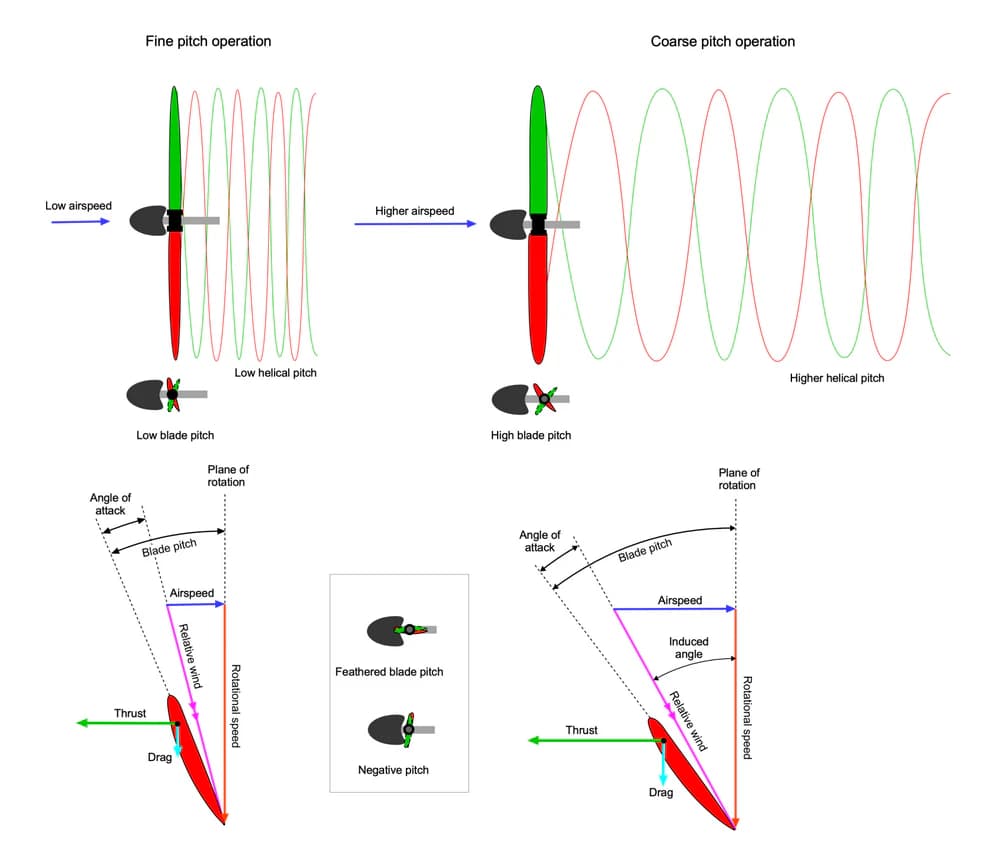
A higher pitch means the blades sit at a steeper angle and take a bigger bite of air with every rotation. More bite means more speed potential, but nothing in engineering is free. A steeper blade is harder to push through the air, so the motor works harder, pulls more current from the battery, and runs hotter. A lower pitch takes smaller, gentler bites: less top speed, but smoother throttle control and less strain on the whole power system.
Here is how pitch feels on a typical 5-inch build:
| Pitch (5-inch props) | Flight character | Motor and battery load |
|---|---|---|
| Lower pitch | Smooth, controllable, forgiving at low throttle | Lighter |
| Mid pitch | Balanced speed and control | Moderate |
| Higher pitch | Aggressive, fast, punchy | Heavier |
If you remember one thing from this whole article, make it this: pitch is the personality of the propeller. Two props with identical diameter and blade count but different pitch will make the same drone feel like two different aircraft.
Blade Count: Two, Three, or Four
The third number is the simplest. More blades means more total blade surface gripping the air, which gives you better cornering grip and smoother control, at the cost of efficiency. Every blade you add is more drag the motor has to fight.
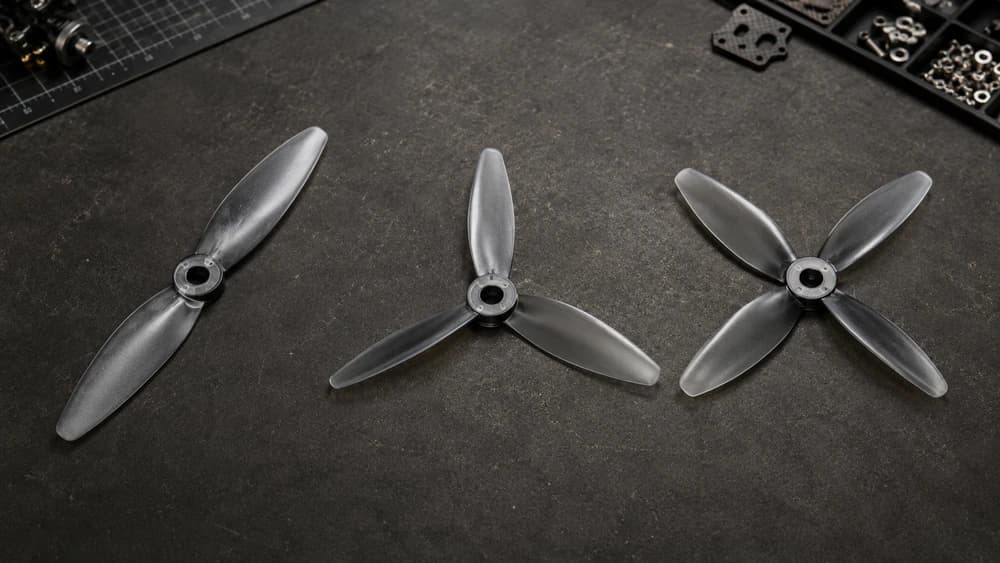
| Blades | Grip and control | Efficiency | Typical use |
|---|---|---|---|
| 2 | Lower | Highest | Long-range and endurance builds |
| 3 | High | Balanced | Freestyle and racing, the standard |
| 4 | Highest | Lower | Cinematic builds chasing smoothness |
Three blades is the default in the 5-inch world for a reason. It is the balance point between grip, efficiency, and predictable handling. As a beginner, you do not need to think hard about this number. Fly tri-blades, and revisit the question later when you know what your flying style actually is.
Why Propeller Size and Pitch Work as a System
Here is where beginners get into trouble. The propeller spec is not just a description of the prop. It is a promise about how much load you are about to put on your motors, ESCs, and battery. A prop with more diameter, more pitch, or more blades demands more torque from the motor. Ask for too much and the motor pulls excessive current, heats up, and in the worst case cooks itself or the ESC.
This is why motor manufacturers publish recommended prop ranges for each motor, and why you should respect them. The prop is the cheapest component in the power chain and the one that decides how hard every other component has to work. A three-dollar piece of plastic gets to boss around your entire electronics stack. Engineering has a sense of humor like that.
The practical rule: change one variable at a time. If your drone feels sluggish, a small step up in pitch is a reasonable experiment. If your motors come back hot after every flight, step the pitch down. Never jump from a mild prop to an aggressive one in a single move and expect the rest of the system to shrug it off.
What Props Should a Beginner Use?
For a first 5-inch build, a mid-pitch tri-blade is the honest answer. Something like a 5.1×4.1×3 or a 5×4.3×3 gives you enough authority to learn real flying without punishing your motors or draining your battery in record time. These specs are popular precisely because they are forgiving: smooth low-throttle behavior for learning, enough top end that you will not outgrow them in a week.
Skip the temptation to buy the highest-pitch racing prop you can find. High pitch on a beginner build means twitchy throttle response, faster battery sag, hotter motors, and a drone that gets away from you exactly when you least want it to. Speed is a skill you grow into, not a spec you buy.
And buy plenty of sets. Props are consumables. Props are usually the first thing to break in any crash, and as a beginner, crashing is part of your job description. A damaged or bent prop causes vibration and strange flight behavior, so replace questionable props instead of flying them.
Common Beginner Mistakes with Props
The first classic mistake is mixing props. All four propellers must be identical: same model, same size, same pitch, ideally the same batch. Mixing specs creates unbalanced thrust and vibration that no software tune can fix.
The second is ignoring pitch entirely and buying on price or looks. Two props can look nearly identical on a store page and fly completely differently because of half an inch of pitch. Read the numbers, not the photos.
The third is over-propping: putting an aggressive high-pitch prop on a setup that was never designed for it. The drone might fly, but the motors and ESC pay the bill in heat. If your motors are too hot to touch comfortably after a flight, your prop choice is part of the conversation.
FAQ: Propeller Size and Pitch
What pitch propeller is best for beginners? A mid-pitch prop in the 4.1 to 4.3 range on a 5-inch tri-blade is a solid starting point. It balances control and speed without overloading a typical beginner power system.
Can high pitch props damage my motors? Indirectly, yes. Higher pitch increases the load on the motor, which increases current draw and heat. On a setup not designed for it, that heat can degrade or destroy motors and ESCs over time. Always check the motor manufacturer's recommended prop range.
What's Next
You now know how to read a prop spec and what each number does to your drone's behavior. The next logical step in the build sequence is the hardware those props attach to: installing your motors the right way, including screw length, wire routing, and the mistakes that cost beginners real money. And remember the golden safety rule from that lesson: propellers only go on at the very end, right before flight. Until then, they stay in the bag.