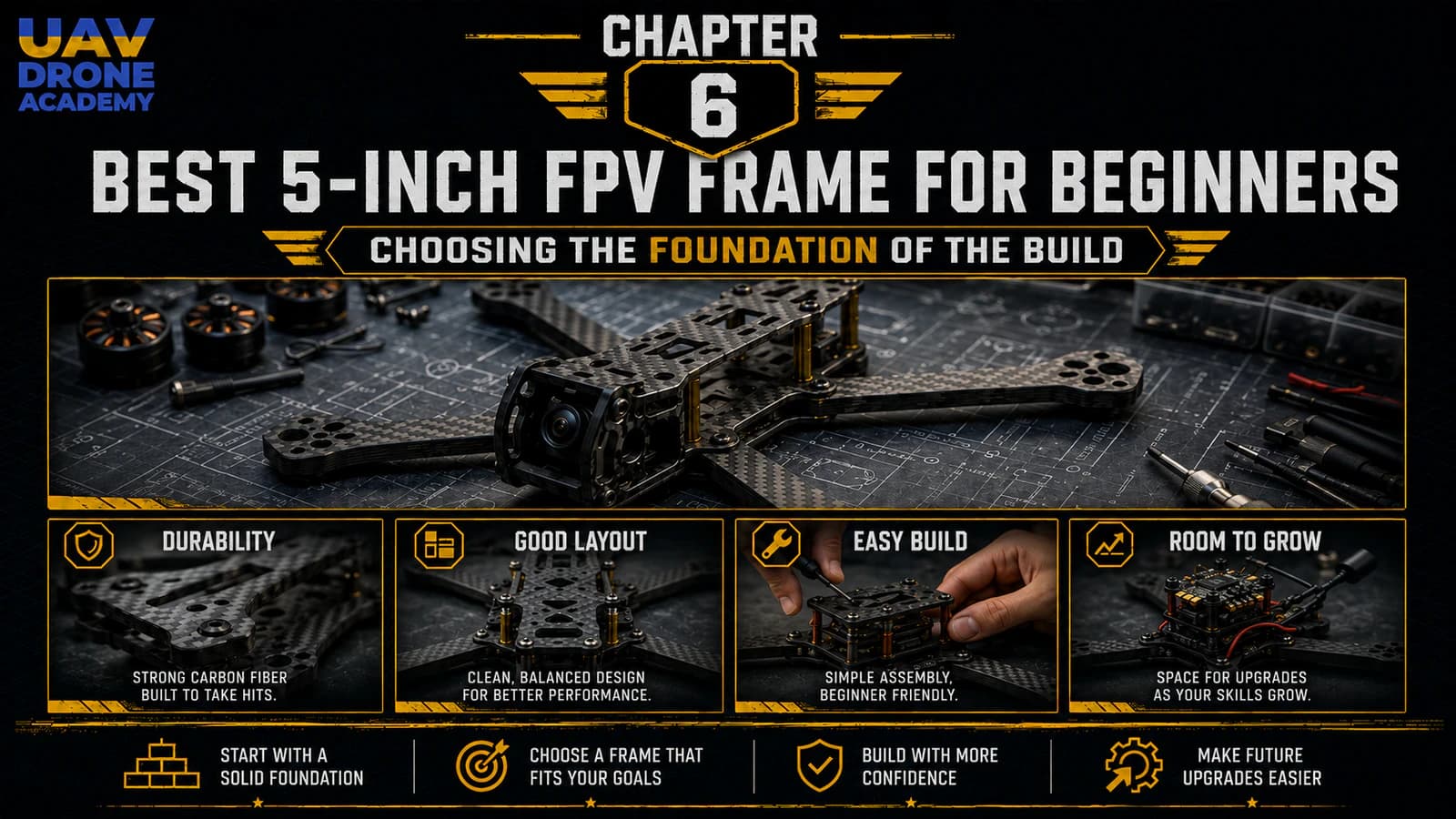
If the flight controller is the brain of the drone, then the frame is the skeleton.
Every major component in the build depends on the frame:
- motors
- electronics
- camera
- antennas
- battery
- propellers
The frame defines:
- the drone’s geometry
- durability
- component compatibility
- weight distribution
- repair difficulty
- flight behavior
That is why choosing the right frame is one of the most important decisions in the entire project.
And for beginners, this decision matters even more.
A bad beginner frame can create:
- difficult maintenance
- weak durability
- vibration issues
- compatibility problems
- frustrating repairs
But a good beginner frame creates:
- easier assembly
- easier repairs
- cleaner layouts
- better durability
- a much smoother learning experience
In this chapter, we will understand:
- how FPV frames work
- the main frame layouts
- what actually matters for beginners
- which type of frame best fits our minimalist 5-inch build philosophy
What Is an FPV Drone Frame?
The frame is the main structural platform of the drone.
Its job is to:
- support the electronics
- hold the motors
- absorb crash forces
- maintain rigidity during flight
Modern FPV frames are usually made from:
Carbon fiber
Carbon fiber became the industry standard because it offers:
- high strength
- low weight
- excellent rigidity
- vibration resistance
Without a good frame, even the best electronics will struggle.
Why the Frame Matters More Than Beginners Think
Many beginners focus almost entirely on:
- motors
- batteries
- video systems
- radio systems
But the frame affects almost everything in the drone.
A poorly designed frame can cause:
- excessive vibrations
- broken arms
- unstable video
- difficult wiring
- cramped electronics
- frustrating maintenance
Meanwhile, a good frame makes the entire build easier.
That is why experienced pilots often care deeply about frame selection.
The Main Goals of a Beginner FPV Frame
For this project, our frame must prioritize:
Durability
Because crashes will happen.
Simplicity
Because beginners need easier assembly and maintenance.
Compatibility
Because we want access to widely available components.
Repairability
Because replacing parts should be fast and affordable.
Community Support
Because popular frames generate more tutorials and troubleshooting information.
These priorities matter more than extreme performance right now.
Understanding Frame Geometry
One of the first things beginners notice is that FPV frames come in different shapes.
The two most common 5-inch layouts are:
- True-X
- Deadcat
Both are excellent.
But they behave slightly differently.
True-X Frames
In a True-X layout:
- the motors are positioned symmetrically
- all arms have similar geometry
- weight distribution stays very balanced
This creates:
- highly responsive handling
- consistent rotational behavior
- very precise freestyle performance
That is why True-X became extremely popular in freestyle FPV.
Advantages of True-X
Balanced Flight Feel
The drone reacts similarly on all axes.
Excellent for Freestyle
Very predictable during flips and rolls.
Strong Community Adoption
Huge number of tutorials and builds available.
Disadvantages of True-X
The front propellers may appear inside the FPV camera view.
This is usually called:
Prop visibility
Some pilots dislike seeing propellers inside the video feed.
Deadcat Frames
Deadcat frames move the front arms outward.
This keeps the propellers outside the camera view.
These frames became popular for:
- cinematic flying
- HD recording
- cleaner footage
Advantages of Deadcat
Cleaner Camera View
Propellers are less visible.
Better for Cinematic Recording
Especially when using action cameras.
Disadvantages of Deadcat
The drone becomes slightly less symmetrical.
This can create:
- slightly different flight characteristics
- slightly less balanced freestyle response
For beginners, however, the difference is usually very small.
Which Geometry Should Beginners Choose?
For our project, both options could work.
But because our build prioritizes:
- learning
- freestyle fundamentals
- balanced flight characteristics
- community support
we will lean slightly toward:
True-X style geometry
This creates the most universal FPV learning platform.
Frame Size and Stack Compatibility
Modern FPV frames are designed around standardized electronics.
The most common stack mounting sizes are:
- 30×30 mm
- 20×20 mm
30×30 mm is the traditional full-size stack format.
20×20 mm is common in compact lightweight builds.
For our beginner build, we will prioritize:
30×30 compatibility
Why?
Because:
- components are easier to work with
- soldering space is larger
- assembly becomes easier
- cooling is better
- compatibility is wider
This matters a lot for beginners.
Frame Thickness and Durability
Not all carbon fiber frames are equally strong.
Arm thickness matters significantly.
Common arm thicknesses include:
- 4 mm
- 5 mm
- 6 mm
For beginners:
Thicker arms are usually better
because they resist crashes more effectively.
A slightly heavier frame is often worth the added durability during the learning phase.
Why Replaceable Arms Matter
Crashes eventually break frames.
That is normal in FPV.
Some cheap frames use:
- single-piece bottom plates
- complicated arm structures
These designs may save weight but become frustrating to repair.
For beginners, replaceable arms are extremely important.
Why?
Because:
- repairs become cheaper
- maintenance becomes faster
- downtime becomes smaller
That is exactly what we want for a learning platform.
Top Beginner-Friendly 5-Inch Frames
Now let’s look at some of the most popular beginner-friendly options in the FPV community.
TBS Source One V5
One of the most recommended beginner frames in FPV.
Why it became popular:
- affordable
- durable
- open-source design
- huge community support
- easy spare part availability
It is an excellent learning platform.
iFlight Nazgul Frame
Popular due to:
- strong durability
- modern geometry
- clean design
- good component spacing
It is very common in prebuilt FPV drones.
GEPRC Mark5
Well-known for:
- premium construction
- clean layout
- smooth freestyle performance
This is a slightly more premium-oriented option.
ImpulseRC Apex EVO
One of the most respected freestyle frames ever made.
Known for:
- exceptional durability
- excellent vibration handling
- premium freestyle performance
However, it is:
- more expensive
- less beginner-budget friendly
What We Actually Want for This Project
Remember our philosophy.
We are not trying to build:
- the lightest drone
- the fastest drone
- the most premium drone
We want:
The best beginner learning platform possible.
That means prioritizing:
- durability
- simplicity
- accessibility
- community support
- repairability
For this reason, frames similar to:
TBS Source One V5
fit extremely well into our project philosophy.
Why Popular Frames Matter
Many beginners underestimate this point.
Popular frames provide:
- more tutorials
- more replacement parts
- more build examples
- easier troubleshooting
- stronger community support
This dramatically reduces frustration during learning.
That is one reason we avoid obscure or highly experimental frames for this build.
Common Beginner Mistakes
Choosing Ultra-Light Racing Frames
These frames prioritize:
- speed
- weight reduction
- aggressive tuning
But they are often:
- fragile
- cramped
- harder to repair
Not ideal for learning.
Choosing Frames Only for Looks
A frame may look amazing online but still:
- repair poorly
- vibrate excessively
- lack spare parts
- complicate assembly
Practicality matters more than aesthetics for beginners.
Buying Cheap Unknown Frames
Very cheap frames often suffer from:
- weak carbon fiber
- poor tolerances
- bad hardware quality
- difficult maintenance
Sometimes spending slightly more saves significant frustration later.
Our Frame Selection Philosophy
For this series, our ideal frame should be:
Durable
Able to survive beginner crashes.
Spacious
Easy to assemble and solder.
Popular
Large community support.
Modular
Easy arm replacement.
Freestyle Friendly
Balanced and predictable flight behavior.
This creates the ideal foundation for the rest of the build.
Conclusion
The frame is much more than a piece of carbon fiber.
It defines:
- durability
- repairability
- layout organization
- flight characteristics
- overall learning experience
For beginners, simplicity and durability matter far more than extreme performance.
That is why our build prioritizes:
- proven geometry
- strong community support
- repairable construction
- beginner-friendly layouts
Now that we have chosen the structural foundation of the drone, the next step is selecting the electronic core of the system: the flight controller and ESC stack.
Next Chapter
Flight Controller and ESC Stack Explained: Choosing the Brain and Power System