After completing the first hover test, the drone has passed one of the most important validation steps in the entire build process.
It lifted off.
It responded to control inputs.
It landed safely.
That is a major achievement.
But a successful hover does not mean the drone is ready for aggressive FPV flying.
The next step is moving from a short hover into a controlled beginner flight.
This is where many new pilots make mistakes.
After seeing the drone fly for the first time, it is very tempting to immediately try:
- fast forward flight
- sharp turns
- freestyle tricks
- high throttle punches
- long flights
- flying through gaps
- switching to full Acro Mode too early
That excitement is completely normal.
But this chapter is about flying smarter.
The goal of your first FPV flight is not to impress anyone.
The goal is to:
- stay calm
- control the drone
- understand how it responds
- avoid avoidable crashes
- land safely
- learn from the flight
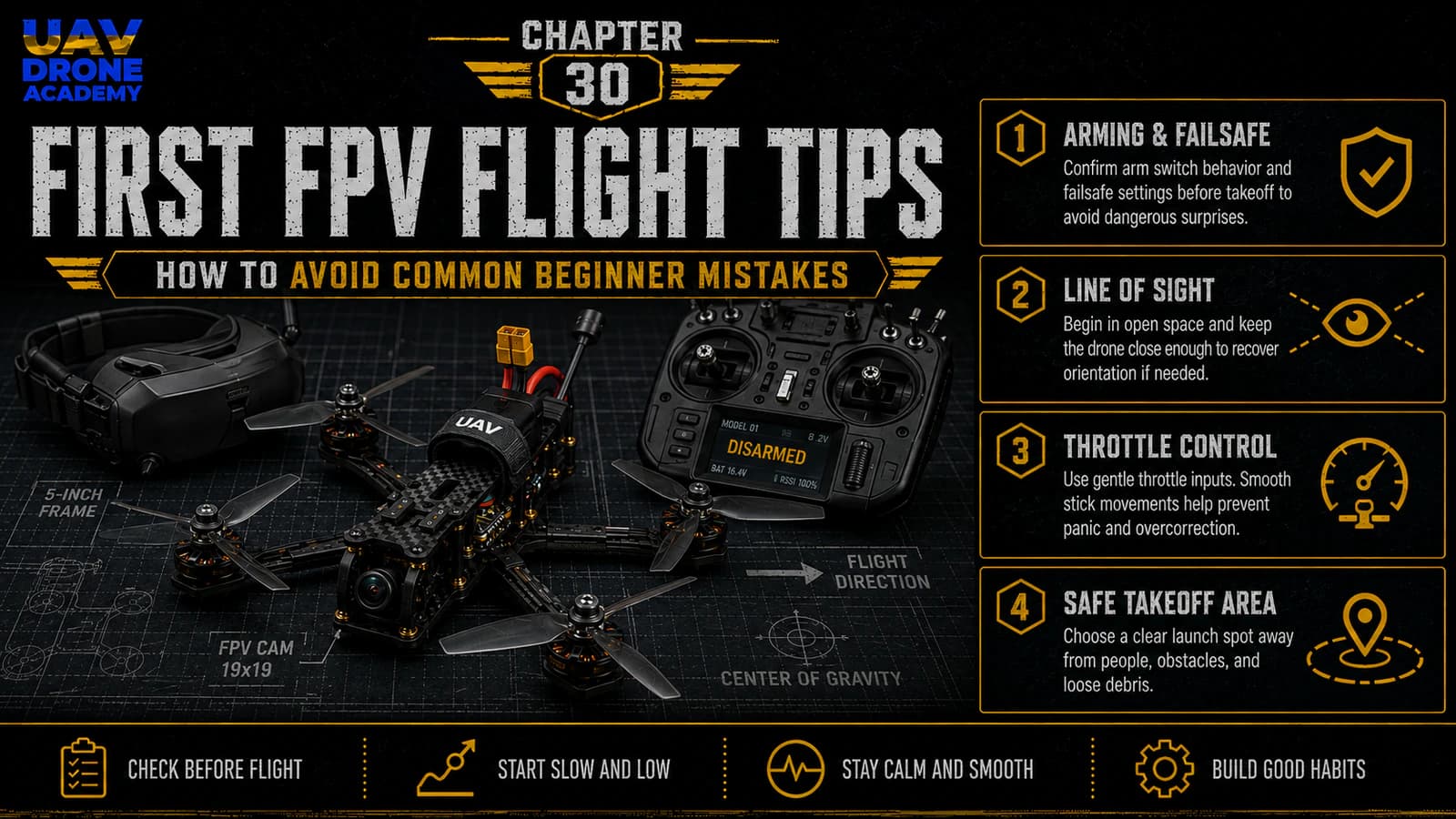
In this chapter, we will cover practical tips to help beginners avoid the most common first-flight mistakes.
The Real Goal of the First FPV Flight
Your first real FPV flight should be treated as a controlled training session.
The goal is not performance.
The goal is:
basic control
During the first flight, you want to practice:
- smooth takeoff
- stable altitude
- gentle turns
- basic forward movement
- controlled stopping
- safe landing
- battery awareness
- emergency disarming if needed
A successful first flight may look boring from the outside.
That is fine.
Boring is good for the first flight.
Boring means the drone survived.
Boring means the pilot stayed in control.
Boring means the build is working.
Do Not Skip Simulator Practice
Before flying a real 5-inch FPV drone seriously, beginners should practice in an FPV simulator.
A simulator helps build:
- stick coordination
- throttle control
- orientation awareness
- turning habits
- recovery skills
- Acro Mode confidence
Simulators are not perfect, but they reduce beginner crashes dramatically.
If you have not practiced in a simulator yet, keep your first real flight extremely simple.
Your real drone is not the best place to learn basic stick movement from zero.
Use the Right Flight Mode
For the first real flight, beginners may choose between:
Angle Mode
Self-leveling mode.
Good for basic hover and orientation practice.
Acro Mode
Manual FPV mode.
Standard for freestyle and real FPV flying.
If you are completely new, Angle Mode can help during early line-of-sight tests.
But if your goal is true FPV freestyle, you will eventually need to practice Acro Mode.
The best strategy is:
use Angle Mode for safety validation, then train Acro Mode progressively
Do not jump into aggressive Acro flying without preparation.
Keep the First Flight Close
Do not fly far away on the first flight.
Stay close enough that:
- you can clearly see the drone
- video signal remains strong
- radio link remains strong
- recovery is easy
- landing area is visible
Avoid the beginner mistake of flying far just because the drone feels stable.
The first flights should happen close, low, and controlled.
Keep the First Flight Low
Do not climb high during the first flight.
Altitude increases risk.
If something goes wrong at high altitude, the crash can be much harder.
For early flights, stay low but not too low.
Too low can cause ground effect and make the drone feel unstable.
A practical beginner range is:
slightly above head height in an open area
This gives enough room to correct small mistakes without creating unnecessary crash energy.
Keep the First Flight Short
Do not drain the battery completely.
The first flight should be short.
Land early.
A short successful flight is better than a long flight that ends in a crash because the battery got too low.
Beginners often lose track of time because FPV feels immersive.
Use your OSD timer and battery voltage.
When in doubt:
land early
Watch Battery Voltage
Battery awareness is one of the most important beginner skills.
During flight, battery voltage drops under load.
This is normal.
But if voltage drops too low, the drone may lose power, sag heavily, or damage the battery.
For beginners, the key is not memorizing every number perfectly.
The key is developing the habit of watching battery voltage and landing before the battery is over-discharged.
Use average cell voltage in the OSD.
It is easier to understand than total pack voltage.
Avoid Full Throttle Punches
A 5-inch FPV drone on 6S has a lot of power.
Beginners often want to test that power immediately.
Do not do that on the first flight.
Full throttle punches can:
- send the drone too high
- disorient the pilot
- drain the battery quickly
- cause voltage sag
- create panic
- lead to hard crashes
Save power testing for later.
The first flight is about control, not maximum thrust.
Use Small Stick Inputs
FPV drones are sensitive.
Large stick movements can quickly create large attitude changes.
Beginners often overcorrect.
For the first flight, use:
- small pitch inputs
- small roll inputs
- gentle yaw
- smooth throttle adjustments
The drone does not need aggressive input to move.
Think smooth, not sharp.
Understand That FPV Drones Do Not Stop Like GPS Drones
Traditional GPS camera drones can stop and hover automatically.
FPV drones are different.
Especially in Acro Mode, the drone will continue moving unless you actively control it.
Beginners sometimes expect the drone to stop by itself.
It will not.
You must manage:
- attitude
- throttle
- momentum
- direction
- braking movement
This is one reason simulator practice is so valuable.
Practice Simple Forward Flight
After a successful hover, the next step is gentle forward flight.
The process is simple:
- Take off.
- Stabilize hover.
- Add a small amount of forward pitch.
- Let the drone move forward slowly.
- Reduce pitch.
- Adjust throttle.
- Turn gently.
- Return toward the open area.
- Land early.
Do not fly toward obstacles.
Do not fly fast.
Do not dive.
Do not chase speed.
Practice Gentle Turns
Turning is one of the most important beginner skills.
In FPV, turns usually involve a combination of:
- roll
- yaw
- pitch
- throttle
Beginners often use too much yaw or too much roll.
Start with slow, wide turns.
A good beginner goal is:
fly large circles in an open area
Large circles teach:
- orientation
- throttle control
- coordinated turning
- smooth movement
Do not start with tight turns.
Avoid Flying Behind Yourself
When learning, keep the drone in front of you.
Avoid flying behind your position.
Flying behind yourself can create:
- orientation confusion
- video signal blockage
- radio signal issues
- panic
- poor recovery options
For the first flights, keep the drone in a simple forward flying zone.
Avoid Obstacles
Do not fly near:
- trees
- buildings
- poles
- wires
- cars
- fences
- people
- animals
- water
Beginners often underestimate how quickly a 5-inch FPV drone moves.
Even small control mistakes can cover distance quickly.
For early flights, space is your best friend.
Avoid Flying Over Water
Do not fly over water during early flights.
Even shallow water can destroy electronics.
A crash over grass is usually recoverable.
A crash into water can end the drone permanently.
Save water shots for much later.
Avoid Tall Grass
Tall grass looks soft, but it creates problems.
It can:
- hide the drone
- wrap around motors
- trap propellers
- make recovery difficult
- increase moisture exposure
- make arming unsafe
Choose short grass, dirt, or a clear landing pad.
Keep the Drone Facing Away at First
During early line-of-sight practice, take off with the drone facing away from you.
This makes controls easier:
- roll right moves right
- roll left moves left
- pitch forward moves away
- pitch back moves toward you
When the drone faces you, controls feel reversed from your perspective.
This can confuse beginners.
Practice nose-away orientation first.
Do Not Panic
Panic causes crashes.
If the drone starts drifting or moving faster than expected, stay calm.
Your options are:
- reduce input
- gain space
- level out if in Angle Mode
- gently reduce throttle
- land
- disarm if necessary
Do not make huge stick movements in panic.
Most beginner crashes become worse because the pilot overreacts.
Learn to Land Early
Landing is a skill.
Do not wait until the battery is low or you are nervous.
A good beginner habit is:
land while everything is still going well
Do not keep flying until something goes wrong.
For early flights, land early, inspect, then fly again if safe.
Practice Disarming Mentally
Before each flight, remind yourself where the Arm switch is.
If something goes wrong, your emergency response is:
disarm
Do not search for the switch during an emergency.
You should know it by muscle memory.
During early flights, keep your finger ready.
Do Not Chase the Drone
If the drone crashes, disarm first.
Then approach.
Do not run toward an armed drone.
Do not pick up the drone while armed.
Do not try to grab it from the air.
Always:
- disarm
- wait for motors to stop
- disconnect battery
- inspect
Watch for Video Signal Problems
If the video becomes noisy, unstable, or starts breaking up, do not fly farther.
Turn back or land.
Analog video usually degrades gradually.
Static is a warning.
Do not ignore it.
Beginner flights should stay close enough for a strong video signal.
Watch for Radio Link Warnings
If your OSD shows radio link warnings or low link quality, land.
Do not keep flying away.
Your control link is more important than continuing the flight.
A short safe flight is always better than losing the drone.
Listen to the Drone
Sound tells you a lot.
A healthy FPV drone should sound relatively smooth and consistent.
Land and inspect if you hear:
- grinding
- sudden vibration
- propeller flutter
- motor squeal
- irregular motor sound
- clicking
- scraping
Do not ignore strange sounds.
Check Motors After Each Early Flight
After each of the first flights, check motor temperature.
Carefully touch each motor after disconnecting the battery.
They may be warm.
They should not be extremely hot.
If one motor is much hotter than the others, stop and investigate.
Possible causes include:
- damaged propeller
- bent shaft
- bad bearing
- loose screw
- tuning issue
- motor screw touching windings
Inspect Propellers Often
Beginners crash and bump props frequently.
Even small propeller damage can cause:
- vibration
- poor flight behavior
- hot motors
- bad video
- unstable control
Inspect props after every crash or rough landing.
Replace damaged props.
Props are cheap.
Electronics are not.
Do Not Fly Battery After Battery Without Inspection
After a successful flight, it is tempting to immediately plug in another battery.
But during early testing, inspect between flights.
Check:
- props
- motor temperature
- battery strap
- wires
- frame screws
- antenna
- XT60 lead
A small issue caught early can prevent a bigger crash later.
Increase Difficulty Slowly
A good progression for first flights is:
Flight 1
Short hover and landing.
Flight 2
Longer hover and small movements.
Flight 3
Gentle forward flight.
Flight 4
Large slow circles.
Flight 5
Figure-eight patterns.
Flight 6
Low-speed FPV cruising.
Only after this should you begin more dynamic flying.
Do not skip progression.
Do Not Copy Advanced FPV Pilots Immediately
Online FPV videos can be inspiring, but they can also create unrealistic expectations.
Advanced pilots have:
- many hours of practice
- simulator experience
- crash experience
- tuning knowledge
- muscle memory
- repair skills
Your first flights should not look like theirs.
That is normal.
The goal is progress, not comparison.
Use DVR if Possible
If your goggles or monitor can record DVR, use it.
DVR footage helps you review:
- flight path
- OSD warnings
- battery voltage
- mistakes
- video signal
- control habits
Even low-quality analog DVR is useful for learning.
After the flight, review the footage calmly.
You will notice things you missed while flying.
Keep a Flight Log
A simple flight log can be very helpful.
After each session, write down:
- battery used
- flight time
- voltage after landing
- any problems
- motor temperature
- crashes
- parts replaced
- settings changed
- lessons learned
This creates a record of your learning process.
It also helps troubleshoot problems later.
Common Beginner Mistakes
Flying Too Far Too Soon
Stay close during early flights.
Distance increases risk.
Flying Too Fast Too Soon
Speed makes mistakes harder to recover from.
Learn control first.
Ignoring Battery Voltage
Low voltage can damage batteries and cause poor performance.
Land early.
Overcorrecting
Use small stick inputs.
Smooth control beats aggressive correction.
Flying Near Obstacles
Trees, wires, buildings, and cars are not beginner-friendly.
Use open space.
Continuing After Something Feels Wrong
If something feels wrong, land.
Do not keep flying just because the drone is still airborne.
Forgetting to Inspect After Landing
Early flights are part of testing.
Inspect after each flight.
Beginner First Flight Checklist
Before takeoff:
- safe open area
- calm weather
- battery charged
- props installed correctly
- radio on
- goggles on
- OSD visible
- Arm switch ready
- correct flight mode selected
- no warnings
- pilot ready to disarm
During flight:
- stay close
- stay low
- use small inputs
- avoid obstacles
- watch battery voltage
- monitor video signal
- keep the flight short
- land early
After landing:
- disarm
- disconnect battery
- check motor temperature
- inspect props
- inspect wires
- inspect battery
- review OSD or DVR
- decide whether another flight is safe
What a Successful First Flight Looks Like
A successful first flight does not need to be impressive.
It may be:
- short
- slow
- cautious
- slightly shaky
- simple
- controlled
That is exactly what we want.
A successful first flight means:
- the drone took off
- pilot stayed in control
- battery was monitored
- no major warnings appeared
- drone landed safely
- post-flight inspection was clean
That is real progress.
What We Have Completed
At this stage, we have moved from a simple hover test into the first controlled FPV flight.
We have learned:
- how to avoid common beginner mistakes
- why short flights are better at first
- why battery awareness matters
- why open space matters
- how to progress slowly
- when to land
- when to disarm
- why inspection after each flight is part of the learning process
The drone has now entered its first real operational phase.
Our Build Philosophy Moving Forward
The main principle remains:
controlled progression
Do not rush.
Do not compare yourself to advanced pilots.
Do not chase tricks before learning control.
A good FPV pilot is built through:
- repetition
- patience
- inspection
- repair
- simulator practice
- controlled real-world flying
The more disciplined your early flights are, the faster you will improve later.
Conclusion
The first FPV flight is a major milestone, but it should be approached carefully.
Beginners should focus on:
- staying close
- flying low
- using small inputs
- watching battery voltage
- avoiding obstacles
- landing early
- inspecting the drone
- gradually increasing difficulty
Most early crashes happen because beginners try to do too much too soon.
The safest and fastest path is simple:
fly short, fly controlled, inspect often, and improve gradually
Now that we know how to perform the first controlled FPV flight and avoid the most common mistakes, the next step is learning what to check after flying.
In the next chapter, we will inspect the drone after the first FPV flight and learn how to identify early signs of problems before they become serious.
Next Chapter
Post-Flight Inspection: What to Check After Your First FPV Flight