One of the biggest reasons beginners feel intimidated by FPV drones is simple:
At first glance, the entire system looks extremely complicated.
You see:
- wires
- antennas
- carbon fiber parts
- electronic boards
- solder joints
- firmware settings
- batteries
- unfamiliar technical terms everywhere
But the truth is much simpler than most people think.
An FPV drone is basically a group of small systems working together toward one goal:
Controlled flight.
Once you understand the purpose of each component, the entire drone suddenly becomes much easier to understand.
That is exactly what we will do in this chapter.
Instead of focusing on advanced technical details, we will build a clear mental map of the drone before we start choosing parts or assembling anything.
By the end of this chapter, you will understand:
- what each major component does
- how the systems connect together
- why every part matters
- how all the pieces work as a complete FPV platform
The Big Picture
Before analyzing individual components, let’s first understand the drone as a complete system.
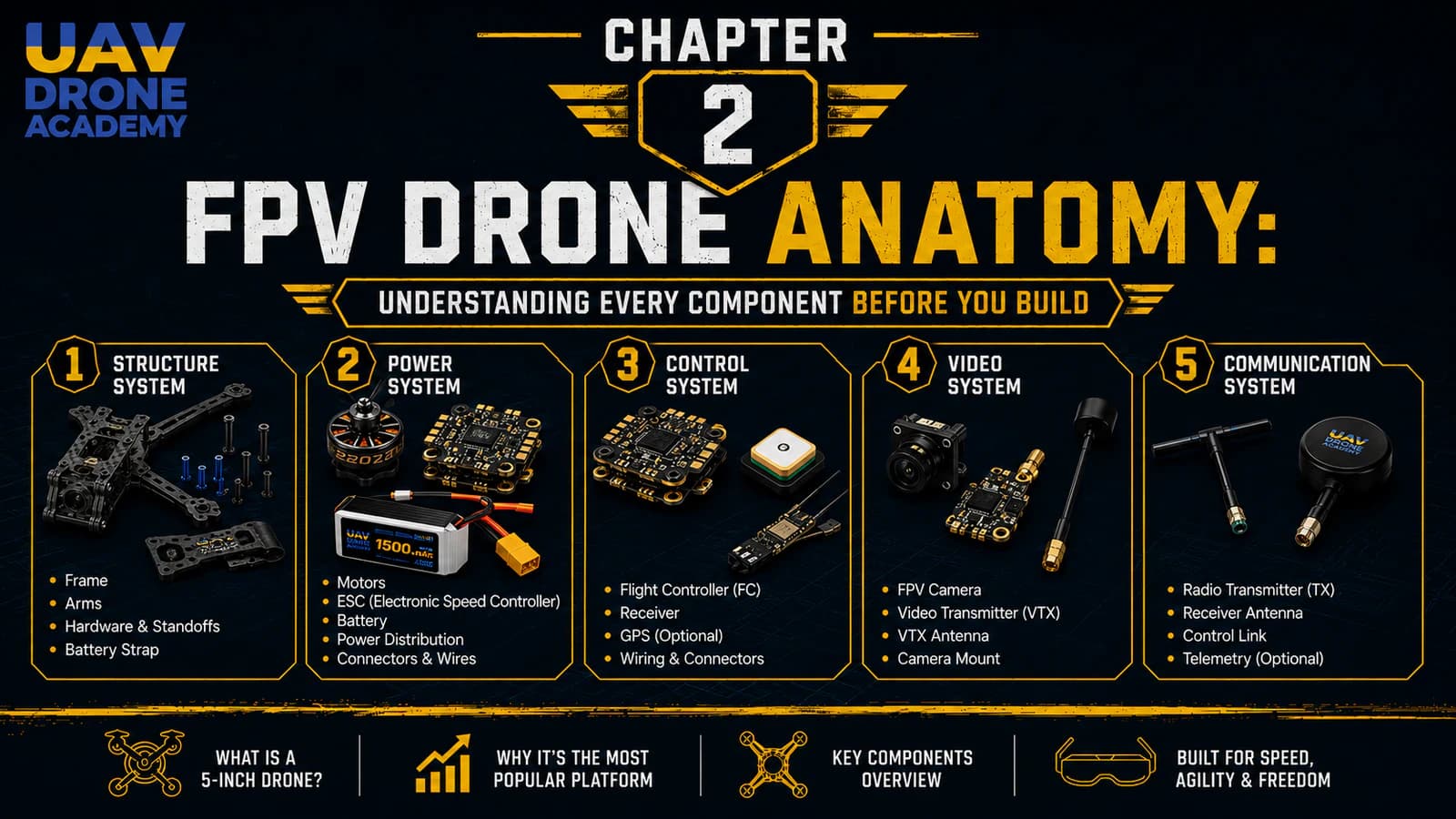
A modern FPV drone is made of five major subsystems:
- structure system
- power system
- control system
- video system
- communication system
Each subsystem has a specific function.
When all of them work together correctly, the drone can:
- fly
- stabilize itself
- receive pilot commands
- transmit video
- respond in real time
1. Structure System
The structure system is the physical body of the drone.
This includes:
- frame
- arms
- standoffs
- mounting plates
- hardware
Its job is simple:
Hold everything together safely and rigidly.
The Frame
The frame is the skeleton of the drone.
Almost every component is attached to it.
A typical 5-inch FPV frame supports:
- motors
- electronics
- FPV camera
- antennas
- battery
Most modern FPV frames are made from carbon fiber because it is:
- lightweight
- rigid
- strong
- vibration resistant
Why the Frame Matters
The frame affects:
- durability
- weight
- flight feel
- component compatibility
- repair difficulty
A poorly designed frame can create:
- vibrations
- weak arms
- bad component fitment
- difficult maintenance
That is why frame selection is extremely important later in the series.
2. Power System
The power system generates and distributes energy throughout the drone.
Without this system, nothing moves.
The power system includes:
- battery
- ESC
- motors
- propellers
Battery
The battery is the drone’s power source.
In our build, we will use:
6S LiPo batteries
These batteries store large amounts of energy in a relatively compact size.
The battery powers:
- motors
- flight controller
- receiver
- VTX
- camera
- all onboard electronics
ESC
ESC stands for:
Electronic Speed Controller
The ESC controls motor speed.
Think of the ESC as the power manager between:
- battery
- flight controller
- motors
The flight controller sends commands to the ESC.
The ESC then adjusts motor speed thousands of times per second.
Modern FPV drones usually use:
4-in-1 ESCs
This means all four motor controllers are combined into one compact board.
Motors
The motors generate rotational force.
FPV drones use:
Brushless motors
Brushless motors are:
- powerful
- efficient
- durable
- responsive
Each motor spins one propeller.
By changing motor speeds independently, the drone can:
- pitch
- roll
- yaw
- maintain stability
Propellers
The propellers convert motor rotation into thrust.
This thrust is what lifts and moves the drone through the air.
Although propellers look simple, they heavily influence:
- flight feel
- responsiveness
- efficiency
- noise
- control precision
Even small propeller changes can dramatically change how a drone behaves.
3. Control System
The control system acts as the drone’s brain and nervous system.
This subsystem includes:
- flight controller
- sensors
- firmware
Flight Controller
The flight controller is the most important electronic component in the drone.
It constantly receives information from:
- sensors
- pilot commands
- radio receiver
Then it calculates how the motors should respond.
The flight controller manages:
- stabilization
- flight behavior
- motor coordination
- communication between systems
Without the flight controller, the drone would instantly become uncontrollable.
Gyroscope and Accelerometer
Modern flight controllers contain sensors that measure movement.
The two most important sensors are:
Gyroscope
Measures rotational movement.
Accelerometer
Measures orientation and acceleration.
These sensors help the drone understand:
- its position
- movement
- rotation
- orientation in space
Firmware
The flight controller runs firmware.
Firmware is specialized software that controls the drone’s behavior.
In this series, we will use:
Betaflight
Betaflight became the industry standard for FPV drones because it is:
- powerful
- flexible
- widely supported
- beginner friendly
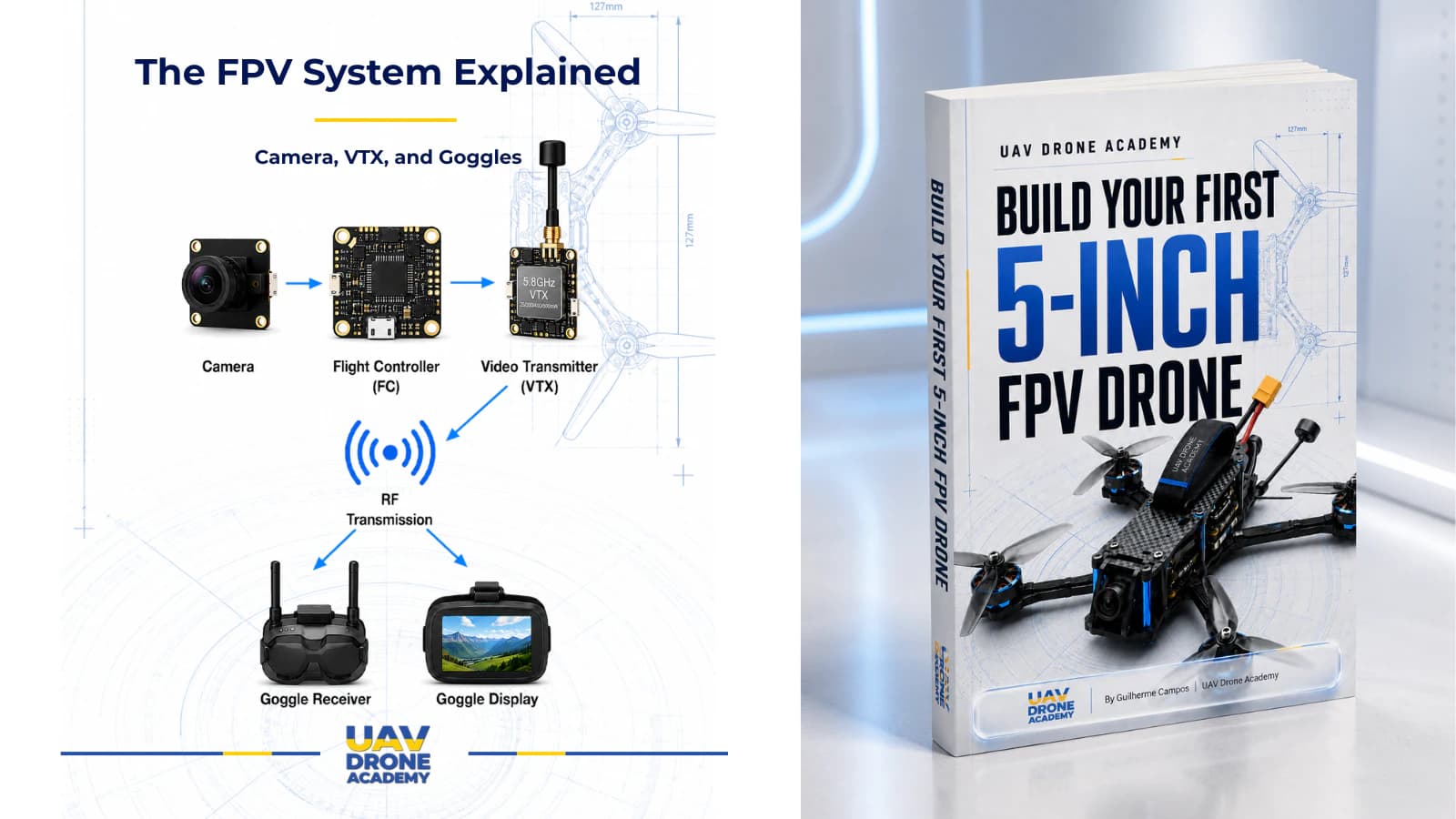
4. Video System
The video system allows the pilot to see from the drone’s perspective in real time.
Without this system, FPV flight would not exist.
The video system includes:
- FPV camera
- VTX
- antenna
- goggles
FPV Camera
The FPV camera captures live video during flight.
Unlike cinematic cameras, FPV cameras prioritize:
- ultra-low latency
- fast exposure adaptation
- real-time responsiveness
Image quality matters, but reaction speed matters even more.
VTX
VTX stands for:
Video Transmitter
The VTX wirelessly transmits video from the drone to the pilot’s goggles.
Without the VTX, the pilot would see nothing.
VTX systems vary in:
- power
- range
- signal quality
- heat generation
Antenna
The antenna transmits and receives radio frequency signals.
A good antenna improves:
- signal stability
- range
- video clarity
A damaged antenna can severely reduce FPV performance.
FPV Goggles
The goggles receive the video signal and display the live feed to the pilot.
This creates the immersive FPV experience.
Some pilots use screens or monitors, but goggles provide:
- better immersion
- better focus
- improved flight precision
5. Communication System
The communication system connects the pilot to the drone.
This subsystem includes:
- radio controller
- receiver
- radio protocol
Radio Controller
The radio controller is the device held by the pilot.
It sends control commands to the drone.
The pilot controls:
- throttle
- pitch
- roll
- yaw
- flight modes
- switches
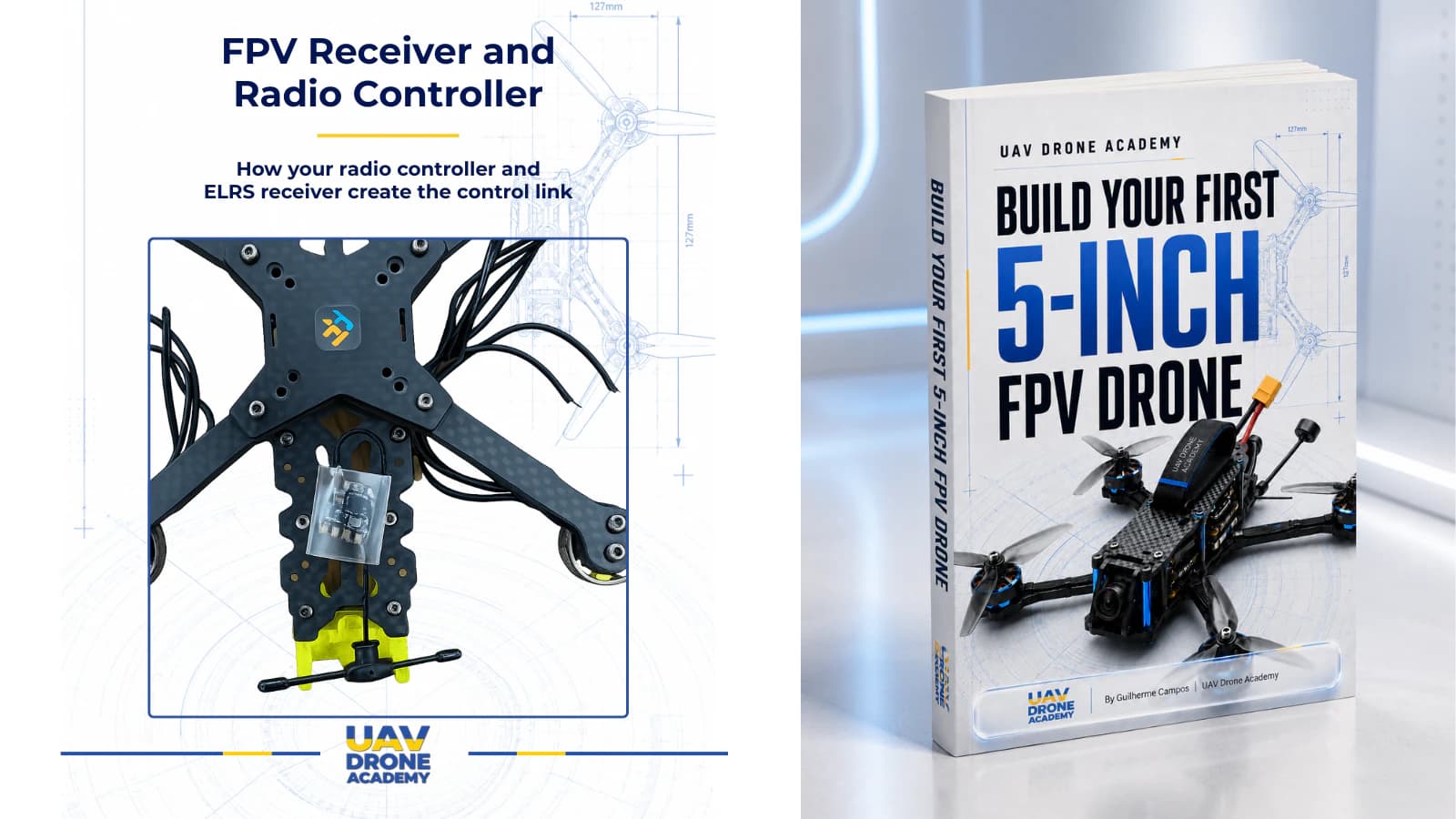
Receiver
The receiver is installed inside the drone.
It receives commands from the radio controller and forwards them to the flight controller.
In our build, we will use:
ExpressLRS, also known as ELRS
because it became the modern FPV standard for:
- low latency
- reliability
- long range
- affordability
How All Systems Work Together
Now let’s simplify the entire process.
Step 1
The pilot moves the radio sticks.
Step 2
The radio controller sends commands wirelessly.
Step 3
The receiver receives the commands.
Step 4
The flight controller processes the information.
Step 5
The ESC adjusts motor speeds.
Step 6
The motors spin the propellers.
Step 7
The drone moves through the air.
At the same time:
- the FPV camera captures video
- the VTX transmits the signal
- the goggles display the live image to the pilot
This entire process happens continuously in real time.
Thousands of calculations occur every second.
Why Understanding the System Matters
Many beginners try to memorize tutorials without understanding the underlying system.
That approach creates confusion later.
But once you understand:
- what each component does
- why it exists
- how it interacts with other systems
troubleshooting becomes much easier.
You stop copying builds and start actually understanding FPV.
That is the real goal of this series.
Common Beginner Mistakes
Treating the Drone Like One Single Component
A drone is not one machine.
It is several interconnected systems.
Understanding the relationships between systems is critical.
Buying Parts Before Understanding Compatibility
Many beginners buy random components too early.
This usually creates:
- voltage mismatches
- mounting issues
- wiring problems
- firmware incompatibilities
That is why we are learning the system first.
Ignoring the Importance of Simplicity
Complex builds are not better for beginners.
Simple builds:
- teach faster
- crash cheaper
- repair easier
- reduce frustration
That is why our project follows a minimalist philosophy.
Conclusion
At first glance, FPV drones may seem highly technical and intimidating.
But once the system is broken into smaller parts, everything becomes much more understandable.
A modern FPV drone is simply the combination of:
- structure
- power
- control
- video
- communication systems
all working together in real time.
Understanding this foundation is one of the most important steps in becoming confident with FPV.
Now that you understand the anatomy of the drone itself, the next step is understanding how these systems interact dynamically during flight.
In the next chapter, we will follow the complete process from pilot input to motor thrust and understand exactly how a 5-inch FPV drone actually flies.
Next Chapter
How a 5-Inch FPV Drone Works: From Radio Signal to Motor Thrust