
Beginner, Course, Education, UAV
Chapter 1: What Is a 5-Inch FPV Drone? Understanding the Most Popular FPV Platform
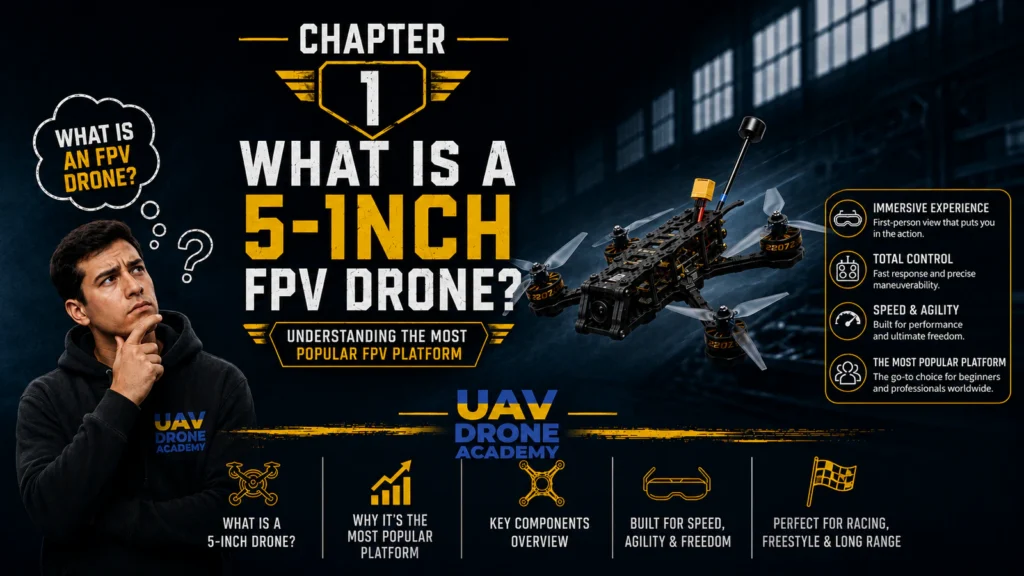
Introduction
If you are completely new to FPV drones, everything may look confusing at first.
You see videos of drones flying:
- through abandoned buildings;
- between trees;
- over mountains;
- inside factories;
- performing flips and dives at incredible speeds.
Then you start searching online and suddenly encounter dozens of terms:
- Betaflight;
- ESC;
- VTX;
- ELRS;
- LiPo;
- 4S;
- 6S;
- analog;
- digital;
- freestyle;
- racing.
For many beginners, this becomes overwhelming very quickly.
That is exactly why this guide exists.
This series was created to simplify the learning process and help you understand FPV drones step by step without unnecessary complexity.
And everything starts with understanding one very important thing:
Why is the 5-inch FPV drone the standard platform of the FPV world?
Before we build anything, we first need to understand what this type of drone actually is and why millions of pilots use it as their main FPV platform.
What Does FPV Mean?
FPV stands for:
First Person View
This means the pilot sees the flight from the drone’s perspective in real time.
Instead of flying while looking directly at the drone from the ground, the pilot uses:
- FPV goggles;
- a monitor;
- or a video receiver connected to a screen.
The experience feels similar to sitting inside the aircraft.
That is what makes FPV so immersive and exciting.
FPV Drones Are Different From Traditional Camera Drones
Many people start FPV after seeing drones like:
- DJI Mavic;
- DJI Mini;
- Autel drones;
- or other GPS camera drones.
Although both are drones, they are designed for completely different purposes.
Traditional camera drones prioritize:
- stability;
- automation;
- GPS assistance;
- obstacle avoidance;
- smooth cinematic movement.
FPV drones prioritize:
- agility;
- speed;
- responsiveness;
- manual control;
- pilot skill.
An FPV drone behaves much more like a high-performance aircraft than an automatic flying camera.
That is one of the reasons people become passionate about FPV.
The pilot is actively flying the drone instead of simply supervising it.
What Does “5-Inch” Mean?
The “5-inch” measurement refers to the size of the propellers.
A 5-inch FPV drone uses propellers with approximately 5 inches in diameter.
This size became the ideal balance between:
- power;
- agility;
- durability;
- efficiency;
- repairability;
- affordability.
Over time, the FPV community discovered that the 5-inch platform offers the best overall experience for most pilots.
That is why it eventually became the industry standard.
Why the 5-Inch Platform Became So Popular
The FPV world has many drone sizes.
Some drones are extremely small.
Others are very large and powerful.
But the 5-inch platform sits directly in the middle of the spectrum.
That creates several advantages.
Strong Enough to Be Exciting
A 5-inch FPV drone has enough power to:
- perform freestyle maneuvers;
- carry action cameras;
- reach high speeds;
- handle aggressive flying.
Even beginner 5-inch builds can feel extremely powerful.
This creates a very exciting flying experience without requiring extremely expensive hardware.
Small Enough to Stay Practical
At the same time, the platform remains:
- relatively lightweight;
- portable;
- repairable;
- affordable.
Larger drones become:
- more expensive;
- more dangerous;
- harder to repair;
- harder to tune.
Smaller drones are easier to manage but usually cannot deliver the same performance and flight feel.
The 5-inch platform became the sweet spot between these extremes.
Massive Community Support
Another reason the 5-inch platform became dominant is community adoption.
Today, most FPV content online is based around 5-inch drones.
That means:
- more tutorials;
- more spare parts;
- more setup guides;
- more troubleshooting information;
- more compatible accessories.
For beginners, this is extremely important.
Whenever you encounter a problem, there is a very high chance someone else already solved it before.
Easier to Learn and Upgrade
The 5-inch ecosystem is mature and highly standardized.
Many components are designed specifically for:
- 5-inch frames;
- 5-inch motors;
- 5-inch electronics;
- 5-inch propellers.
This makes:
- compatibility easier;
- repairs easier;
- upgrades easier;
- future modifications easier.
That is exactly why we chose this platform for the course.
The Type of Drone We Will Build
Throughout this series, we will build a beginner-friendly FPV drone designed around a very important philosophy:
Simplicity First
We are not trying to build:
- the fastest drone;
- the lightest drone;
- the most expensive drone;
- the most advanced drone possible.
Instead, we are building:
a clean, reliable, understandable FPV platform for learning.
Our drone will focus on:
- essential components only;
- simple wiring;
- reliable performance;
- popular hardware;
- easy maintenance;
- upgrade flexibility.
This approach helps beginners learn faster and avoid unnecessary frustration.
Why Beginners Often Feel Lost
Many FPV beginners make the same mistake:
They try to learn everything at the same time.
They watch:
- advanced freestyle videos;
- tuning tutorials;
- firmware updates;
- cinematic setups;
- long-range builds;
- radio configuration videos;
all before understanding the basic system.
This creates information overload.
FPV starts feeling much more complicated than it actually is.
In reality, FPV drones are simply several small systems working together.
Once you understand those systems individually, the entire drone becomes much easier to understand.
That is exactly how this course is structured.
How This Series Will Work
This guide follows a progressive roadmap.
We will not jump randomly between topics.
Each chapter was designed to build naturally on the previous one.
Part 1 — Fundamentals
First, we understand:
- what FPV is;
- how the systems work;
- why the 5-inch platform matters.
Part 2 — Choosing Components
Next, we choose:
- frame;
- motors;
- electronics;
- batteries;
- video system;
- radio link.
Part 3 — Physical Assembly
Then we physically build the drone step by step.
Part 4 — Configuration
After the build is complete, we configure:
- Betaflight;
- receiver;
- radio;
- motors;
- OSD;
- safety settings.
Part 5 — First Flight
Then we prepare for the first flight safely and correctly.
Part 6 — Maintenance and Upgrades
Finally, we learn:
- repairs;
- upgrades;
- maintenance;
- future evolution paths.
This roadmap ensures we never get lost during the learning process.
The Goal of This Course
By the end of this series, you will understand:
- how FPV drones work;
- how components interact together;
- how to assemble an FPV drone;
- how to configure the system;
- how to perform safe first flights;
- how to continue evolving your setup.
Most importantly:
you will stop seeing FPV drones as mysterious machines.
Instead, you will understand them as logical systems that can be learned step by step.
Final Thoughts Before Moving Forward
At first glance, FPV may seem intimidating.
But almost every experienced FPV pilot started exactly where you are now:
- confused;
- overloaded with information;
- unsure where to begin.
The key is not trying to learn everything at once.
The key is following a logical process.
That is exactly what we are going to do throughout this guide.
And now that you understand why the 5-inch platform became the foundation of modern FPV, it is time to look inside the drone itself.
In the next chapter, we will break down every major component and understand exactly what each part does inside the system.
Next Chapter
FPV Drone Anatomy: Understanding Every Component Before You Build
