
Beginner, Build, Course, Education, FPV, Guide, UAV
Complete Beginner’s Guide — Official Series Roadmap
Building your first FPV drone can feel overwhelming at the beginning.
There are countless videos, tutorials, components, and technical terms that often confuse beginners before they even start building.
That is exactly why we created this series.
Instead of jumping randomly between topics, this guide follows a structured roadmap designed specifically for beginners who want to understand FPV drones step by step while building a real and practical 5-inch FPV platform.
This series was designed to become:
- a complete blog series;
- a future book/manual;
- a YouTube content roadmap;
- a beginner FPV course;
- and eventually a digital product available on the UAV Drone Academy website.
Our goal is simple:
understand the system, choose the components, build the drone, configure it correctly, perform the first flight safely, and continue evolving from there.
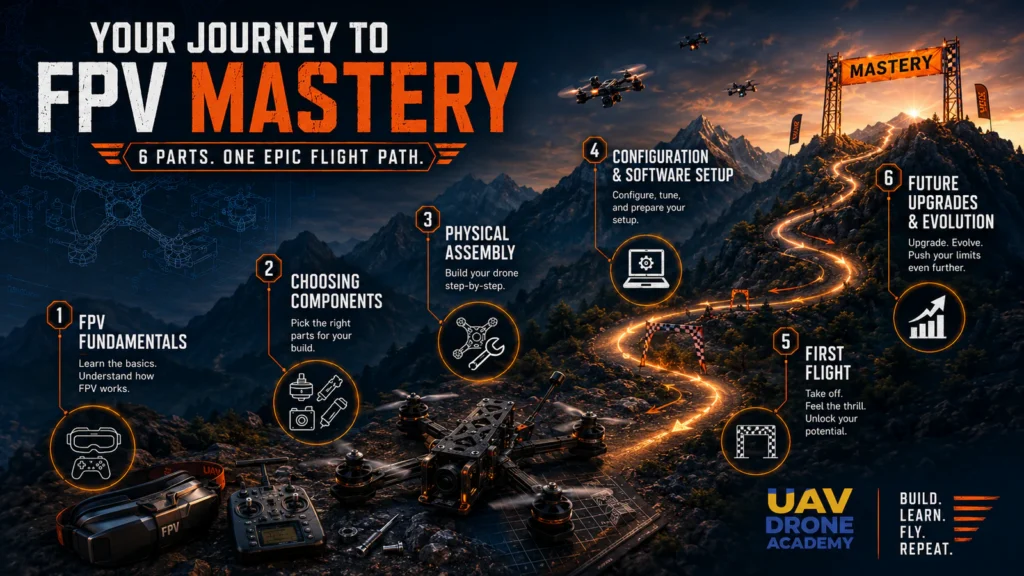
To make sure we never get lost during the learning process, the course is divided into six major parts.
Each part has a very clear purpose.
Part 1 — FPV Fundamentals
Objective of Part 1
Create the minimum theoretical foundation before buying or assembling any component.
In this section, beginners will understand:
- what an FPV drone is;
- why the 5-inch platform became the industry standard;
- and how the major systems work together.
Chapters
Chapter 1
What Is a 5-Inch FPV Drone? Understanding the Most Popular FPV Platform
Status: already started.
Chapter 2
FPV Drone Anatomy: Understanding Every Component Before You Build
Chapter 3
How a 5-Inch FPV Drone Works: From Radio Signal to Motor Thrust
Chapter 4
Freestyle, Racing, Cinematic, and Long Range: Choosing the Right FPV Direction
Chapter 5
Beginner FPV Build Strategy: Why We Are Building a Minimalist 5-Inch Drone
Part 2 — Choosing Components
Objective of Part 2
Choose every component of the drone logically, compatibly, and affordably.
This is where theory becomes real purchasing decisions.
Chapters
Chapter 6
Best 5-Inch FPV Frame for Beginners: Choosing the Foundation of the Build
Chapter 7
Flight Controller and ESC Stack Explained: Choosing the Brain and Power System
Chapter 8
FPV Motors Explained: KV, Size, Thrust, and 6S Compatibility
Chapter 9
FPV Propellers Explained: How Props Affect Control, Efficiency, and Flight Feel
Chapter 10
Analog FPV System Explained: Choosing the Camera, VTX, and Antenna
Chapter 11
ExpressLRS for FPV Beginners: Choosing the Radio Receiver and Control Link
Chapter 12
FPV Batteries Explained: Choosing the Right 6S LiPo for a 5-Inch Drone
Chapter 13
Complete 5-Inch FPV Drone Parts List for Beginners
Part 3 — Physical Assembly
Objective of Part 3
Assemble the drone physically, step by step.
This is where we stop talking about parts and start building the real drone.
Chapters
Chapter 14
Essential Tools for Building Your First FPV Drone
Chapter 15
How to Assemble a 5-Inch FPV Frame Step by Step
Chapter 16
How to Install Motors on a 5-Inch FPV Drone
Chapter 17
FPV Soldering Guide for Beginners: Tools, Technique, and Safety
Chapter 18
How to Install the ESC and Flight Controller Stack
Chapter 19
How to Wire the FPV Camera, VTX, and Receiver
Chapter 20
Final Wiring Check: Continuity Test, Smoke Stopper, and Safety Inspection
Part 4 — Configuration
Objective of Part 4
Transform the assembled drone into a fully functional FPV system.
In this section, we will configure:
- Betaflight;
- radio systems;
- receiver communication;
- motor direction;
- OSD;
- and basic flight controls.
Chapters
Chapter 21
Betaflight for Beginners: Installing and Connecting Your FPV Drone
Chapter 22
Betaflight Ports and Configuration: Setting Up the Flight Controller
Chapter 23
How to Bind ExpressLRS Receiver to Your Radio Controller
Chapter 24
Receiver Setup in Betaflight: Channels, Modes, Arm Switch, and Failsafe
Chapter 25
Motor Direction and Propeller Setup in Betaflight
Chapter 26
FPV OSD Setup: What You Need to See in Your Goggles
Chapter 27
Basic PID and Filter Concepts for Beginner FPV Pilots
Part 5 — First Flight
Objective of Part 5
Prepare the student for the first FPV flight safely and methodically.
We will not simply “fly the drone.”
We will validate the system before, during, and after the first test flight.
Chapters
Chapter 28
FPV Pre-Flight Checklist: What to Check Before Your First Flight
Chapter 29
Your First FPV Hover Test: How to Safely Test Your Build
Chapter 30
First FPV Flight Tips: How to Avoid Common Beginner Mistakes
Chapter 31
Post-Flight Inspection: What to Check After Your First FPV Flight
Part 6 — Evolution, Maintenance, and Upgrades
Objective of Part 6
Show the learning path after the first successful flight.
At this stage, the drone stops being just a build project and becomes a long-term learning platform.
Chapters
Chapter 32
FPV Drone Maintenance Guide: How to Keep Your Build Reliable
Chapter 33
Common FPV Crashes and Repairs: What Usually Breaks First
Chapter 34
Beginner FPV Upgrades: Buzzer, GPS, LEDs, and Better Antennas
Chapter 35
Analog to Digital FPV Upgrade: When Should You Move to HD?
Chapter 36
From First Build to Advanced FPV: Your Next Learning Path
Final Structure Overview
This complete series will contain 36 chapters.
This structure is ideal because it allows the content to be transformed into:
- blog posts;
- book chapters;
- YouTube scripts;
- PDF manuals;
- beginner FPV courses;
- printable build checklists;
- and digital products for the website.
The Main Rule of the Entire Series
Every part has a very clear purpose.
Part 1
Understand the system.
Part 2
Choose the components.
Part 3
Build the drone.
Part 4
Configure the drone.
Part 5
Perform the first flight.
Part 6
Maintain, repair, and evolve the platform.
This roadmap ensures that beginners never feel lost during the learning process while gradually developing real understanding, practical skills, and confidence in FPV drone building.
