
Beginner, Build, Course, Education, FPV, Guide
Build Your First 5-Inch FPV Drone: Complete Beginner’s Guide
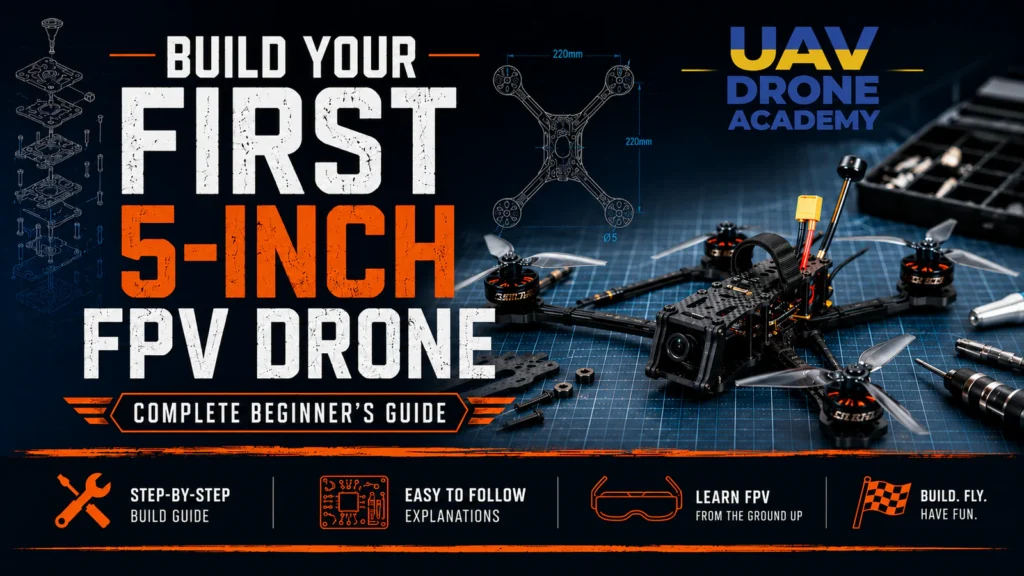
Introduction
Welcome to the Series
Welcome to the complete beginner’s guide to building your first 5-inch FPV drone.
This series was created for people who want to truly understand FPV drones from the ground up instead of simply copying random builds from the internet without understanding how the system actually works.
By the end of this guide, you will not only have a fully functional FPV drone, but also a solid understanding of the architecture, electronics, assembly process, configuration, and operational logic behind modern FPV systems.
Our goal is simple:
Learn by building.
Instead of overwhelming you with advanced theory, expensive components, or unnecessary complexity, we will focus on a practical and realistic beginner-friendly FPV build that teaches the fundamentals while remaining accessible, repairable, and easy to reproduce.
This is not just another “parts list tutorial.”
This is a structured roadmap designed to take you from complete beginner to someone capable of understanding, building, configuring, repairing, and evolving FPV drones with confidence.
Why We Chose a 5-Inch FPV Drone
The 5-inch FPV platform became the industry standard for a reason.
It offers the best balance between:
- performance;
- durability;
- agility;
- repairability;
- component availability;
- community support;
- upgrade possibilities;
- flight experience.
A 5-inch drone is powerful enough for freestyle flying, fast enough for racing, efficient enough for long sessions, and modular enough for endless upgrades.
Most importantly:
almost everything in the FPV world is designed around the 5-inch ecosystem.
That means:
- more tutorials;
- more spare parts;
- more community knowledge;
- easier troubleshooting;
- lower learning friction.
For beginners, this is critical.
Why We Are Building a Minimalist Drone
One of the biggest mistakes beginners make is trying to build an advanced drone immediately.
Adding:
- GPS;
- LEDs;
- HD systems;
- buzzers;
- complex wiring;
- unnecessary accessories;
- expensive components;
usually creates confusion instead of learning.
That is why this build follows a minimalist philosophy:
only the essential components required to fly.
This approach gives several advantages:
Easier to Understand
Fewer components mean fewer variables and a clearer understanding of how each system works.
Easier to Build
The wiring becomes simpler, cleaner, and less intimidating for beginners.
Easier to Repair
Crashes happen in FPV. A simple drone is easier and cheaper to fix.
Lower Cost
We focus on highly popular and affordable components with strong community support.
Better Learning Experience
You will understand the fundamentals first before moving into advanced upgrades later.
Once you fully understand the base system, upgrading becomes natural.
The Philosophy Behind This Course
This course follows a very important principle:
Theory must always connect to practice.
Every chapter will explain:
- what the component does;
- why it matters;
- how it interacts with the rest of the drone;
- how we apply it in the real build.
We will avoid:
- unnecessary technical jargon;
- information overload;
- overly academic explanations;
- unrealistic “professional-only” setups.
Instead, we focus on:
- practical understanding;
- real-world assembly;
- beginner-friendly explanations;
- progressive learning.
The goal is to ensure that:
- you never feel lost;
- every chapter builds on the previous one;
- the project evolves logically from start to finish.
The Drone We Will Build
Throughout this series, we will build a:
Beginner-Friendly 5-Inch FPV Freestyle Drone
Core Characteristics
- 5-inch platform
- 6S system
- Analog FPV
- ExpressLRS radio link
- Minimalist architecture
- Modular design
- Widely available components
- Beginner-friendly configuration
- Upgrade-ready platform
This drone will serve as your foundation for future:
- freestyle;
- cinematic flying;
- long-range systems;
- HD upgrades;
- autonomous systems;
- advanced FPV projects.
Course Roadmap
To make sure we never lose direction during the build process, the course follows a structured roadmap.
Each section has a specific purpose and progressively builds your understanding.
PART 1 — FPV Fundamentals
In this section, we will understand:
- what FPV drones are;
- how they work;
- why the 5-inch platform dominates the industry;
- how every subsystem interacts together.
Goal:
Build a strong mental model before touching hardware.
PART 2 — Choosing Components
In this section, we will select:
- frame;
- flight controller;
- ESC;
- motors;
- video system;
- radio receiver;
- batteries;
- propellers.
Goal:
Learn how to choose compatible and reliable components.
PART 3 — Physical Assembly
Now we begin the actual build.
We will:
- assemble the frame;
- install electronics;
- solder components;
- organize wiring;
- verify electrical safety.
Goal:
Transform theory into a real FPV drone.
PART 4 — Configuration and Software Setup
Hardware alone is not enough.
In this section, we will:
- configure Betaflight;
- flash firmware;
- bind ExpressLRS;
- configure radio controls;
- set up OSD;
- verify motor direction.
Goal:
Make the drone operational and flight-ready.
PART 5 — First Flight
This is where everything comes together.
We will cover:
- pre-flight inspections;
- safety procedures;
- beginner flight techniques;
- common mistakes;
- crash prevention.
Goal:
Achieve a successful and safe first FPV flight.
PART 6 — Future Upgrades and Evolution
Once the base system is mastered, we will explore:
- GPS;
- buzzers;
- HD systems;
- tuning;
- maintenance;
- repair strategies;
- future upgrade paths.
Goal:
Turn a beginner FPV build into a long-term learning platform.
What You Will Learn by the End
By completing this series, you will understand:
- FPV drone architecture
- Electronics integration
- Power systems
- Radio communication systems
- Video transmission systems
- Soldering basics
- Betaflight configuration
- Flight preparation
- Repair fundamentals
- Upgrade planning
Most importantly:
you will develop the confidence to continue learning independently.
Final Message Before We Begin
FPV drones may look intimidating at first.
But once the system is broken down into logical steps, everything becomes much easier to understand.
That is exactly what this series is designed to do.
We are not just building a drone.
We are building:
- understanding;
- confidence;
- technical intuition;
- real practical experience.
And we will do it one step at a time.
Now let’s begin with the first chapter:
What Is a 5-Inch FPV Drone? Understanding the Most Popular FPV Platform
