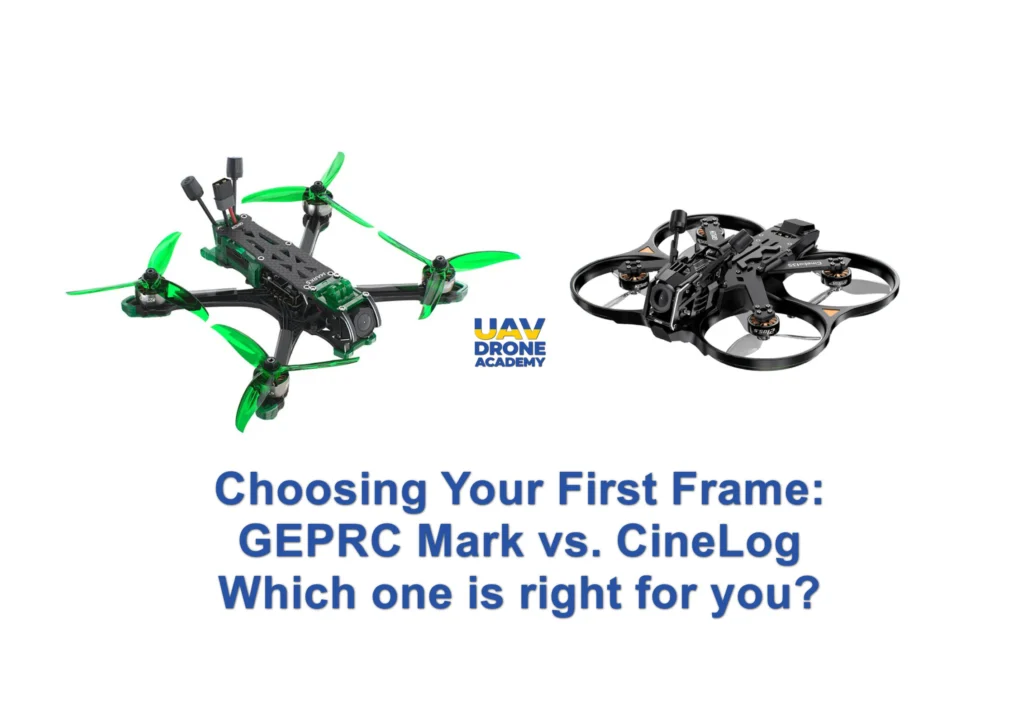
If you are just entering the world of FPV, you’ve probably noticed that the market is flooded with options. At the top of every recommendation list, two names constantly pop up: GEPRC Mark (4 or 5) and GEPRC CineLog.
But do they do the same thing? The short answer is: no. Although they come from the same premium manufacturer (GEPRC), they were created for different worlds. Let’s understand which one should be the foundation of your first build.
1. The GEPRC Mark Series (The Freestyle “Tank”)
History and Evolution
The Mark series began with the goal of creating a racing/freestyle drone that was easy to repair. The Mark4 became a legend for being lightweight and affordable. The Mark5 refined this formula, introducing an aircraft-grade 7075 aluminum “cage” to protect the camera and arms that can be swapped in seconds.
Purpose and Objectives
- What it is: An “open-body” frame (exposed propellers).
- Objective: Maximum performance, agility, and crash resistance. This is the drone for those who want to learn acrobatic maneuvers (Power Loops, Juicy Flicks) or fly long distances (Long Range).
Applications
- Acrobatic maneuver training.
- Exploring mountains or wide-open areas.
- Carrying heavy action cameras (Full GoPro).
Cost-Benefit
Excellent. The Mark4 is one of the most accessible and durable frames on the market. The Mark5 is slightly more expensive, but it saves you money in the long run due to its ease of maintenance.
2. The GEPRC CineLog Series (The Cinematography Master)
History and Evolution
As “indoor” FPV videos—flying through houses, offices, and near people—became popular, GEPRC created the CineLog series. The CineLog35 is now the industry standard for what we call a Cinewhoop.
Purpose and Objectives
- What it is: A frame with propeller guards (Ducts).
- Objective: Safety and stability. It is designed to carry a cinema camera smoothly, without the risk of the propellers cutting anything (or anyone) in case of a minor collision.
Applications
- Event filming (weddings, parties).
- Real estate videos (flying through windows and doors).
- Flights close to models, animals, or sensitive obstacles.
Cost-Benefit
The initial investment is slightly higher due to the complex protective structure, but it pays for itself by allowing you to take on professional jobs that a freestyle drone couldn’t handle for safety reasons.
The Verdict: Which one should you choose for your first drone?
- Choose the GEPRC MARK if: You want to feel the adrenaline of speed, learn radical maneuvers, and aren’t afraid to crash (it can take a beating!). It’s the best for learning the fundamentals of manual flight.
- Choose the GEPRC CINELOG if: Your main focus is producing stable video content for social media or clients, and you need a drone that forgives small proximity errors without destroying your propellers.
UAV Drone Academy Tip: If you’ve never flown before, start in the simulator! But when you finally hit the workbench, choosing a GEPRC frame ensures you’ll have access to spare parts in almost any shop worldwide.
Did you like this guide? Leave a comment below telling us which of these two frames best fits your pilot style!
