
Accessories, Communication Systems
The Electronics of Detonation: Payload Initiation Systems in War Drones
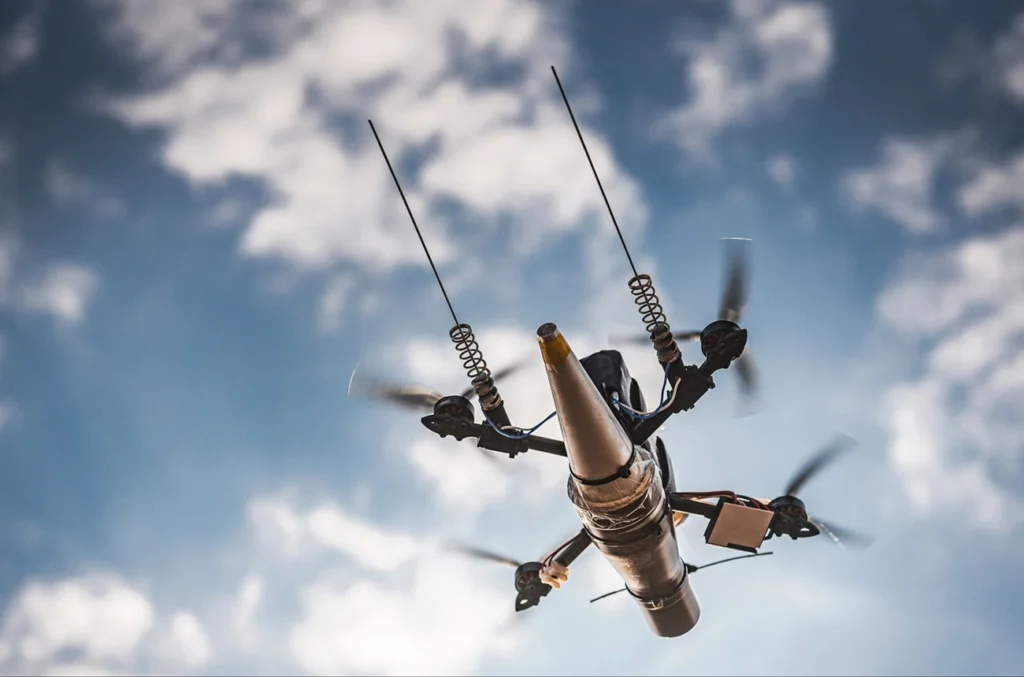
In the modern landscape of warfare, a drone’s effectiveness is not just in its flight performance, but in the sophistication and safety of its payload activation systems. What once started as improvised solutions has now evolved into high-precision electronic engineering.
In this article, we explore the critical components that transform an aerial platform into a functional and secure weapon system.
1. Arming and Initiation Boards
The so-called Arming Boards act as the intermediary brain between the Flight Controller (FC) and the physical initiator. They are responsible for interpreting digital commands and converting them into high-power electrical pulses.
- VIF (Visual Interface Boards): Modules that translate PWM signals into energy for the detonator.
- Safety Protocols: Modern systems require a logical “arming” sequence to prevent premature detonations. This may include a minimum safety altitude and a specific cruise speed before allowing the circuit to activate.
2. Detonation and Impact Methods
How the payload is initiated defines the drone’s mission profile. There are three primary architectures in today’s battlefield:
- Galvanic Sensors (Contact Whiskers): Common in FPV drones, these use two front-facing metal rods. Upon colliding with the target, the circuit closes, instantly sending current to the initiator.
- Inertia Fuzes: These utilize the Flight Controller’s IMU (Inertial Measurement Unit) accelerometers to detect sudden deceleration (G-force), triggering the system at the exact moment of kinetic impact.
- Proximity Systems (Airburst): These use LiDAR or ultrasonic sensors to detonate the payload at a specific distance from the ground, maximizing fragmentation damage over a wider area.
3. Resilience and Electronic Warfare (ECCM)
An initiation system is useless if neutralized by interference. Therefore, integration with advanced radio protocols is vital:
- Frequency Hopping (FHSS): Systems like ELRS or Crossfire ensure the “Arm” command reaches the drone even under heavy radio-frequency interference (Jamming).
- Channel Redundancy: High-end boards operate with two independent signal channels; the payload is only armed if both signals are simultaneously validated by the firmware.
Technical Table: System Comparison
| System | Application | Primary Advantage | Technical Challenge |
| Mechanical | Drop Munitions | Simplicity & Low Cost | Handling Risks |
| Digital Electronic | Suicide FPV Drones | Precision & Remote Safety | EM Pulse Vulnerability |
| Optical Sensors | Anti-Trench Warfare | Ideal Detonation Height | Integration Cost |
Conclusion
Integrating these systems requires deep knowledge of electronics and operational safety. At UAV Drone Academy, we emphasize that understanding these components is essential for operators seeking to master the tactical capabilities of unmanned aircraft in high-complexity environments.
Safety Note: The handling of initiation systems and power electronics must be performed strictly within legal frameworks and military/industrial safety protocols.
